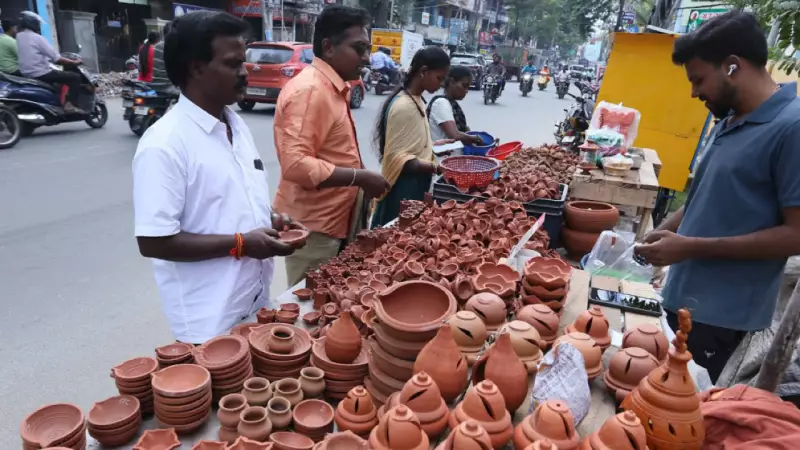
In the lead-up to the Karthigai Deepam festival, celebrated on Wednesday, the Salem region of Tamil Nadu witnessed a significant trend: a 10% increase in the price of traditional akal lamps (earthen lamps). This price rise, reported by local pottery workers, is attributed to escalating raw material costs and a growing difficulty in sourcing quality clay. Despite the higher cost, festive spirit prevailed as sales saw an uptick, driven by strong demand for the ritual lamps.
Festival Markets Buzzing Despite Price Hike
Markets across five districts – Salem, Namakkal, Dharmapuri, Krishnagiri, and Erode – were vibrant with activity. Roadside stalls, shops, carts, and entire shopping streets were stacked with akal lamps of various designs. M Viswanathan, a lamp seller from Salem's Vincent area, noted that more than 50 varieties were available for shoppers. These ranged from lotus and tulsi mata lamps to star and coconut-shaped designs, with prices spanning from Rs 20 to Rs 200 per piece.
Underlying Crisis in the Pottery Industry
Behind the bustling festival sales, however, lies a struggling pottery community. Artisans in Denkanikottai, Uddanapalli, and Bagalur in Krishnagiri district reported a severe decline in their craft. Where they once produced and supplied two lakh (200,000) earthen lamps statewide for Karthigai Deepam, this year's output plummeted by approximately 50%.

The reasons are multifaceted: difficulties in extracting clay, rising prices for all raw materials, and a critical shortage of skilled workers. S Vijayalakshmi from Denkanikottai revealed that this production crunch forced them to source and sell printed incandescent lamps manufactured in Cuddalore and Dharmapuri instead.
Adding to the woes, continuous rains before the festival in Sathyamangalam (Erode district) hampered the drying process, further reducing the availability of akal lamps and contributing to the price increase.
Potters' Plea for Government Intervention
Facing an existential threat, potters are calling for concrete support to sustain their traditional industry. M Sundar Kumar, a lamp maker from Sathyamangalam, made a direct appeal to the government. He urged authorities to grant formal permissions for clay extraction, which has become a major hurdle.
Furthermore, he requested loan assistance to purchase new moulds for creating contemporary lamp designs to keep up with market trends. A long-term solution proposed was the establishment of dedicated sales channels. "Steps should be taken to sell pottery products, including akal lamps, through khadi and cooperative societies," he said. This model, he believes, would ensure a steady stream of business for artisans throughout the year, moving beyond the seasonal demand of festivals.
The scenario presents a paradox: high festival demand juxtaposed with a dying artisanal base. While the public's keenness to buy traditional lamps remains undiminished even at higher prices, the future of the potters who make them hangs in the balance without systemic support.