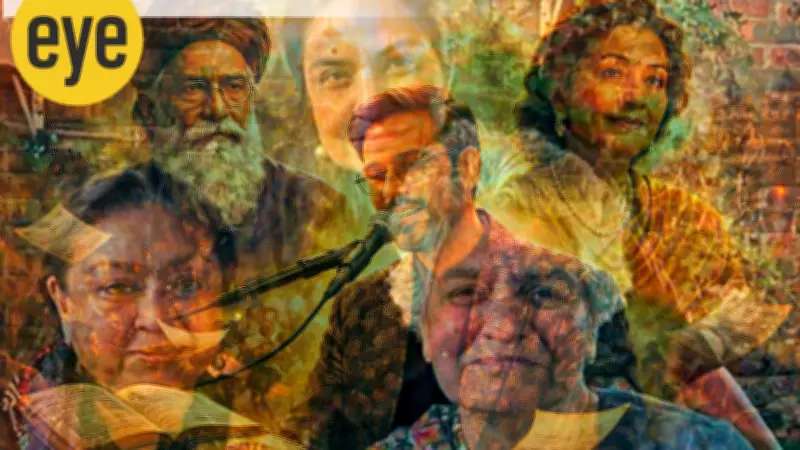
Ali Sethi's Ghazal Revival: A Timeless Bridge Across Borders
In an era where identity is increasingly policed, language weaponised, and empathy forced to declare allegiance, Ali Sethi's performance of a classic ghazal stands as a powerful refusal of simplification. This artistic expression, rooted in centuries-old tradition, speaks directly to contemporary human experiences with remarkable accuracy and emotional depth.
The Quiet Confidence of Cultural Continuity
Ali Sethi sings with the quiet confidence of someone who understands fundamental truths about human connection. He knows that music has always travelled more freely than people, that poetry slips through checkpoints disguised as memory, and that the human heart has never asked to see a passport before breaking. When he sings "Uzr aane mein bhi hai aur bulaate bhi nahin," he is not merely reviving a ghazal but reopening a corridor that politics has tried, unsuccessfully, to brick up for decades.
This performance places his voice inside a lineage that predates Partition, predates nations, and even predates grievance. In doing so, Sethi makes a crucial choice: he is not choosing sides but choosing people. The ghazal becomes, in his interpretation, a bridge rather than a relic, connecting listeners across geographical and political divides through shared emotional architecture.

Daagh Dehlvi's Timeless Emotional Anatomy
The ghazal in question was written by Daagh Dehlvi, born in Delhi in 1831 into a world where Urdu represented cultural inheritance rather than political identity. Living through the trauma of 1857 and witnessing the collapse of the Mughal world, Dehlvi's poetry carries both elegance and fatigue. His work does not rage against loss but observes it with profound insight.
Daagh's ghazal is not merely about romance but serves as a meditation on avoidance, pride, and the elaborate theatre of emotional distance that humans perform when afraid to be seen. The lines "Ho chuka qata-e-ta'alluq to jafaaen kyun hon / Jin ko matlab nahin rehta, woh sataate bhi nahin" reveal devastating modern truth: indifference is not peace but the final violence. This nineteenth-century insight lands cleanly in the twenty-first century across breakups, friendships, and nations.
Farida Khanum's Legacy of Restraint
The transmission of this emotional wisdom owes much to Farida Khanum, who taught generations how to hear Daagh. Born in Amritsar before Partition would rename geography and rearrange belonging, Khanum sang with a dignity that refused to plead. Her voice carried unbroken memory from a time when India and Pakistan were not yet ideologies but shared landscapes of songs, seasons, and syntax.
Khanum's restraint taught crucial lessons about relationships at their most beautiful: they are not flawless because they succeed but because they reveal us to ourselves. The ache is not an error but evidence of our humanity. Her interpretation demonstrated that love does not always arrive triumphantly—sometimes it simply survives, teaching us how to sit with disappointment without becoming bitter.
Sethi's Purposeful Cultural Stewardship
Ali Sethi understands this inheritance intimately. As an educated, articulate, globally visible artist, he is acutely aware of the optics surrounding every note he sings across the India-Pakistan divide. Yet he persists purposefully—not provocatively or apologetically. When he sings in remembrance of Farida Khanum, he honors not just a musical foremother but acknowledges a continuity that politics cannot erase.
In singing Daagh, Sethi quietly honors India as a civilizational space that shaped the language he sings in. This represents not nationalism but recognition—an understanding that culture is not divisible by border fences, that memory does not reorganize itself according to visa regimes, and that the human condition remains stubbornly unchanged even as flags change color.
The Ghazal as Emotional Vocabulary
What makes Sethi's interpretation extraordinary is his sensitivity in allowing the ghazal to speak to the present without modernizing it. He does not update or dilute the work but trusts its emotional intelligence. This approach invites listeners worldwide—South Asian and otherwise—into a vocabulary of feeling that requires no translation.

- We still hesitate and avoid difficult conversations
- We still punish with silence and mistake pride for self-respect
- We still long to be called without having to ask
- We still pretend indifference when care feels too risky
The plea "Sar uthaao to sahi, aankh milaao to sahi" (Lift your head, meet my eyes, at least try) resonates across relationships, communities, and histories. It asks what we still seek from one another: to be seen honestly without performance, to acknowledge presence without theatrics, to admit feeling without surrendering dignity.
The Quiet Rebellion of Art
This ghazal performance represents the quiet rebellion of art—not through protest songs or manifestos but through reminders. It affirms that our inner lives remain remarkably consistent across time and territory, that what breaks us is not ideology but neglect, and that what heals us is not victory but recognition.
The ghazal matters not because it is old but because it is accurate. It tells the truth about how we wound each other gently, how we retreat instead of resolve, how we cling to pride when tenderness would save us. In its refusal to shout, it models another way of being where dignity represents not the absence of feeling but its refinement.
When Ali Sethi sings this ghazal to audiences across continents today, he asks not for agreement but for remembrance. He reminds us that before we were citizens, we were human; before we were divided, we were listening; before borders hardened, voices travelled. The ghazal does not promise reconciliation but does something more radical: it promises recognition. In our fractured world, this may represent the most enduring form of grace available to us all.