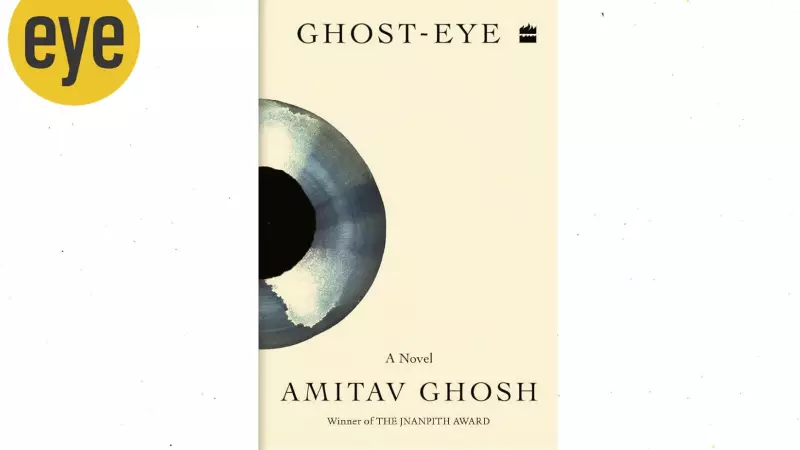
Amitav Ghosh's Ghost-Eye: A Whodunit Exploring Memory, Ecology and Reason
Amitav Ghosh takes a bold new direction with his latest novel Ghost-Eye. Unlike his previous works that used major historical events as backdrops, Ghosh crafts this book as a gripping whodunit spanning over five decades. The novel reimagines memory, ecology, and the very limits of human reason.
A Child's Unusual Demand
The story begins with three-year-old Varsha Gupta making a shocking request. "Ami machh-bhat khabo" she declares in rustic Bangla dialect - "I want to eat fish and rice." This simple demand throws her vegetarian Marwari family in Kolkata into complete turmoil.
Varsha describes a past life where she caught fish by a river in Lusibari village in the Sundarbans. She remembers cooking the younger, smaller rui fish with generous amounts of chilli. Ghosh cleverly avoids framing this as a supernatural tale. Instead, he uses the child's unlikely demand as a gateway to explore deeper questions about human experience.

Questioning Rational Epistemes
Ghosh pushes readers to consider a fundamental question. Would our world be different if we properly valued experiences that fall outside rational understanding? The author challenges conventional thinking through psychiatrist Shoma Bose, who becomes fascinated with Varsha's case.
Dr. Bose embodies the tension between scientific training, personal atheist beliefs, and experiences that defy rationality. She goes further than characters in Ghosh's earlier works like The Hungry Tide and Gun Island. She questions whether empirical systems can truly do justice to lived experiences.
Memory as Historical Archive
Ghosh continues his exploration of memory as a vehicle for understanding history. In Ghost-Eye, he suggests that memory can be reconstructed. Multiple versions of the past can be archived to create more comprehensive historical records.
The novel builds on themes from Ghosh's earlier works:
- Shadow Lines used memory to challenge political boundaries
- The Hungry Tide questioned the neglect of experiential narratives
- The Ibis Trilogy attempted to recover suppressed histories
Ecological Longue Durée
Ghost-Eye expands Ghosh's ecological concerns to encompass what he calls the "ecological longue durée." Food, particularly fish, becomes more than dietary preference. It represents continuities and discontinuities in the Sundarbans region.
The novel serves as a nudge to empiricists. It asks them to listen more attentively to memory - not to piece together fragments from the past, but to hear voices like Varsha's for their own sake.
The Moral Imperative
Ghosh remains one of our time's prominent moral voices. He maintains that climate change exposes the limits of modern understanding. For him, recovering suppressed histories becomes a moral task. It addresses the hypocrisy where those least responsible for climate change - like Sundarbans residents - suffer its worst effects.
This ethical imperative manifests through Dinu, Dr. Bose's nephew. As a detached young theorist, he gets prodded by his mashima to study Sundarbans folklore when his academic career in the US stalls. She tells him these stories contain historical data about diet, trade, and climatic patterns.
Stories That Choose Us
The psychiatrist-turned-folklore archivist makes a crucial observation. These stories have existed in Eastern India's soil for hundreds of years. They are presences that literally arise from the land, inscribing their stories upon the world. The myths had "chosen" Dinu, raising difficult questions.
Can a materialist do justice to these stories? Would it require a "ghost eye" - one that discerns multiple aspects of reality? This refers to Tipu, another recurring Ghosh character, an activist rooted in the Sundarbans now fighting environmental destruction.
Resisting Easy Answers
Ghost-Eye deliberately avoids neat conclusions. It doesn't provide easy answers about how a rationalist reconciles with ancient stories. It leaves readers wondering about Varsha's fate and broader questions about history's relationship to present challenges.

The novel stands as a tribute to storytelling by one of its finest modern practitioners. Ghosh delivers a powerful message: in our troubled times, stories remain critical for living richer, more meaningful lives. Ghost-Eye may be his most inventive work yet, challenging readers to see beyond conventional boundaries of reason and memory.