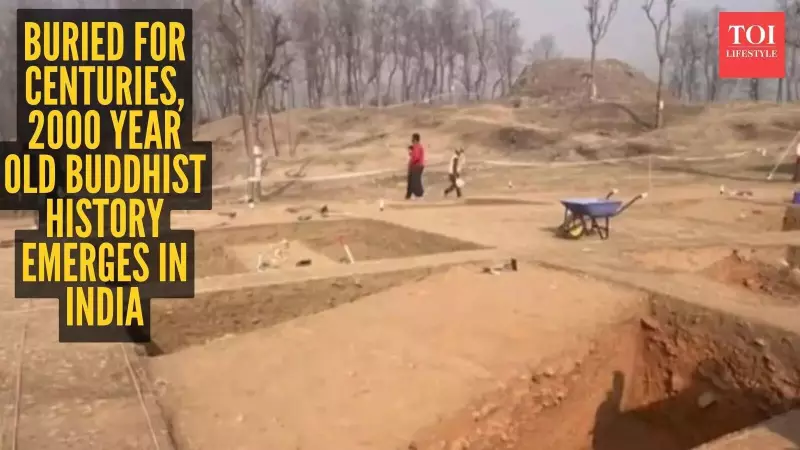
For decades, they were simply part of the landscape—unassuming mounds in a quiet corner of north India. With no signboards or fanfare, these gentle rises in Zehanpora village gave no hint of the two-millennia-old narrative they concealed. Today, that silence has been broken. Archaeologists have unearthed a significant Buddhist settlement from the Kushan period, fundamentally altering our understanding of the region's ancient past.
From French Archives to Indian Soil: The Unlikely Discovery
The story of this groundbreaking find starts not in India, but thousands of miles away in a French museum. Researchers there were examining a collection of old, grainy photographs depicting three stupas. The structures seemed out of place, not matching any well-documented sites. This archival curiosity sparked an investigation that eventually led experts back to the overlooked village of Zehanpora.
Initial suspicions were confirmed through modern technology. Drone surveys revealed the mounds were not natural formations but man-made structures, deliberately built. This prompted a full-scale excavation led by the Department of Archives, Archaeology and Museums of the state in collaboration with the state university.

Unearthing a Lost Chapter: Stupas, Cells, and Stone Foundations
As the soil was carefully removed, the ground began to reveal its secrets. The team discovered the bases of ancient stupas, monastic living quarters for monks, and meticulously planned stone foundations. The architectural layout felt immediately familiar to experts, bearing a striking resemblance to Gandharan Buddhist sites found along historic trade corridors.
This similarity points to Zehanpora's potential role as a vital hub. The site likely served as an important stop for monks, traders, and pilgrims travelling between the Gandhara region and the valley centuries ago. Its strategic location along a major ancient trade and pilgrimage route made it a natural resting point, a place for spiritual exchange, commerce, and learning.
A Proud Moment and a Profound Shift in Historical Narrative
Prime Minister Narendra Modi highlighted the discovery on his 'Mann Ki Baat' address, calling it a "proud moment" for the nation. He emphasized how the forgotten photographs in France helped researchers connect the dots, describing the site as a window into the state's complex and diverse ancient identity.
The implications are profound. This find challenges a narrow view of the valley's history, proving it was far more than a scenic backdrop. It was an active participant in a vast network of cultural and spiritual exchange. Furthermore, historians are exploring a potential link to Huvishkapura, the lost capital of the Kushan ruler Huvishka. If verified, Zehanpora could be positioned at the heart of an ancient political and cultural power centre.
The power of Zehanpora lies not in grand, towering ruins but in the quiet, layered history it represents. It tells a story of earth, silence, and time—a narrative of faith, footpaths, and connection. As excavations continue, each carefully uncovered layer promises to further shift our comprehension of the valley's deep-rooted past, reminding us that history often waits patiently beneath our feet for the curious to look deeper.