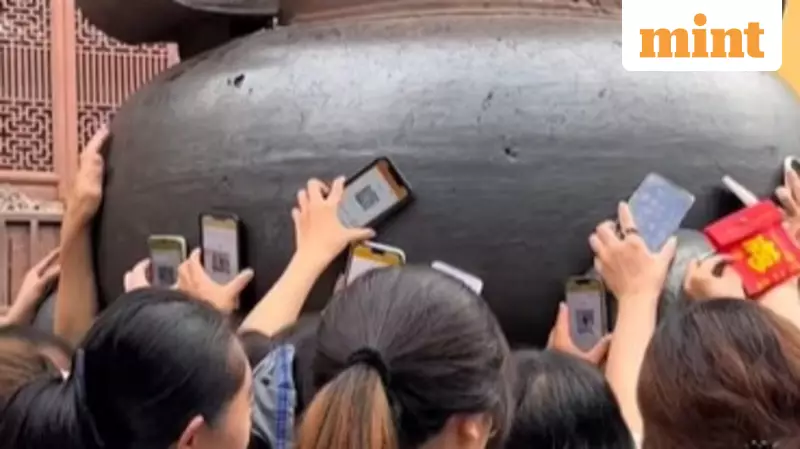
A centuries-old Buddhist temple in China has become the unlikely epicenter of a viral internet sensation, showcasing a fascinating blend of deep-rooted spirituality and contemporary digital habits. A video from the historic Lingyin Temple in Hangzhou shows worshippers engaging in a novel ritual: using their smartphones to seek and receive divine blessings.
The Viral Fusion of Faith and Technology
The widely circulated clip captures a scene both familiar and strikingly modern. Devotees are seen approaching a massive, ornate incense burner within the temple grounds. Instead of just bowing or praying, they touch their mobile phone screens to the burner. The reason? The burner prominently displays a QR code, a ubiquitous sight in China used for everything from payments to information sharing. Pilgrims also perform circumambulation around the burner, and some even hold their devices in the path of the rising incense smoke, symbolically bathing them in sanctity.
This practice is not a random act but is integrated into the temple's donation system. Like many institutions across China, Lingyin Temple accepts digital contributions via QR code scans. The ritual appears to complete this transactional loop: after making a digital donation, devotees lightly tap their phone against the burner as a symbolic gesture to 'accept' blessings in return, merging the act of giving with a tangible, albeit digital, receipt of grace.

Mixed Reactions and Cultural Context
The video sparked a wave of diverse reactions on social media platforms globally. Many international viewers found the sight amusing, calling it an example of 'blind faith' adapting to the digital age. One user humorously remarked on the "advanced technology bhagwan," while others questioned if the footage was generated by artificial intelligence.
However, commentators familiar with Chinese customs offered clarification. They explained that the primary function of the QR code is for practical, cashless donations—similar to India's UPI system. The subsequent tapping of the phone is largely a symbolic gesture of respect, a modern nod to the traditional practice of touching sacred objects for blessings. It represents a cultural adaptation rather than a literal belief that divine approval is transmitted via data packets.
The Historic Significance of Lingyin Temple
The setting for this modern phenomenon is a site of immense ancient heritage. Lingyin Temple, or 'Soul's Retreat' Temple, is located on the northwest side of West Lake in Hangzhou, Zhejiang province. Its history is profound, dating back to 328 AD, when it was founded by an Indian monk named Huili. This connection highlights the ancient cultural and religious links between India and China.
Over its 16-century-long history, the temple has witnessed numerous reconstructions and renovations, its fate intertwined with the rise and fall of dynasties. Today, it is celebrated as one of the oldest and largest Buddhist shrines in the country, renowned for its exceptional architecture and intricate carvings. It attracts not only pilgrims but also tourists and history enthusiasts eager to explore China's rich religious past.
The incident at Lingyin Temple serves as a powerful snapshot of our times—a world where ancient rituals seamlessly incorporate the tools of daily modern life, creating new traditions that are as much about cultural continuity as they are about technological adaptation.