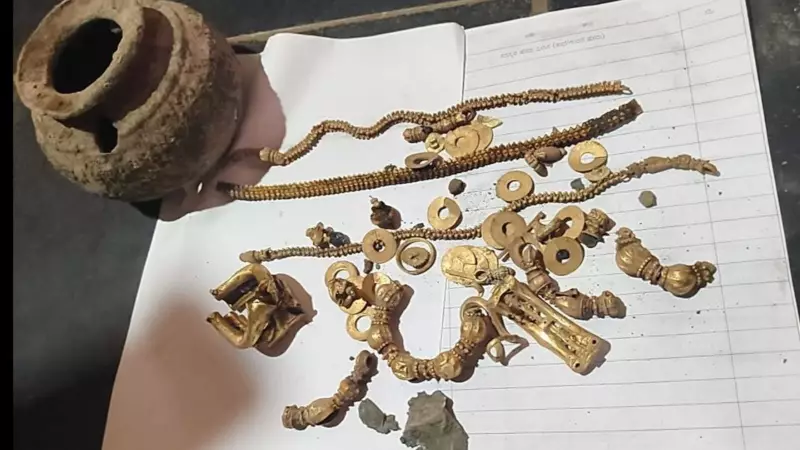
The Archaeological Survey of India (ASI) has stirred a controversy by dismissing the discovery of gold ornaments in Karnataka's historic Lakkundi village as an "ancient treasure." This assessment has been strongly contested by the local heritage body, which is now preparing to petition for a comprehensive review of the findings.
The Discovery and Initial Assessment
The incident unfolded on Saturday when a resident, digging the foundation for a house expansion in Lakkundi, unearthed a copper pot filled with gold ornaments. The haul, weighing approximately half a kilogram, included items like rings, bracelets, and a bangle. Following the discovery, district administration officials documented the items through a panchnama and secured them in the district treasury.
Ramesh Mulimani, a Senior Archaeologist with the ASI, visited the site on Sunday to examine the find. He cast doubt on the antiquity of the hoard. "The ornaments were unlikely to be a treasure that was buried centuries ago," Mulimani stated. He pointed out that many of the pieces were broken and were found in the kitchen area of the house.

"In the past, elders used to hide ornaments by burying them beside the kitchen," he explained, suggesting the items could have been buried by the ancestors of the current family residing there. He added that without accompanying coins to help date the find precisely, and given the ornaments' condition, they did not appear to be very old.
Heritage Authority's Strong Rebuttal
The ASI's preliminary conclusion was met with immediate criticism from Siddu Patil, a member of the Lakkundi Heritage Area Development Authority (LHADA). Patil accused the ASI curator of making claims without proper verification.
"Anything found under the earth is considered treasure as per the rules," Patil argued, countering the ASI's stance. He claimed that the ornaments could be 500-600 years old and might have belonged to a man. Accusing the ASI official of misleading locals, Patil declared that LHADA would approach senior ASI officials to demand a thorough, professional investigation into the recovered artefacts.
Lakkundi's Historical Significance and the Stakes
The debate holds particular significance because of Lakkundi's rich historical past. The site was a major city between the 10th and 12th centuries CE and is now a protected heritage village in Gadag district. In recent years, numerous campaigns have focused on preserving its thousand-year-old artefacts and structures.
This context makes any discovery within its limits a matter of keen archaeological and historical interest. The disagreement between the national archaeological body and the local heritage authority underscores the challenges in interpreting such finds and balancing immediate on-site assessments with detailed laboratory analysis and historical context.
The next steps are now clear: while the ASI maintains its view of a relatively modern, familial cache, the Lakkundi Heritage Area Development Authority is gearing up to formally challenge this interpretation, seeking a more exhaustive review to potentially unlock another chapter in the region's illustrious history.