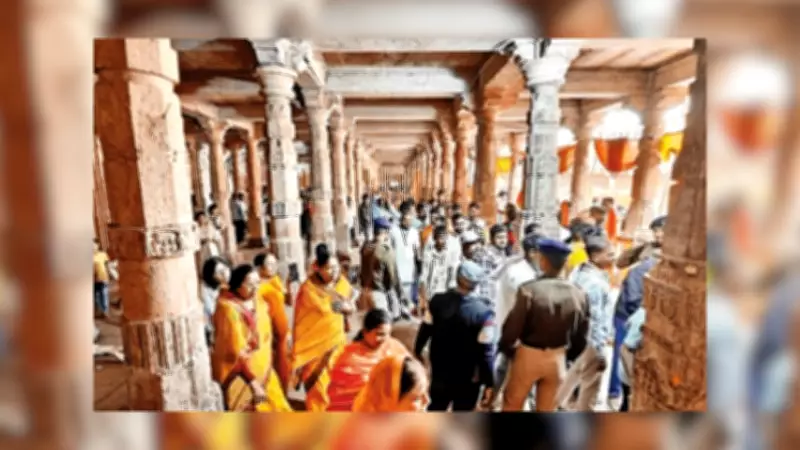
ASI Report Reveals Kamal Maula Mosque Constructed with Ancient Temple Parts
The Archaeological Survey of India has concluded that the Kamal Maula Mosque at the Bhojshala complex in Madhya Pradesh's Dhar district was built using parts of ancient temples. This finding is based on comprehensive scientific investigations, surveys, excavations, and detailed analysis of architectural remains, inscriptions, art, and sculptures.
Report Details and Court Proceedings
The ASI report, submitted to the Indore bench of the Madhya Pradesh High Court in 2024, states that the existing structure was constructed centuries later without much attention to symmetry, design, or uniformity. On Monday, the bench, comprising Justice Vijay Kumar Shukla and Justice Alok Awasthi, directed that the report be made available to all parties involved in the Bhojshala-Kamal Maula Mosque dispute. The court has given two weeks for parties to file objections, suggestions, opinions, and recommendations, with the next hearing scheduled for March 16.
Petitioners' Reactions and Historical Claims
Ashish Goyal, state vice-president of Hindu Front for Justice and a petitioner, expressed that the ASI report establishes the entire structure dates back to the Paramara dynasty, built by Raja Bhoj and his forefathers approximately 950 to 1,000 years ago. He described the report as deeply encouraging for the Hindu community, emphasizing that the focus should be on determining the religious character of Bhojshala, an issue the community has struggled with for years.

Another petitioner, Ashok Jain, convenor of Bhoj Utsav Samiti, noted that the petition was filed with the intent that if the place is a mosque, it should be given to Muslims, and if it is a temple, it should go to Hindus. He mentioned that the court's two-week window for responses will guide their next steps after the hearing.
Scientific Findings and Architectural Evidence
The 2,000-page report in 10 volumes was prepared by ASI additional director general Alok Tripathi and a team of experts, including Zulfiqar Ali, Bhuvan Vikram, Gautami Bhattacharya, Manoj Kumar Kurmi, Izhar Alam Hashmi, Aftab Hussain, Shambhoo Nath Yadav, and Niraj Kumar Mishra. Using the latest scientific techniques during a 98-day survey, the team excavated and studied the site, hinting it may have been a temple dedicated to goddess Saraswati.
ASI discovered a total of 94 sculptures and sculptural fragments, many of which were chiselled out or defaced. Sculptures of four-armed deities were found carved on windows, pillars, and beams used in the existing structure. Images included deities such as Ganesh, Brahma with his consorts, Narasimha, Bhairava, and various gods and goddesses, along with human and animal figures like lions, elephants, horses, dogs, monkeys, snakes, tortoises, swans, and birds. The report also noted mythical and composite figures, including kirtimukhas with human-faced, lion-faced, and composite-faced motifs, and vyala of different shapes.
Jain added that the report establishes materials and remains from the original Bhojshala period were used in later constructions after being dismantled, reinforcing the historical significance of the site.