Bhagavad Gita's Timeless Perspective on Death and the Soul's Journey
Death represents the single universal certainty in human existence, yet it remains the most unsettling and profound mystery that confronts every individual. What truly occurs in that pivotal moment when breathing ceases and the physical body becomes still? Does consciousness simply vanish into oblivion, or does something essential continue beyond? The ancient spiritual scripture, the Bhagavad Gita, approaches this fundamental question with remarkable serenity and depth. Rather than portraying death as a frightening finality, this sacred text describes it as a significant transition, a gentle turning of the page in the soul's extensive and ongoing journey.
The Eternal Nature of the Soul: Beyond Birth and Death
The teaching emerges during a moment of intense human crisis and vulnerability. On the historic battlefield of Kurukshetra, the warrior Arjuna stands completely paralyzed by overwhelming grief and moral confusion. Facing beloved relatives, respected teachers, and dear friends aligned on the opposing side, he questions the very meaning of life, duty, and death itself. It is within this context that Lord Krishna reveals one of the Gita's most enduring and comforting truths: the physical body may perish, but the immortal soul never dies.
Krishna addresses humanity's deepest existential fear—the terror that death annihilates our existence completely—with these powerful verses:

"Na jāyate mriyate vā kadācinnāyaṁ bhūtvā bhavitā vā na bhūyaḥ ajo nityaḥ śāśvato 'yaṁ purāṇo na hanyate hanyamāne śarīre."
This translates to: "The soul is never born and never dies. It has not come into being, does not come into being, and will not come into being again. It is unborn, eternal, everlasting and ancient. It is not destroyed when the body is destroyed." (Bhagavad Gita 2.20)
In this illuminating vision, what we commonly refer to as death is merely the conclusion of the physical body's temporary existence. The soul—known as the Atman—remains completely untouched by this physical cessation. It existed eternally before birth and continues eternally after death, remaining unchanged and unaffected by the body's inevitable rise and decay. Krishna's profound words gently but fundamentally shift our entire perspective on mortality. If the soul is inherently indestructible, then death transforms from a terrifying ending into a simple change of form and residence.
The Soul's Departure: Leaving the Temporary Physical Home
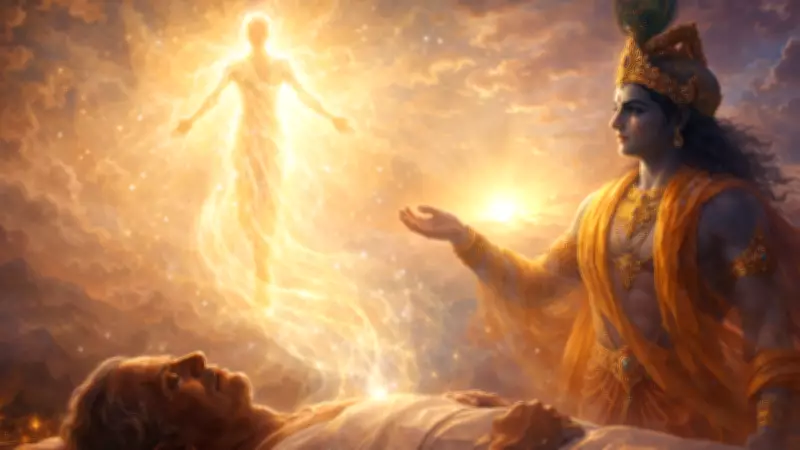
The Bhagavad Gita poetically describes death as the precise moment when the soul consciously leaves the physical body, much like a traveler departing from a temporary dwelling or a guest house. While the material body decomposes and returns to the fundamental elements of nature—earth, water, fire, air, and space—the consciousness that animated and inhabited that body continues its journey beyond the physical realm.
Krishna masterfully illustrates this concept with a metaphor that has resonated across centuries and cultures:
"Vāsāṁsi jīrṇāni yathā vihāya navāni gṛhṇāti naro 'parāṇi tathā śarīrāṇi vihāya jīrṇāny anyāni saṁyāti navāni dehī."
This means: "Just as a person discards worn-out clothes and puts on new ones, the soul discards worn-out bodies and takes on new ones." (Bhagavad Gita 2.22)
In simpler terms, the physical body does not represent the true identity or essence of a person; it functions merely as a temporary garment worn during a particular lifetime. When that body becomes too aged, diseased, or damaged to sustain life any longer, the soul simply releases it and moves forward to its next appropriate destination and form.
Karma: The Soul's Invisible Companion and Compass
However, the soul does not travel empty-handed or without direction after death. According to the Gita's comprehensive teachings, every thought, intention, word, and action leaves a subtle but powerful imprint on the soul's consciousness. These accumulated impressions, collectively known as karma, actively shape and determine the soul's future path and circumstances.

The quality of life a person lives essentially becomes the moral and spiritual compass that guides the soul's journey after physical death. Actions consistently driven by compassion, truthfulness, selflessness, and spiritual awareness naturally lead the soul toward higher, more refined states of existence and consciousness. Conversely, actions predominantly born of selfishness, ignorance, hatred, or greed can pull the soul into more challenging and restrictive circumstances in future incarnations.
Krishna presents this karmic process not as arbitrary divine punishment or reward, but as an immutable natural and spiritual law—the moral equivalent of cause and effect operating at the soul level. The soul inevitably carries its unfinished lessons, unresolved tendencies, and latent desires forward into its next phase of existence.
The Critical Importance of the Final Conscious Thought
One of the Gita's most intriguing and practical teachings concerns the final conscious moment of life. Krishna explains that the predominant state of mind at the precise moment of death powerfully reflects and summarizes the mental habits cultivated throughout an entire lifetime.
The mind naturally tends to move toward whatever it has practiced and cherished most deeply and consistently. If a person has diligently cultivated devotion, wisdom, inner peace, or selfless love, those elevated qualities will naturally guide and influence the soul's transition. If, however, the mind remains strongly attached to material desires, paralyzing fears, or worldly concerns, it will gravitate toward those lower vibrations during the critical passing.
Therefore, the final thought is not random or arbitrary; it represents the concentrated echo and culmination of how one has lived, thought, and prioritized throughout life. This understanding emphasizes the importance of conscious living and spiritual practice.
Beyond the Eternal Cycle: The Possibility of Liberation
The Gita acknowledges that most souls continue progressing through the endless cycle of birth, death, and rebirth—a process traditionally known as samsara. Earthly life becomes a long, educational journey of learning, growth, purification, and self-discovery across numerous lifetimes and experiences. However, Krishna also analyzes this cyclical process with deep insight and offers a glorious possibility beyond it.
Through sincere self-realization, disciplined selfless action (karma yoga), profound knowledge (jnana yoga), and unwavering devotion to the divine (bhakti yoga), a soul can ultimately attain moksha—complete spiritual liberation. In this exalted state, the soul is no longer bound by karma or compelled to return to earthly existence. Instead, it experiences eternal union with the ultimate reality (Brahman), forever free from the endless rhythm of birth and death.
The person we mourn and remember has not vanished into nothingness. The soul that animated their physical form continues its evolutionary journey, shaped by the life it lived and the spiritual lessons it gathered along the way. Viewed through this enlightened perspective, death is not an impenetrable wall. It is a sacred doorway. And beyond that doorway, according to the timeless, compassionate vision of the Bhagavad Gita, the eternal soul simply keeps traveling, learning, and moving closer to its divine source.