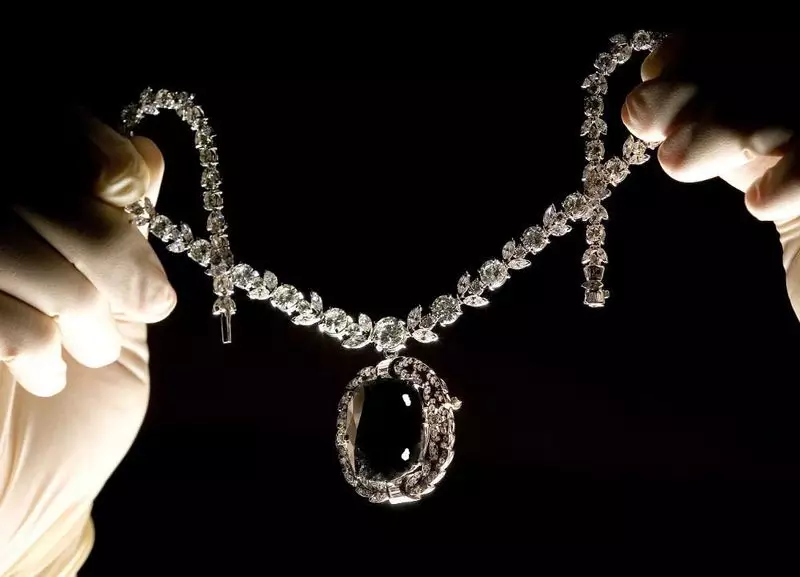
The glittering world of rare gems holds many secrets, but few are as dark and steeped in legend as the story of the Black Orlov diamond. This magnificent 67.50-carat black stone, now set in a brooch surrounded by 108 diamonds and suspended from a necklace of 124 diamonds, carries a heavy past. Its origins are traced back to a sacred site in India, where it was allegedly stolen from the eye of a revered Hindu deity, casting a long shadow of misfortune and mystery over its subsequent owners.
The Sacred Theft and the Journey to the West
According to persistent lore, the diamond's story begins in early 19th century Pondicherry, a French colonial enclave in India. The stone was not merely a geological wonder but a sacred object. It is said to have been one of the eyes of a majestic idol of the Hindu god Brahma, enshrined within a temple in the region. The diamond's spiritual significance was profound, representing divine vision and power.
This sacred peace was shattered when a European monk, often identified as a French Jesuit or a Russian adventurer depending on the account, committed a grave act of desecration. Sometime around the 1850s, this individual is believed to have stolen the diamond directly from the idol. This theft from a place of worship marked the beginning of the gem's notorious "curse." The monk then fled India, smuggling the priceless stone out of the country. His journey took him to Europe, and the diamond eventually found its way to Russia, entering the collection of the aristocratic Orlov family, from whom it derives its current name.

A Trail of Tragedy: The Legend of the Curse
The Black Orlov is often dubbed "The Eye of Brahma Diamond," and its reputation is inextricably linked to a series of tragic events. The curse, as legend has it, punishes those who possess the stolen sacred stone. The most cited victims are two former owners from the Russian nobility. Princess Nadia Vyegin-Orlov and Princess Leonila Galitsine-Bariatinsky are both said to have leapt to their deaths from buildings in separate incidents, decades apart. These suicides in 1947 and the 1800s respectively became the cornerstone of the diamond's macabre fame.
Later, the diamond crossed the Atlantic. In 1947, it was purchased by Charles F. Winson, a prominent New York jeweler. Perhaps wary of its dark history, Winson took deliberate steps to symbolically "break" the curse. He had the stone recut from its original rough weight of 195 carats to its current 67.50-carats, hoping to sever its malevolent ties. He also set it in the now-famous brooch and necklace design. Since then, the diamond has passed through the hands of several wealthy owners, including a European countess and later, the estate of American heiress and philanthropist, Maude Plant.
Unraveling Fact from Fiction: The Modern Quest for Truth
While the tale of the curse is compelling, historians and gemologists have cast doubt on some of its elements. Research has struggled to conclusively verify the existence of the two ill-fated Russian princesses linked to the jumps. Furthermore, the diamond's precise path from India to Russia remains partially obscured by time, with some experts suggesting it may have been part of the treasures of the Nizam of Hyderabad before appearing in the West.
Despite the historical ambiguities, the core narrative of its Indian origin and sacrilegious theft remains powerful. The story taps into a deep-seated cultural respect for temple artifacts and the perceived consequences of violating sacred spaces. The Black Orlov was last seen in the public eye in 2006 when it was auctioned at Christie's in London. Today, its whereabouts are private, but its legend endures.
The legacy of the Black Orlov diamond is a complex tapestry woven from verified history, unverified legend, and enduring folklore. It stands as a stark reminder of the colonial-era plunder of India's cultural and religious heritage. Whether one believes in the literal curse or not, the stone's story is undeniably one of displacement, loss, and the heavy price often attached to ill-gotten treasures. The mystery of its exact origins in Pondicherry continues to fascinate historians and gem enthusiasts alike, ensuring that the dark legacy of the Black Orlov will sparkle with intrigue for generations to come.