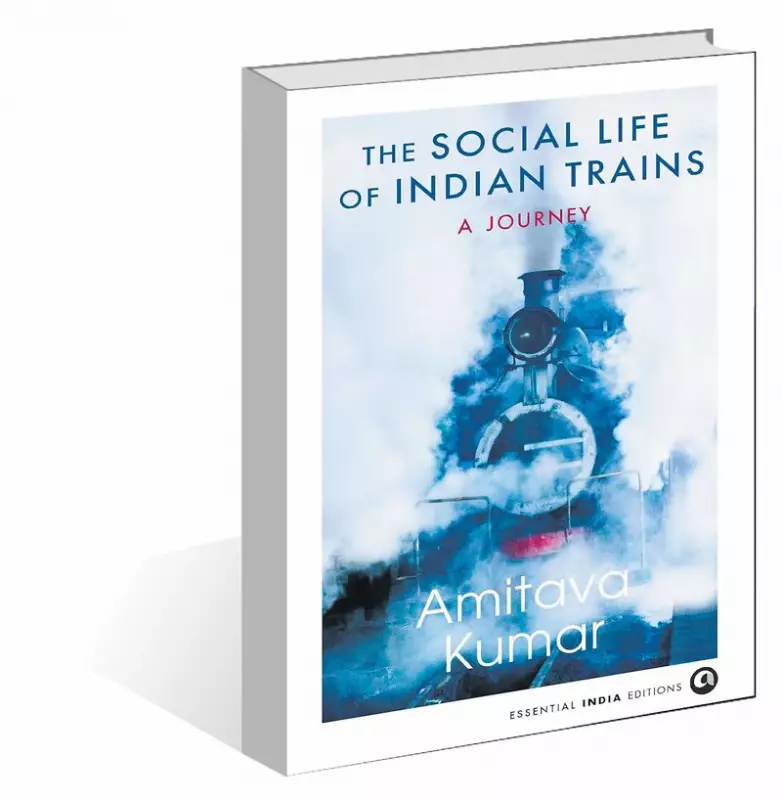
A new book offers a captivating window into the heart of India, not through its palaces or politics, but through the bustling, chaotic, and profoundly human world of its railways. Author Amitava Kumar's The Social Life of Indian Trains is more than a travelogue; it is a rich tapestry woven from personal memoir, historical anecdote, and striking visual photography that together narrate the story of a nation in motion.
A Moving Chronicle of India's Railway Network
The book, published by Aleph, masterfully uses the Indian Railways as its central character. Kumar, a professor at Vassar College in the United States, frames his narrative around a long train journey from Delhi to Patna and then to Mumbai. This physical movement becomes a metaphor for memory, migration, and the relentless passage of time. He intertwines his own experiences and family history with the larger saga of the railways, an institution that connects over 8 billion passengers annually across a network spanning more than 68,000 kilometers.
Kumar's prose is reflective and observant. He does not merely describe scenes from a train window; he delves into the intimate social ecosystem that thrives within the compartments. The book captures the fleeting friendships, shared meals, unsolicited advice, and collective endurance that define train travel for millions of Indians. It highlights how the railway compartment becomes a microcosm of Indian society, where boundaries of class, region, and religion are constantly negotiated in close quarters.

Blending Personal History with National Narrative
A significant portion of the narrative is anchored in Patna, Kumar's hometown, and the role of the railway in shaping his and his family's life. The book becomes a poignant exploration of home and belonging, especially for someone who has lived abroad for decades. The train journey to Patna is a journey into personal history, with stations and landscapes triggering memories of childhood, family, and a changing city.
The historical insights are seamlessly integrated. Kumar references the colonial legacy of the railways, built initially for military and economic control, which later transformed into a democratizing force in independent India. He touches upon tragic chapters like the 1981 Bihar train disaster, one of the world's deadliest rail accidents, reminding readers of the system's scale and its occasional terrible cost. The narrative also acknowledges the railways' role in moments of national pain, such as the Partition, when trains became vessels of unimaginable violence and displacement.
Visual Journey Through a Photographer's Lens
An outstanding feature of The Social Life of Indian Trains is its visual component. The book is richly illustrated with photographs by Rohit Vohra and Anu Kumar. These are not generic stock images but powerful, candid shots that capture the essence of railway life—the weary faces of passengers, the vibrant chaos of platforms, the quiet moments of solitude, and the intricate details of the trains themselves. The photography works in dialogue with the text, providing a visceral, immediate layer to Kumar's reflective writing.
The book's structure is deliberately non-linear, mimicking the associative nature of memory itself. It moves between past and present, between personal recollection and broader social commentary. This style might challenge readers seeking a conventional, chronological history, but it effectively recreates the experience of a long train ride, where thoughts meander and stories unfold in unexpected ways.
More Than Transport: A Reflection on Modern India
Ultimately, Amitava Kumar's work is a meditation on contemporary India seen from its most democratic vantage point. The train is portrayed as a great equalizer, yet it also reveals the persistent inequalities and complexities of the nation. The book discusses everything from the efficiency of the online ticket booking system to the stark reality of travel in overcrowded general compartments.

The Social Life of Indian Trains concludes not with a grand statement, but with a continued sense of movement. It suggests that India's journey, much like a long-distance train, is ongoing, filled with contradictions, camaraderie, and constant change. The book has been praised for its originality, its evocative blend of text and image, and its ability to find profound meaning in the everyday ritual of train travel. It is a must-read for anyone seeking to understand the pulsating, human rhythm of India beyond the headlines.
By focusing on the shared experience of rail travel, Kumar has authored a unique and deeply resonant portrait of a country. The railways, as this book brilliantly illustrates, are not just about getting from point A to point B; they are the veins through which the lifeblood of India flows, carrying its people, its stories, and its endless possibilities forward.