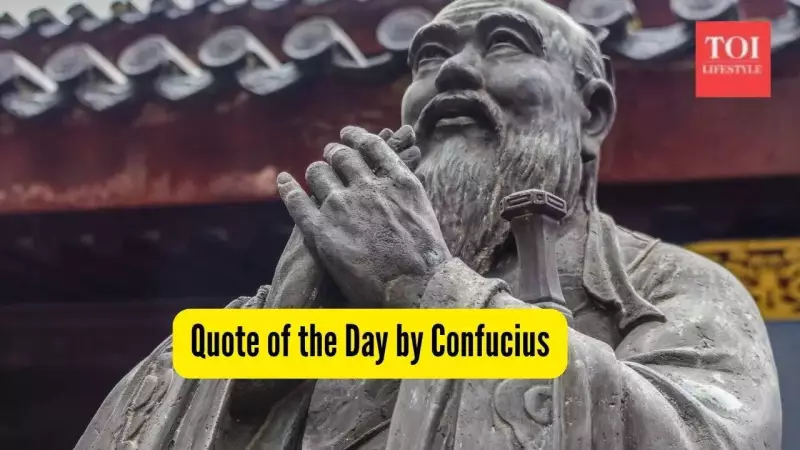
In the year 551 BCE, in the ancient state of Lu located in what is now modern Shandong Province, China, a child named Kong Qiu was born. This child would grow to become known worldwide as Confucius, one of history's most enduring philosophical figures. His early life was marked by tragedy when he lost his father at a young age, leaving him orphaned in a turbulent period of Chinese history.
From Self-Education to Philosophical Mastery
Despite these challenging beginnings, Confucius demonstrated remarkable intellectual curiosity and determination. He embarked on a journey of self-education, immersing himself in the study of ancient texts, rituals, and cultural traditions. This autodidactic approach laid the foundation for what would become a revolutionary philosophical system. Through dedicated learning and reflection, he developed profound insights into human nature and social organization that would resonate across centuries.
The Teacher Who Transformed Education
Confucius eventually established himself as a teacher, attracting students from diverse social backgrounds and economic circumstances. His teaching methods were revolutionary for their time, emphasizing that wisdom and virtue were accessible to all who pursued them diligently. He created an educational environment where knowledge was shared freely, breaking down traditional barriers to learning and creating what many consider the first private academy in Chinese history.

Political Aspirations and Exile
Driven by a desire to implement his philosophical principles in practical governance, Confucius sought political office where he could apply his ideas about ethical leadership and social harmony. However, the ruling powers of his time rejected his proposals, leading to his political marginalization and eventual exile. During this period of wandering, he traveled through various states including Wei and Chen, observing different approaches to governance while refining his philosophical concepts through real-world experience.
Return and Philosophical Legacy
After years of travel and political disappointment, Confucius returned to his homeland to focus on teaching and philosophical development. He passed away in 479 BCE at the age of 73, leaving behind no personal writings but an immense intellectual legacy. His disciples meticulously recorded his teachings in what became known as the Analects, a collection of sayings and conversations that preserved his wisdom for future generations.
The Core Principles of Confucian Thought
Confucius developed a comprehensive ethical system centered on several key virtues that continue to influence East Asian societies. Ren, often translated as humaneness or benevolence, represents the highest virtue of empathy and kindness that fosters mutually beneficial relationships. This is achieved through conscious self-cultivation rather than innate characteristics.
Li, or ritual propriety, provides the framework for social harmony through prescribed behaviors and ceremonies that reinforce respect and order in daily life. Yi, meaning righteousness, emphasizes making moral decisions based on fairness rather than personal advantage. Zhi, or wisdom, emerges from studying classical texts and reflecting on their meaning to develop sound judgment. Xiao, filial piety, establishes the foundation for all social duties through respect for parents and loyalty to superiors.
Historical Impact and Cultural Transformation
During the Han dynasty, Confucian philosophy became state orthodoxy, profoundly shaping China's imperial examination system and bureaucratic structure for centuries. The philosophy spread beyond China's borders, influencing governance, education, and social norms in Korea, Japan, and Vietnam. Confucius emphasized moral leadership over coercive power, creating cultural frameworks where hierarchy coexisted with compassion and mutual responsibility.

Contemporary Relevance and Practical Wisdom
Confucius addressed universal human concerns that remain remarkably relevant today. He focused on practical ethics, social order, and personal development, asserting that human beings possess the capacity to solve their own problems through reason and moral cultivation rather than relying on supernatural intervention. His teachings continue to influence business ethics, educational approaches, and policy-making throughout East Asia.
One of his most famous aphorisms illustrates his practical wisdom: "By three methods we may learn wisdom: First, by reflection, which is noblest; Second, by imitation, which is easiest; and third by experience, which is the bitterest." This statement captures the balanced approach to knowledge acquisition that characterizes Confucian thought, warning against both empty accumulation of facts without reflection and speculative thinking without empirical grounding.
Philosophical Contributions and Enduring Influence
Confucius fundamentally transformed Chinese thought by prioritizing human agency over fate or mysticism, asserting that anyone could achieve virtue through dedicated study and self-reflection. He synthesized ancient rituals and poetry into a systematic approach to personal and social improvement, arguing that rulers should exemplify moral excellence to inspire their subjects, thereby connecting individual ethics with societal stability.
His oral teachings, preserved and expanded by his followers, evolved into Confucianism, which eventually merged with Legalist principles during imperial unification and became the dominant philosophical framework under Emperor Han Wudi. This synthesis created an educational and bureaucratic system that endured for millennia, with Confucian values permeating every aspect of East Asian civilization from family relationships to state governance.
While some critics have noted that Confucian conservatism occasionally resisted innovation, the philosophy's emphasis on human potential and ethical cultivation continues to offer a powerful alternative to cynicism in moral discourse. Confucius demonstrated that philosophical ideas could shape civilizations, proving that thoughtful reflection on human relationships and social organization could create enduring cultural frameworks that transcend their historical origins.