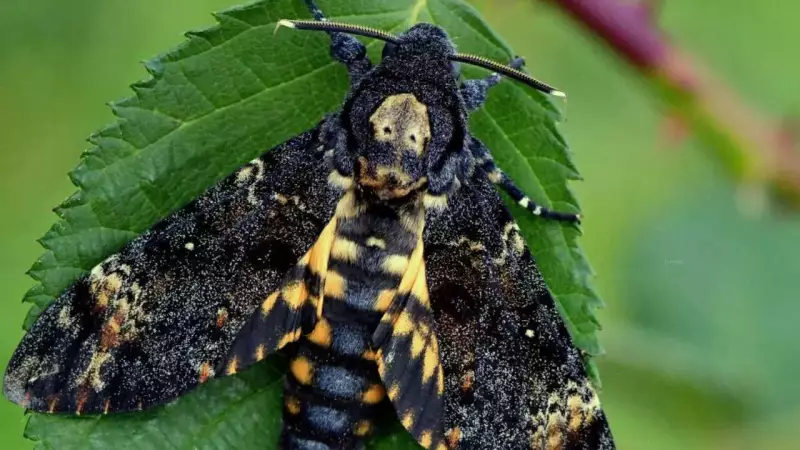
In the vast tapestry of nature, few creatures command immediate recognition and a sense of eerie wonder quite like the death's-head hawk moth. Instantly identifiable by the stark, skull-shaped pattern on its thorax, this moth has woven itself into centuries of human folklore, superstition, and even modern pop culture, often cast as an omen of death.
The Science Behind the Skull: More Than Just a Spooky Mark
Despite its intimidating visage, the death's-head hawk moth is surprisingly gentle and poses no threat to humans. The iconic marking, which has inspired countless myths, is actually an evolutionary masterpiece designed for survival. When viewed from above by potential predators like birds, the skull pattern creates the illusion of a much larger, more threatening animal, effectively deterring attacks.
The species known collectively as the death's-head hawk moth comprises three main types within the Acherontia genus. Acherontia atropos is the most famous, found across Africa and Europe. The larger Asian species is Acherontia lachesis, while the smaller Asian counterpart is Acherontia styx. These moths are substantial insects, with a wingspan that can reach an impressive three to five inches.

Their colouring is a study in camouflage and deception. The forewings, mottled in shades of brown and black, allow them to blend seamlessly with tree bark. In contrast, their hindwings are a vibrant yellow with bold black bands, a feature that plays a key role in their unique defence strategies.
Master of Disguise and Deception: Unique Defence Mechanisms
The moth's unsettling appearance is just the beginning of its fascinating biology. It possesses a suite of remarkable defence mechanisms that set it apart from other insects. One of its most startling abilities is to produce a high-pitched squeak. When threatened, the moth forcibly expels air through its proboscis—the long, tube-like organ it uses for feeding—creating a sound that effectively startles predators.
This auditory warning is often accompanied by a visual one: the rapid flashing of its bright yellow abdomen. This sudden burst of colour adds another layer of intimidation, confusing and discouraging any animal that considers it a meal.
Perhaps its most audacious survival strategy is its ability to infiltrate honeybee hives. The moth's yellow and black colouring provides a perfect mimicry of bees, allowing it to slip into colonies undetected. Once inside, it uses its thick exoskeleton for protection against stings and feeds on the nutrient-rich honey. This bold behaviour ensures it gets the energy required to support its large size, making it one of the few insects capable of such a daring raid.
A Cultural Icon and Scientific Marvel
The death's-head hawk moth's journey from a feared omen to a subject of scientific admiration is a testament to its unique place in the natural world. Its image has been powerfully used in films and literature to symbolize fear and the unknown. However, the real narrative is one of incredible adaptation and ecological importance.
Ecologically, these moths contribute as pollinators and as a part of the food chain. Their complex relationship with bee hives offers valuable insights into insect behaviour and evolutionary arms races. For researchers and nature enthusiasts in India and beyond, the death's-head hawk moth is a compelling subject that demonstrates how nature's most unusual-looking creatures often harbour the most extraordinary secrets.
Ultimately, the death's-head hawk moth is a powerful reminder that a frightening exterior can conceal a world of remarkable biological ingenuity. Its skull marking, squeaking defence, and honey-stealing prowess make it a true marvel of adaptation, transforming initial apprehension into deep fascination for those who take a closer look.