Cyanotype Workshops in Delhi Revive Analogue Photography with Prussian Blue Art
Across Delhi, a resurgence in analogue photography is captivating enthusiasts and art lovers through cyanotype workshops. These sessions invite participants to slow down and engage with an early photographic process, creating distinctive white-on-Prussian blue images using a simple mix of chemicals and ultraviolet light. The appeal lies in how these prints resemble artworks while being accessible photographic creations.
What Is Cyanotype?
Cyanotypes are among the earliest photographic printing processes, developed in 1842 by Sir John Herschel and famously used by botanist Anna Atkins for the world’s first photographically illustrated book. Distinguished by their striking cyan-blue hue, the technique involves coating paper with two iron salts—ferric ammonium citrate and potassium ferricyanide—and exposing it to ultraviolet light. The result is a deep Prussian blue image with whites from the bare paper beneath. Historically, this method was widely employed by architects and engineers to produce blueprints for technical drawings in the 19th century.
An Experience in Alternative Photography
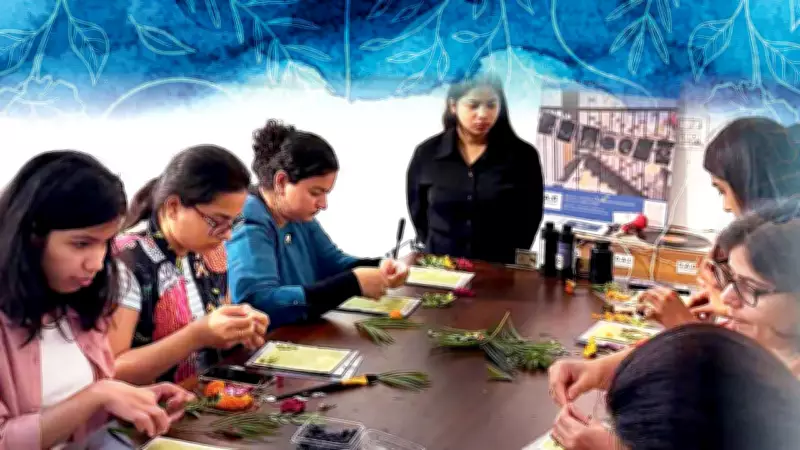
Aruna Anand, founder of NIV Art Centre, which regularly hosts these workshops, explains the printing process in detail. Participants start by making a light-sensitive solution by mixing ferric ammonium citrate and potassium ferricyanide, typically in equal parts. This solution is applied to thick, handmade paper or other surfaces like fabric, pebbles, or shells, and left to dry in a dark room with red light.

Once dry, objects such as pressed flowers, leaves, lace, feathers, or photographic negatives are placed on the coated surface. The arrangement is then exposed to direct sunlight, usually under a glass sheet to keep elements in place, until the paper shifts to a muted greenish tone—often taking as little as five minutes. After exposure, the objects are removed, and the print is rinsed under running water to lock the impression. As it oxidises, the image develops into its signature deep blue, with some practitioners adding hydrogen peroxide to accelerate the process. The print is then left to air-dry.
Room for Experimentation
Workshop hosts are expanding cyanotypes beyond traditional photograms, experimenting with formats like tote bags, sticker sheets, postcards, and stamps. Pratyush Thaker, a graphic designer and founder of Show Me The Blue, shares, “In cyanotype, there’s a lot of room for experimentation, not just with the image one wants but also the surface. I love how the surface becomes such a major part of the final image.” He has experimented with cyanotype animations, burnt prints, and printing on items like Bombay Local tickets and used tea bags.
Aditya Arya, curator-director of Museo Camera in Gurgaon, notes, “Cyanotype is the most accessible entry point into alternative process photography. Every cyanotype is a direct record of the light that fell on it: a contact print, a photogram, a sun print.” He observes growing interest, with attendees drawn to the process through social media videos and a desire to move away from screens, even if just for a few hours.
Therapeutic and Educational Benefits
Participants find the workshops therapeutic and educational. Divya Ashta, who recently attended a workshop with a friend, says, “It was a therapeutic experience for me. Discovering and learning an alternative form of photography was fun, observing each step unfold beautifully from transparency to magnificent Prussian blue.” She used leaves and flowers foraged during morning walks, now framed at home. Another attendee, Sakshi D, adds, “Cyanotype helps you understand texture, light, the delicacy of patterns, and, most importantly, patience.”
These workshops not only revive a historical technique but also foster creativity and mindfulness, making cyanotype a beloved activity in Delhi’s art scene.