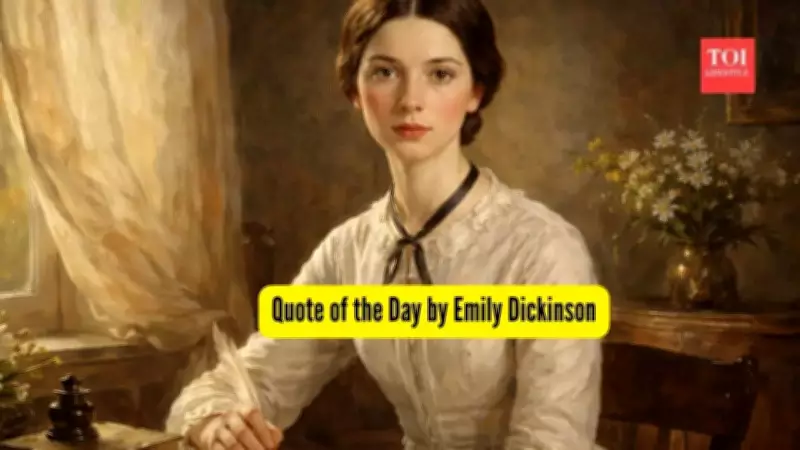
The Enigmatic Life of Emily Dickinson
Emily Dickinson stands as one of the most original and profoundly influential poets in the entire history of American literature. Yet, in a remarkable paradox, she remained almost completely unknown during her own lifetime. Today, she is celebrated as a central, transformative figure whose compressed lines, startling imagery, and radical punctuation fundamentally altered how we perceive and use language.
A Life of Quiet Contradiction
In the quiet, unassuming town of Amherst, Massachusetts, where she spent virtually her entire life, Emily Dickinson was known simply as Emily: a dutiful daughter, a caring sister, an avid gardener, and a woman who privately composed nearly 1,800 poems. To truly understand Emily Dickinson is to embrace a series of profound paradoxes. She lived in near-total seclusion, yet her poetry explores themes of vast, cosmic scale. Her world was physically small, but her imagination was boundless.
Emily Elizabeth Dickinson entered the world on December 10, 1830, in Amherst. Her father, Edward Dickinson, was a successful lawyer and a prominent community figure who served in both state and national politics. The Dickinson family placed high value on education, religious faith, and social responsibility. Emily received a robust education, first at Amherst Academy and later at Mount Holyoke Female Seminary, where she studied literature, science, and theology. Even in her youth, however, she displayed clear signs of a fiercely independent spirit.

The Great Withdrawal and Private Revolution
Following her formal schooling, Dickinson began a gradual but decisive withdrawal from public life. By her thirties, she was rarely seen outside the confines of her family home. Visitors would often speak to her through a barely opened door. She adopted white clothing so consistently that she became known locally as “the Woman in White.” This withdrawal, however, was not an act of emptiness or defeat. It was an act of immense creative intensity. Within the walls of her room, she was quietly conducting a private literary revolution.
At the time of her death in 1886, only about a dozen of her poems had been published, and these were heavily edited to conform to the sentimental poetic standards of the 19th century. The literary world was utterly stunned when, after her passing, her sister Lavinia discovered the true extent of her work: nearly 1,800 poems meticulously hand-stitched into small booklets called fascicles.
The Radical Style of a Literary Pioneer
Dickinson’s poems were unlike anything popular in her era. They were brief, sharp, intellectually daring, and often unsettling. She pioneered a distinctive style characterized by several groundbreaking techniques:
- Short, Compressed Lines: Every word carried immense weight.
- Slant Rhyme: She preferred imperfect, suggestive rhymes over perfect ones.
- Unconventional Capitalization: Used for emphasis and symbolic meaning.
- Frequent Dashes: Replacing standard punctuation to indicate pause, interruption, or layered meaning.
- Abrupt Shifts in Thought: Creating surprising intellectual and emotional leaps.
Her poetry delved into themes that were both intimately personal and universally resonant: death and immortality, love and longing, the precise beauty of nature, faith and doubt, and the mysteries of identity and consciousness.
Signature Poems and Lasting Impact
One of her most famous poems begins: “Because I could not stop for Death – He kindly stopped for me –” Here, Death is personified not as a terrifying specter but as a polite, patient suitor. This imaginative boldness—transforming fear into eerie calm—is quintessential Dickinson.
Another renowned poem starts: “Hope is the thing with feathers – That perches in the soul –” In just a few lines, she masterfully captures concepts of resilience, fragility, and endurance through a single, powerful metaphor. This ability to condense vast emotion into minimal language became her enduring signature.

Dickinson’s style often feels deceptively simple. Many poems are only eight lines long, yet each word is chosen with surgical precision. She frequently employed hymn meter, a rhythmic pattern from Protestant hymns, giving her radical content a familiar, musical quality that both comforted and startled the reader. Her iconic dashes remain a subject of fascination, capable of meaning pause, interruption, continuation, or uncertainty—sometimes all at once.
Enduring Legacy and Modern Relevance
Although she published little in life, Dickinson’s posthumous influence has been monumental. She transformed American poetry, inspiring generations of writers including Sylvia Plath, Adrienne Rich, and Elizabeth Bishop. Modernist poets admired her compression. Feminist critics recognized her as a woman who claimed intellectual and artistic authority in a time that severely limited female voices. She helped pave the way for free verse and deep psychological introspection in poetry, proving that impact does not require grand, epic scale but can come from small, private, and explosive truth.
Beyond the Myth of Isolation
Who was Emily Dickinson, really? Reducing her to a stereotype of lonely isolation misses the formidable force of her imagination. She maintained rich correspondences with friends and mentors, read voraciously, and remained deeply intellectually engaged. Her solitude may have been a conscious choice—a deliberate narrowing of the external world to infinitely expand the internal one. Her garden was central to her life; she knew flowers intimately and observed nature with precise, poetic eyes. She once wrote, “The Brain—is wider than the Sky—” a line that perfectly captures her worldview: the inner landscape mattered most.
Her own words reveal her philosophy: “I know nothing in the world that has as much power as a word. Sometimes I write one, and I look at it, until it begins to shine.” This quote underscores her belief in the active, shaping power of language. In a world of noise, she practiced profound concentration, choosing few, luminous words over many careless ones.
In today’s fast, digital, information-saturated age, Dickinson feels astonishingly modern. Her brevity suits shortened attention spans, yet her depth demands and rewards slow, careful reading. She teaches us to pause, to consider, and to value the quiet interior life. Her poetry is a timeless reminder that words are not disposable—they matter, and they can shine if we give them our attention.
More than a century after her death, we continue to return to her lines. We whisper them in moments of grief and hope. We marvel at how a few short, carefully chosen words can contain an entire cosmos. In doing so, we participate in her enduring belief: that a word, deeply seen, can truly shine—and in shining, change the world.