The Enduring Legacy of Enid Blyton: A Children's Literary Icon
Enid Blyton remains one of the most influential and prolific children's authors in literary history, with an uncanny ability to capture the imagination of young readers across generations. Born on August 11, 1897, in East Dulwich, South London, her early life was shaped by both nurturing influences and profound challenges that would later inform her storytelling.
Early Life and Formative Years
Her father, Thomas Carey Blyton, instilled in young Enid a deep appreciation for nature, birds, and wildlife, while her relationship with her mother Theresa was strained from the beginning. When Enid was just thirteen years old, her father abandoned the family for another woman, an event that shattered her childhood and fundamentally altered her perception of family dynamics. This personal trauma would later contrast sharply with the close-knit groups and familial bonds she depicted in her stories.
Despite these early difficulties, Blyton excelled academically and athletically at St. Christopher's School in Beckenham, where she demonstrated particular talent in tennis and lacrosse. Her educational journey continued at Ipswich High School, where she trained to become a teacher beginning in 1916. By 1919, she had achieved top marks in subjects including botany and child hygiene, showcasing her diverse intellectual capabilities.

The Writing Career Takes Flight
Though she worked briefly as a governess and taught at Bickley Park School, Blyton's true passion always lay in writing. Her literary career began modestly with poems published in Nash's Magazine in 1916. Her first book, Child Whispers, a slender collection of poetry, appeared in 1922. She soon established regular contributions to publications like Teachers' World, where she maintained her own column, developing her distinctive voice and connection with young audiences.
In 1924, Blyton married Hugh Pollock, a publisher at George Newnes, in a quiet ceremony at the Bromley Register Office without family present. The couple settled into homes including Elfin Cottage and Old Thatch, where they faced fertility struggles before welcoming daughters Gillian in 1931 and Imogen in 1935. However, the marriage deteriorated as Hugh's drinking escalated, and Blyton began an affair with surgeon Kenneth Darrell Waters, leading to divorce in 1942.
Personal Challenges and Prolific Output
Blyton married Waters in 1943, changing her daughters' surnames and moving to Green Hedges in Beaconsfield—a home name selected by readers of her magazine. Despite ongoing personal hardships including miscarriages, estrangement from her mother, and her husband's declining health, Blyton channeled her energy into writing with extraordinary productivity, often typing 6,000 to 10,000 words daily directly from her imagination.
The 1930s and 1940s marked her creative zenith. She began with educational works like Teachers' Treasury and nature stories before achieving monumental success with fantasy series including Adventures of the Wishing-Chair (1937) and The Enchanted Wood (1939), which launched the beloved Faraway Tree series. Adventure stories like The Secret Island (1938) and school series such as The Naughtiest Girl (1940) and Malory Towers (1946) further expanded her repertoire.
Iconic Series and Unprecedented Success
Blyton's mystery series became cultural phenomena. Five on a Treasure Island (1942) introduced the Famous Five, featuring cousins Julian, Dick, Anne, George, and their dog Timmy solving crimes across 21 books. This was followed by the Secret Seven (15 books beginning in 1949) and Five Find-Outers (15 books from 1943). Her creation of Noddy, the Toyland elf who debuted in 1949, spawned over 30 books and became a merchandising sensation.
Her work ethic was legendary. Over five decades, Blyton authored more than 700 books while editing magazines including Sunny Stories (1926–1953) and Enid Blyton's Magazine. She wrote plays, retold myths and Bible stories, and published serialized stories sometimes under the pseudonym Mary Pollock. Her themes consistently celebrated friendship, bravery, mischief, and moral integrity, with children often outwitting villains independently of adults.

Critical Reception and Lasting Impact
Later criticism highlighted perceived simplicity in her writing and accusations of racism and sexism, leading to revised editions. However, children worldwide adored her fast-paced narratives, cliffhangers, and escapist worlds. By the 1950s, Blyton had become a formidable brand with jigsaw puzzles, games, and charitable clubs like the Famous Five club and Busy Bees animal welfare initiative.
Noddy alone sold 200 million copies, while her total sales exceed 600 million books globally, translated into 90 languages—surpassed only by Agatha Christie, Jules Verne, and William Shakespeare in publishing history. British children voted her their favorite author in 1982, and a 2008 Costa poll ranked her above contemporaries like Roald Dahl and J.K. Rowling. Between 2000 and 2010, UK sales reached 8 million copies worth £31 million.
Later Years and Enduring Message
Adaptations flourished across television, film, and theater, including Famous Five series in the 1970s and 1990s and animated Noddy cartoons. Blyton's health declined in the 1960s with early signs of dementia. She died on November 28, 1968, at age 71 in a Hampstead nursing home, predeceased by her husband in 1967. Hachette now controls most publishing rights, while her granddaughter Sophie Smallwood authored a new Noddy book in 2009.
Despite rumors about ghostwriters—she successfully sued to disprove these—and family memoirs depicting her as strict, Blyton's legacy endures through her profound understanding of childhood. Plaques mark the former site of Green Hedges, commemorating her literary home.
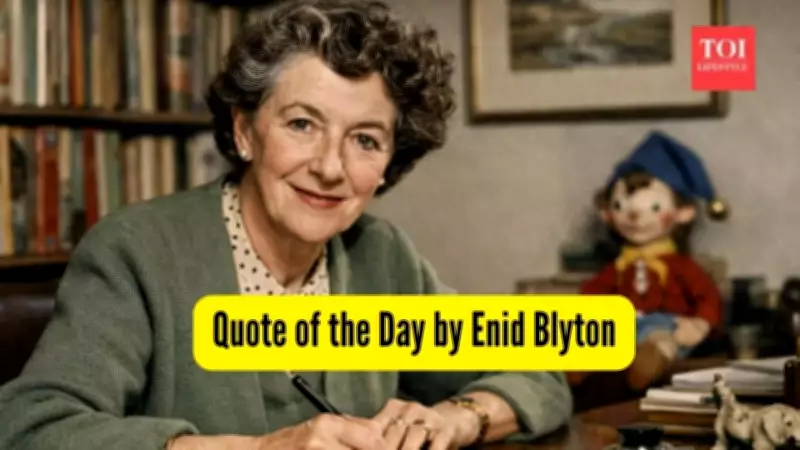
One of her most memorable quotes from The Mystery of the Strange Messages encapsulates her philosophy: “When you're paid to do a job, it's better to give a few minutes more to it, than a few minutes less. That's one of the differences between doing a job honestly and doing it dishonestly!” This simple yet profound work ethic—emphasizing thoroughness over minimal effort—reflects the integrity that fueled her extraordinary career. In a world often seeking shortcuts, Blyton's message champions the lasting value of dedication, quality, and character, principles that continue to resonate with readers seeking both entertainment and moral guidance.