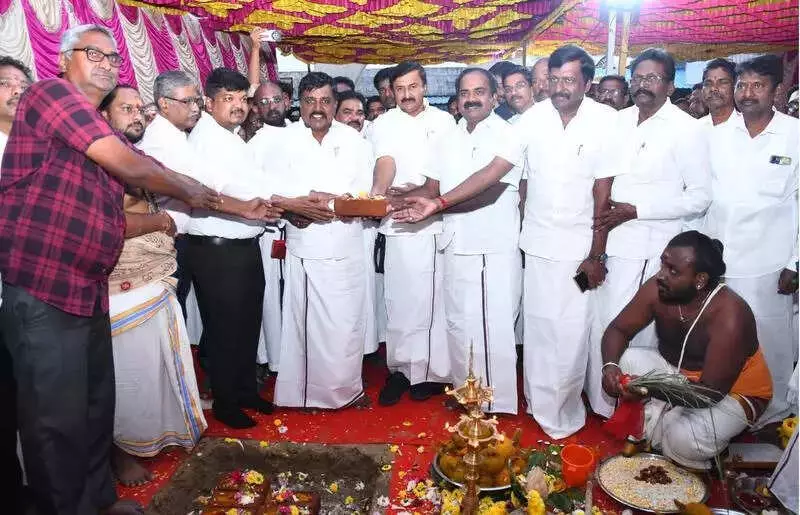
The Tamil Nadu government has initiated the construction of a grand memorial dedicated to the pioneering 17th-century Christian missionary, Bartholomäus Ziegenbalg. The foundation stone for the manimandapam and a bronze statue was laid on Saturday at a site in Erukattancheri, near Poraiyar in Mayiladuthurai district.
Ceremony Marks Start of Ambitious Project
Minister for Tamil Development, Information, and Publicity, M P Saminathan, officially inaugurated the project site. The ceremony was attended by key officials including Mayiladuthurai District Collector H S Srikanth and local MLAs Nivetha M Murugan (Poompuhar), M Panneerselvam (Sirkazhi), and S Rajakumar (Mayiladuthurai). Representatives from the Tamil Evangelical Lutheran Church (TELC) were also present at the event.
The planned structure will span an impressive 9,490 square feet and is estimated to cost Rs 7 crore. The Tamil Development Department will oversee the construction of this significant memorial.

Honoring a Pioneer of Tamil Literature and Printing
Born in June 1683, Bartholomäus Ziegenbalg arrived in the Danish colony of Tranquebar, now known as Tharangambadi, in the year 1706. His contributions to Tamil culture and Christianity in India are profound.
By 1715, Ziegenbalg had accomplished the monumental task of translating and printing the New Testament in the Tamil language, marking the first Bible printed in India. Beyond religious texts, he also produced significant works of Tamil literature. Furthermore, he oversaw the construction of the New Jerusalem Church in Tharangambadi in 1718, a church that remains active to this day.
Controversy Over the Memorial's Location
The decision on where to build the memorial has not been without controversy. The state government had originally announced in June 2024 that the manimandapam would be established in Tharangambadi, the historic town intrinsically linked to Ziegenbalg's life and work.
However, difficulties in acquiring suitable land in Tharangambadi led the district administration to select the alternative site in Poraiyar. The state government formalized this change with an official government order issued on December 17.
This shift sparked immediate protests in Tharangambadi on the same Saturday the foundation was laid elsewhere. Hundreds of fisherfolk, traders, local residents, and activists held a hunger strike, demanding the memorial be built in its historically correct location. Protesters emphasized that Tharangambadi is where Ziegenbalg lived, worked, died, and was buried, arguing it holds the true historical significance for such a tribute.