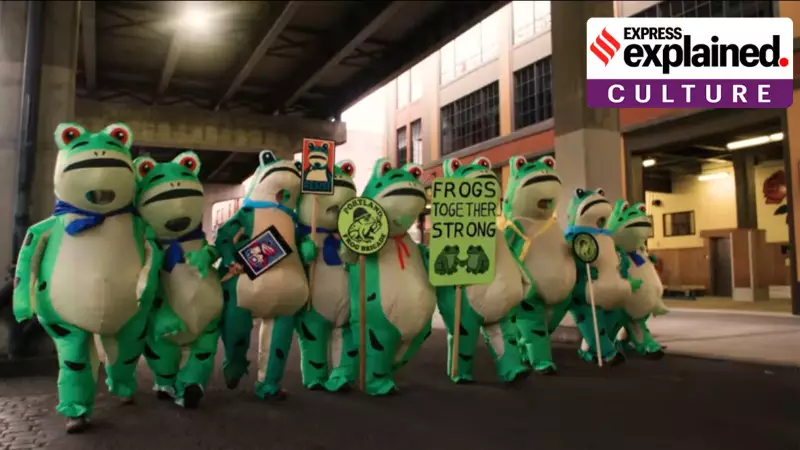
In an unexpected twist of cultural evolution, the humble frog has leaped from fairy tales and children's television onto the front lines of global political resistance. The phenomenon, highlighted by the 2025 Portland protests in the United States and the 2019 Hong Kong demonstrations, showcases a powerful trend: weaponising humour and absurdity to challenge authority.
The Birth of the Portland Frog Brigade
The story begins in Portland, USA, in June 2025. As protests intensified against the US president's decision to deploy the National Guard over anti-immigration policies, a unique figure emerged: a protestor named Seth Todd, known as "Toad" or the "Portland Frog," who attended rallies in a large, green inflatable frog costume.
The situation escalated on October 2, 2025. Federal agents in riot gear pepper-sprayed Todd directly through an air intake vent in his costume. This aggressive act backfired spectacularly, triggering widespread outrage. Instead of quelling dissent, it spawned the self-proclaimed "Portland Frog Brigade." This group saw numerous protestors adopting similar inflatable frog suits. Their movement expanded into "Operation Inflation," encouraging people to wear costumes ranging from chickens and unicorns to Tyrannosaurus rexes, embodying Portland's "Keep It Weird" ethos alongside other creative dissent like naked bike riding and 'craftivism.'

Although the president's order was later blocked by federal courts and protests concluded in October 2025, the frog had cemented its status as a potent anti-administration symbol.
A Long History: From Ancient Symbol to Modern Meme
The frog's journey to protest icon is centuries long. Civilisations from ancient Egypt to Greece and Rome revered it for fertility and vitality. Aesop's fables and the Brothers Grimm's The Frog Prince embedded it in folklore. For over 50 years, Kermit the Frog of The Muppets has been a beloved pop culture staple.
However, the 21st century introduced a more complex amphibian: Pepe the Frog. Created by cartoonist Matt Furie in 2005 as an apirical character, Pepe was hijacked by the alt-right movement around 2015-2016. It was remixed into memes featuring Nazi symbolism and white supremacist imagery, even being reposted by Donald Trump during his 2016 campaign. This era also spawned the Groyper movement, a far-right, racist variant of the frog from online message boards like 4chan.
In a dramatic reclamation, Pepe resurfaced as a symbol of defiance during the 2019 Hong Kong protests, appearing alongside Winnie the Pooh and slogans like "Give me liberty or give me death." This set the stage for the frog's next act in Portland.
The Strategy of 'Tactical Frivolity'
Experts label this use of humour and costume as "tactical frivolity." Performing artist and academic L M Bogad, who authored a book on the subject, explains it as a tactic to make protests accessible, encourage self-expression, and highlight the absurd overreactions of police forces. He traces its roots to carnival protests in the Middle Ages that mocked kings and the church.
In today's context, it serves multiple purposes. Firstly, it provides a measure of safety; inflatable costumes can hinder the effectiveness of tear gas and pepper spray. More importantly, it acts as a cultural countermove. In an era of "aura farming"—where political figures cultivate charisma through aggressive posturing—tactical frivolity deflates that gravity.
"I obviously started a movement of people showing up looking ridiculous, which is the exact point," Seth Todd told The Oregonian. "To show how the narrative that is being pushed [that] we are violent extremists is completely ridiculous."
As journalist Sarah Jeong noted in The Verge, sending in the National Guard is an ultimate exercise in aura farming. The frog costumes, in response, masterfully use ridicule to expose the perceived excesses of power, proving that in the modern protest playbook, laughter can be a revolutionary act.