Frog Weddings: India's Ancient Answer to Drought
For countless generations, small croaking creatures have lived quietly at the edges of ponds and paddy fields. Their voices rise just before the skies open. To meteorologists, these frogs serve as bioindicators. To farmers staring at cracked earth and empty canals, they represent something far more profound.
In villages scattered across India, when the monsoon fails and prayers seem unanswered, hope takes an unusual form. It wears miniature wedding clothes. It receives blessings with turmeric, vermilion, and sacred mantras. And its union is sealed not by humans, but by frogs themselves.
This is the remarkable story of India's frog weddings. These rituals emerge from drought, fear, deep faith, and an intimate relationship with the natural world. From Assam's vibrant Bhekuli Biya to Karnataka's solemn Mandooka Parinaya, these ceremonies show how communities confront climate uncertainty. They use song, powerful symbolism, and collective belief instead of data charts.

What Exactly Is a Frog Wedding?
A frog wedding is a folk ritual where villagers ceremonially "marry" a male and a female frog following Hindu-style wedding customs. People perform this ritual primarily to invoke rainfall during prolonged dry spells, droughts, or delayed monsoons.
Frogs have a strong association with rain because they become most active during the monsoon season. This period is their mating season, when they croak loudly and breed in newly formed water bodies. Villagers hold the belief that marrying frogs encourages joyful croaking. They think it appeases rain deities like Indra or Varuna and invites the essential rain for agriculture.
The ritual does not appear in ancient Hindu scriptures such as the Vedas or Puranas. Instead, it is a folk custom shaped by indigenous tribal beliefs, agrarian anxieties, and local Hindu practices. It reflects a deep emotional bond with nature.
The Origins and Age of This Tradition
Scholars believe the frog wedding ritual originated in Northeast India, particularly in Assam. It later spread to states including Uttar Pradesh, Madhya Pradesh, West Bengal, and Karnataka.
This is a very old oral tradition, passed down through generations rather than recorded in religious texts. Although the Sanskrit word manduka means frog, no frog wedding is mentioned in texts like the Mandukya Upanishad.
Experts suggest the practice is several centuries old, dating back to pre-British times. During that era, monsoon failures posed existential threats to farming communities. Folklore studies from the 1990s document it as part of traditional Assamese culture. Some trace its roots to ancient tribal belief systems of the Northeast.
The ritual continues strongly today. In Assam alone, communities reported frog weddings in 2023, 2024, and 2025 in districts like Kamrup, Biswanath, and Darrang. This demonstrates how age-old customs persist as coping mechanisms amid changing climate patterns.
Regional Variations Across India
The basic steps remain consistent. Villagers catch a male and a female frog. They conduct a wedding ceremony with prayers, mantras, and offerings. They dress the frogs and then release them into water. However, the style, scale, and details vary significantly according to local customs.
Assam's Bhekuli Biya
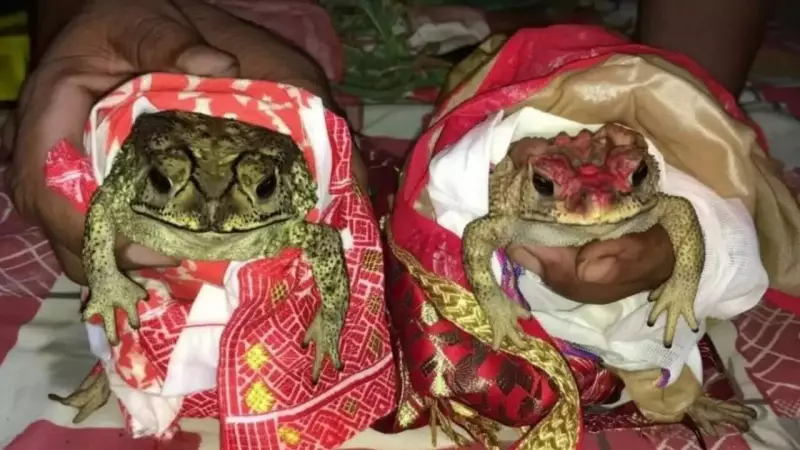
The ceremony in Assam is lively and elaborate, resembling a full Assamese wedding. People clean the frogs with turmeric and mah dal paste. They rub them with oil, bathe them, and dress them in traditional Assamese clothes and jewellery.
They place the frogs on a platform and tie them with a red thread. They apply vermilion to the female frog. A priest performs prayers to rain gods like Varuna. The entire village participates with band parties, drummers, dances, food, and a procession similar to a groom's party. Afterwards, they release the frogs into a pond. If the frogs remain together, villagers believe rain will arrive soon.
Songs sung during Bhekulir Biya form an important genre of Assamese folk literature. These songs have no specific author. They have been passed down orally from generation to generation since time immemorial.

Uttar Pradesh's Version
In regions like Varanasi and Gorakhpur, the ritual follows traditional Vedic Hindu customs. Priests often conduct it in temples such as the Kalibari temple. They chant mantras, apply sindoor, and perform the ceremony seriously. Community groups organize it especially during intense heat or drought.
Karnataka's Mandooka Parinaya
The ceremony in Karnataka is calmer and more prayer-focused. People often name the frogs Varuna and Varsha. They bathe the frogs in turmeric water, dress them in special clothes, and adorn them with symbols like toe rings. The ritual takes place in temples or community spaces decorated with flowers and small pandals. It involves less festivity than the Assamese version.
Madhya Pradesh's Adaptations
In some cases, communities use clay or toy frogs to avoid harming live animals. They offer prayers to Indra. In one notable instance in Bhopal in 2019, people performed a symbolic "frog divorce" after excessive rainfall followed the wedding.
Other Regions
Similar rituals occur in Tripura, influenced by local tribal traditions. People occasionally observe them in Bihar, West Bengal, and rarely in parts of Maharashtra, Rajasthan, or Tamil Nadu. The ritual does not occur everywhere in these states. Villagers usually perform it only in small rural areas when rainfall is scarce and farming suffers.
Faith, Science, and Cultural Heritage
Interpreting traditional rain-invocation rituals like Assam's Bhekulir Biya does not require choosing only one perspective. These practices are layered and meaningful. A balanced understanding can draw from faith, science, and cultural heritage, especially in a world affected by climate change.
From a faith-based perspective, frog weddings are expressions of spiritual belief and connection with divine or natural forces. In agrarian communities, frogs symbolize fertility and rain due to their link with water and monsoons. The ritual is an act of devotion, invoking Hindu gods or local deities. Even today, faith offers comfort during droughts. It reinforces moral harmony and provides hope and resilience.
Scientifically, these rituals do not cause rain, but they align with ecological patterns. Frogs breed and croak in response to humidity and rainfall, acting as bioindicators. Anthropology and psychology show that such communal rituals reduce stress. They strengthen cooperation and help communities cope with drought. In this sense, people can view them as early, observation-based responses to weather variability.
As cultural heritage, frog weddings preserve folklore, music, and community traditions passed down for generations. In Assam, they reinforce identity and continuity. Anthropologists and institutions like UNESCO recognize such rain rituals as intangible cultural heritage. This heritage supports resilience and respect for nature's cycles.
Ultimately, an integrative interpretation works best. Faith provides emotional depth. Science offers explanation. Cultural heritage ensures continuity. In regions like Assam, dismissing these rituals as mere superstition overlooks their role in social cohesion and well-being.
Reports also suggest that rituals like Bhekulir Biya have become more frequent in recent years. Climate change has made rainfall patterns increasingly unpredictable.
Recent Examples Across India
Chhattisgarh's Tribal Ceremony
In August of last year, an unusual wedding took place in a remote village of Chhattisgarh's Surajpur district. The ceremony united not humans, but two frogs. This ritual, steeped in centuries-old tribal belief, aimed to appease the Rain God as monsoon clouds remained elusive.
Villagers adorned the male and female frogs in miniature bridal attire. They solemnized the union with rituals identical to a human marriage. The ceremony included dance, a wedding procession, music, and traditional drum beats.
People from Dhondha and neighbouring hamlets thronged the venue. They danced and sang in celebration. Women performed the main rituals and sang folk songs. Among the Gond and Oraon tribal communities, such ceremonies are rooted in the belief that marrying frogs can invoke the God of rain to bless parched fields.
"When the skies remain dry, we turn to our deities in the ways our ancestors taught us," said village elder Ramesh Kerketta. "The frog wedding is symbolic. It's nature calling to nature to save us from drought and bring rain."
Dozens participated with religious reverence and festive enthusiasm. They later released the frog couple into a nearby pond, symbolizing the union's connection with water.
Karnataka's Response to Delayed Monsoon
In June 2023, residents of Surashettikoppa village in Dharwad district, Karnataka, conducted a frog wedding. The delayed monsoon had dried up water bodies and halted agricultural activity.
To appease the Rain God, villagers organized the wedding of a pair of frogs. This practice is followed in several parts of North Karnataka during monsoon delays or drought-like conditions. In some villages, people also conduct donkey weddings.
The villagers decorated the local Brahmalingeshwara temple with flowers, buntings, and festoons. They performed all customary wedding rituals, including pujas. They married the frog couple inside the temple in the presence of villagers.
"A few years back, we faced a drought-like situation and held a frog wedding. After a few days, we received rainfall," said Kubergowda Nagangowda Murali, a folk artist and villager. "We are supposed to be busy with agricultural activities at this time. But due to the lack of rain, agricultural activities have stopped. So, we decided to perform a frog wedding once again in the hope of rain."
Another villager, Gangangowda Naduvinmani, added, "We sowed maize last week, but there has been no rain. If there are no rains in the next few days, we are likely to face drought. As our elders suggested that we marry a pair of frogs, we did so."
The Frog 'Divorce' in Bhopal
In September 2019, a frog couple married two months earlier to bring rain was symbolically 'divorced' in Bhopal. Incessant rainfall had caused widespread flooding across Madhya Pradesh.
The original frogs, married in mid-July during a dry spell, could not be found. Organizers therefore created two clay frog models and performed the divorce ritual in a temple.
"It is believed that getting a male and female frog married brings rain as Indra Dev sends his blessings," said Rinku Bateja, secretary of the organizing Mandal. "Till mid-July, the state was facing a dry spell and people were suffering. So we decided to perform the 'totka'. Bhopal had rain the very next day."
But the rain did not stop. "Now, the heavy rain has started causing a lot of problems. There is flooding in many parts of the state. So, our priest suggested that we separate the two," Bateja explained.
Unable to locate the frogs, the Mandal used oversized clay models. "We sent the female back to her 'maternal home'. Then we immersed the two clay-frogs in separate vessels filled with rainwater," he said.
Why These Rituals Matter Today
Dr. Dipankar Thakuria, a folklore researcher and environmental activist, emphasizes that people must view frog weddings through twin lenses. These are cultural memory and ecological understanding.
He explains that Bhekulir Biya is a traditional rain-invocation ritual practiced mainly in rural Assam during periods of low or delayed rainfall. It is deeply rooted in agrarian life, where farming depends almost entirely on timely monsoons. The ritual symbolizes a community's collective appeal to rain gods and natural forces for survival.
"Viewing frog weddings only as superstition misses their deeper cultural and social meaning," says Dr. Thakuria. "These rituals evolved from generations of close observation of nature. Frogs are strongly associated with water, humidity, and monsoons. They became natural symbols of rainfall and fertility. The ritual also provides emotional reassurance and strengthens community bonds during times of environmental stress."
He notes the clear ecological connection. Frogs are highly sensitive to moisture and rainfall. Their breeding and croaking increase with rising humidity and the onset of monsoons. Communities noticed these patterns long before modern science explained them. While frogs do not cause rain, their behaviour often signals changing environmental conditions.
Scientifically, these rituals do not influence weather. However, ecology and anthropology show that they reflect early, observation-based responses to climate variability. Communal rituals like these also reduce stress. They encourage cooperation and help people cope with drought. These benefits are very real, even if the ritual itself does not produce rain.
Frog weddings continue to be performed today. In rural Assam, communities hold them especially during severe dry spells. Reports suggest they have become more frequent in recent years as rainfall patterns have grown increasingly unpredictable due to climate change.
The rituals are evolving. In some places, frog weddings have become more symbolic or heritage-focused. Sometimes they attract media attention. However, in many villages, the ritual still carries genuine meaning. People perform it only when rain is urgently needed.
Dr. Thakuria believes these rituals will survive, though in adapted forms. "As long as rural communities remain dependent on rainfall and face climate uncertainty, such rituals will continue to serve as cultural lifelines," he says. "They connect people to nature, shared memory, and collective resilience."
Nature as Observed by Communities
The practice of Bhekulir Biya in Assam reveals how historical agrarian communities understood and engaged with nature and climate.
Villagers demonstrated keen observation of ecological cues. They noticed that frogs croak vigorously during their mating season, coinciding with the monsoon. Folklore reflects this observation. By ritually "marrying" frogs, communities symbolically encouraged this natural signal. This demonstrates ecological wisdom and the use of amphibians as bio-indicators long before modern meteorology.
These communities held an animistic and interdependent worldview. They saw nature as alive and relational. Frogs symbolized water, fertility, and abundance. They acted as intermediaries to rain deities. Dressing frogs in miniature wedding attire and performing ceremonies reflected a belief that human actions could harmonize cosmic forces. People viewed agriculture, weather, and human welfare as interconnected.
The rituals represent cultural adaptation to climate vulnerability. In monsoon-dependent regions, delayed rains caused drought and crop failure. Frog weddings served as a cultural coping mechanism. They offered psychological comfort and reinforced community solidarity through songs, feasts, and collective participation. Symbolic "divorces" during excessive rainfall show adaptability to real-time weather changes.
Ultimately, these rituals combine respect for nature with human dependence on it. Even amid modern climate challenges, frog weddings persist. They preserve cultural memory and teach lessons of resilience and harmony.