The Bhagavad Gita's Timeless Lesson on Mental Clarity
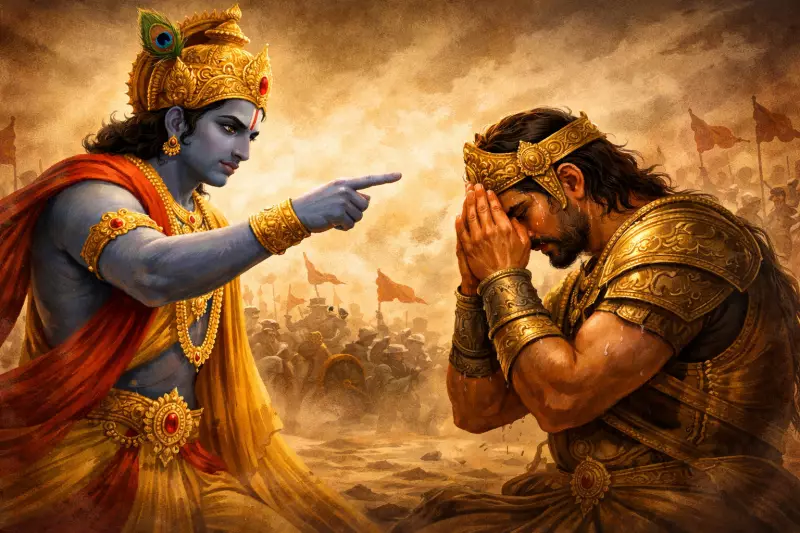
In the sacred dialogue between Krishna and Arjuna, a powerful verse emerges that speaks directly to the human condition. Chapter 2, verse 41 of the Bhagavad Gita presents a profound contrast between two types of minds. Krishna tells Arjuna: "Those who are resolute have a single-pointed intellect. The thoughts of the irresolute are many-branched and endless."
Understanding the Context of This Teaching
This verse appears early in Krishna's teachings, during what is known as Sāṅkhya Yoga. Arjuna stands on the battlefield of Kurukshetra, utterly confused. His mind pulls him in multiple directions simultaneously. Duty clashes with emotion. Responsibility battles fear. Action conflicts with the desire to escape. He cannot decide, he cannot act, and he cannot find stability.
Krishna has already explained the nature of the soul and the temporary nature of worldly circumstances. Now he addresses the root cause of Arjuna's distress: a lack of inner focus. This shloka marks a crucial turning point from emotional turmoil to mental discipline.

The Power of Vyavasāyātmikā Buddhi
The Sanskrit phrase vyavasāyātmikā buddhiḥ holds the key to understanding this teaching. This does not refer to academic intelligence or cleverness. In the Gita's framework, 'buddhi' represents the faculty of discernment. It is that part of our consciousness that determines what truly matters and maintains alignment with it.
Krishna presents two distinct mental states:
- The focused mind knows its direction and moves toward it consistently, without constant distraction
- The scattered mind chases multiple outcomes, opinions, fears, and desires simultaneously
This distinction feels remarkably relevant in our modern world. Most people struggle with focus not because of laziness, but because of excess. We face too many goals, too many comparisons, and too many external voices telling us who to be and what to want. Our minds become noisy, fractured, and perpetually exhausted.
Why Focus Brings Inner Calm
Krishna's teaching reveals an important psychological truth. When our mind runs in numerous directions, it engages in constant negotiation. We doubt ourselves, second-guess our decisions, and experience inner conflict. This creates significant mental friction that manifests as anxiety and stress.
Single-pointedness quiets this internal debate. When your inner compass becomes clear, decisions feel lighter. Your effort becomes cleaner and more effective. Even challenges lose some of their emotional weight because your mind is no longer arguing with itself.
It is crucial to understand that vyavasāya does not mean blind stubbornness or rigid thinking. This clarity emerges from understanding, not from inflexibility. It represents the steadiness that comes from knowing your values and consistently aligning your actions with them.
Applying This Wisdom in Daily Life
The Bhagavad Gita's teaching invites us to adopt simple yet powerful practices:
- Do less, but do it with complete presence
- Choose direction over constant distraction
- Release outcomes that fragment your attention
As focus deepens, steadiness follows naturally. You stop reacting to every external pull. You begin to act from an inner center of clarity and purpose.
Krishna's message carries subtle but immense power. Peace does not come from managing every possibility that life presents. True peace emerges when you commit to one path with full awareness and intention.
In our contemporary world that constantly fragments attention through endless notifications, multiple screens, and competing demands, this ancient verse stands as a vital reminder. Clarity is not something you stumble upon accidentally. It is a conscious choice you make. Once chosen, this clarity becomes the anchor that keeps your mind steady, even when everything around you is in motion.
The Bhagavad Gita continues to offer profound insights for modern living. Its teachings on mental focus and inner discipline remain as relevant today as they were thousands of years ago on the battlefield of Kurukshetra.