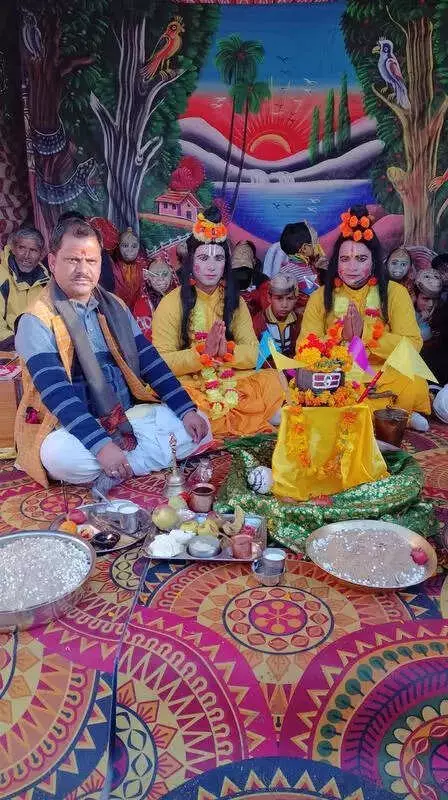
As India celebrated New Year's Day on January 1, the remote village of Gorshali in Uttarkashi district witnessed the grand finale of a different, deeply spiritual celebration. The community marked the culmination of its annual Ramlila, a theatrical enactment of the Ramayana, which is uniquely staged in the heart of winter, defying the nationwide norm of autumn performances.
A Century-Old Tradition With a Royal Twist
This distinctive tradition took root in 1904, when villagers first began staging episodes from the epic. Subhash Nautiyal, president of the Shri Vasuki Nag Devta Temple Restoration and Tourism Committee, recounts that the performances quickly attracted the attention of officials from the then Tehri princely state. Spies reported to the king that a coronation was being performed for Lord Rama, not for the ruler himself. Offended, the king imposed an immediate ban on the Ramlila that very year.
The prohibition was short-lived. Two village elders petitioned the monarch, who agreed to revoke the ban on one crucial condition: the concluding ritual must honour Vasuki Nag Devta, the village's presiding serpent deity. This agreement was formalized through a copper plate inscription, granting official sanction. The practice of crowning Rama before Vasuki Nag's palanquin continued until the end of princely rule roughly 76 years ago. For the past seven decades, the coronation has been symbolically returned to Lord Rama, performed with Vedic chants in the presence of the deity's palanquin.

21 Days of Austerity and Collective Devotion
Today, the Ramlila is a massive collective effort involving more than 300 families. Surat Ram Nautiyal, former vice-chairman of the Char Dham Development Council, explains the rigor involved. "For 21 days, the committee members and actors live a life of austerity, eating only one meal a day and staying within the temple premises," he said.
Dharmendra Singh Rana, president of the Ramlila committee, emphasizes that the event is far more than a play. Alongside daily enactments, the period features continuous recitation of the Ramayana and Hanuman Chalisa, alongside various rituals observed according to ancient customs. Bhagwan Singh Rana, a veteran who has portrayed Lord Rama multiple times, states with pride, "This tradition, which is more than 100 years old, is still followed by everyone. No other place in the entire region stages such a grand and traditional Ramlila."
The Ritual Calendar and This Year's Celebration
The Ramlila season commences shortly after Diwali, in the lunar month of margashirsha, with the hoisting of a ceremonial flag. Each day begins with a mangalacharan (auspicious start), followed by recitation and explanation of Ramayana passages. The afternoons are reserved for the staged performance. The narrative climaxes with Lord Ram's return from exile, when the entire village decorates homes and pathways with flowers to welcome him. The coronation is performed before Vasuki Nag's palanquin, after which the actor portraying Rama blesses villagers for happiness and prosperity.
This year, Gorshali's Ramlila began on December 14 and concluded on January 1. Pawan Nautiyal, a resident, noted that the coronation time of 3 PM on New Year's Day was fixed in consultation with the temple and custodians of Vasuki Nag, following traditional reckonings.
Historical Footnotes and a Golden Reward
Village elders Madan Singh Rana and Abbal Singh share intriguing historical anecdotes. During the princely era, the unique Ramlila caught the interest of a British expatriate, Frederick "Pahari" Wilson. A former army man turned powerful timber trader in Garhwal, Wilson was so impressed after having the troupe perform in Harsil in 1914 that he rewarded the committee with 100 gold coins.
Thus, Gorshali's winter Ramlila stands not just as a religious observance, but as a resilient cultural institution. It has weathered royal bans, adapted to conditions, and continues to thrive through the unwavering devotion and collective spirit of an entire village, preserving a unique slice of Uttarakhand's heritage for future generations.