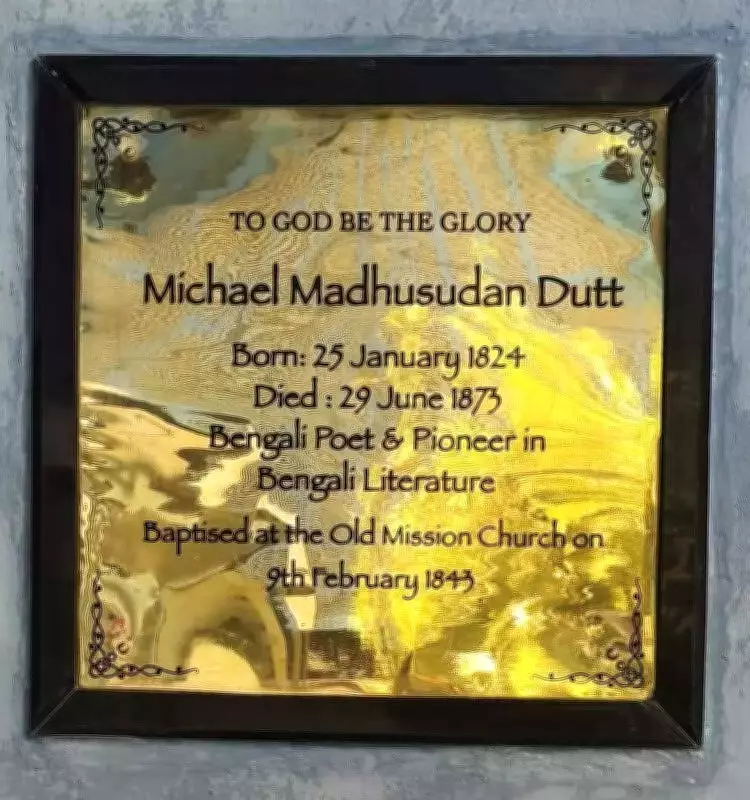
Kolkata's Old Mission Church Revives History with Plaque for Michael Madhusudan Dutt's Baptism
In a poignant ceremony that bridged centuries, the Old Mission Church on RN Mukherjee Road near Dalhousie in Kolkata unveiled a commemorative plaque marking the baptism of the legendary poet and playwright Michael Madhusudan Dutt in 1843. This event has turned a renewed spotlight on the church's layered and enduring legacy within the heart of the city.
A Tribute to a Literary Giant and a Historic Witness
The plaque specifically honors February 9, 1843, the day the young Bengali literary icon was baptized. Ajit Sikder, a devoted member of the church congregation, shared his reflections on the significance of this moment. "For many of us, this is not merely a tribute to a literary giant but a powerful reminder that this quiet building near Dalhousie has been a silent witness to some of the most dramatic chapters in Kolkata's history—from deeply personal stories to sweeping political movements and devastating natural events," he stated.
On most days, the church's grandeur is somewhat concealed behind parked vehicles and bustling hawkers, blending into the urban fabric. However, stepping beyond its gates reveals a long corridor leading into a serene sanctuary that feels remarkably untouched by the relentless hustle and bustle of the surrounding central business district.

The Founding and Evolution of Bengal's Oldest Protestant Church
Founded in 1770 by the Swedish missionary John Zechariah Kiernander, the Old Mission Church holds the distinction of being the oldest Protestant church in Bengal. Kiernander was invited to Kolkata by Robert Clive during a period when the British, while consolidating their power in the region, lacked a dedicated church of their own.
His journey began with a modest chapel and school near the old Fort William before he acquired land to construct a more substantial church. The foundation stone was laid in May 1767, and the building was formally dedicated "on the 4th Sunday in Advent in 1770." Over the ensuing decades, the church grew in tandem with the city itself, standing as a resilient witness to monumental global and local events.
- It endured through two World Wars.
- It survived at least two major pandemics.
- It observed the intense struggles of India's independence movement.
It was within these historic walls that a young Michael Madhusudan Dutt, a student profoundly influenced by English literature, chose to be baptized, marking a pivotal personal and cultural moment.
Resilience Through Natural Disasters and Time
The church's endurance is not merely symbolic; it has physically withstood numerous natural calamities. It survived the catastrophic Great Cyclone of 1864, which obliterated the Khejuri and Hijli ports and flooded large parts of western Calcutta. When the powerful Assam earthquake struck in 1897, only one of its spires was damaged, which was later demolished as a precautionary measure. More recently, during Cyclone Amphan, some of the church's walls sustained damage, yet the structure remained fundamentally intact.
"The church has seen everything Kolkata has endured," emphasized Sikder. "From the colonial era to Independence, from natural disasters to world wars. And yet, it stands quietly, steadfast. Unveiling this plaque felt like we were restoring one more vital chapter of the city's intricate story right back to the very place where it originally unfolded."
This plaque unveiling serves as a powerful act of historical reclamation, ensuring that the legacy of both a literary pioneer and a venerable architectural landmark continues to inspire and educate future generations about Kolkata's rich and multifaceted heritage.