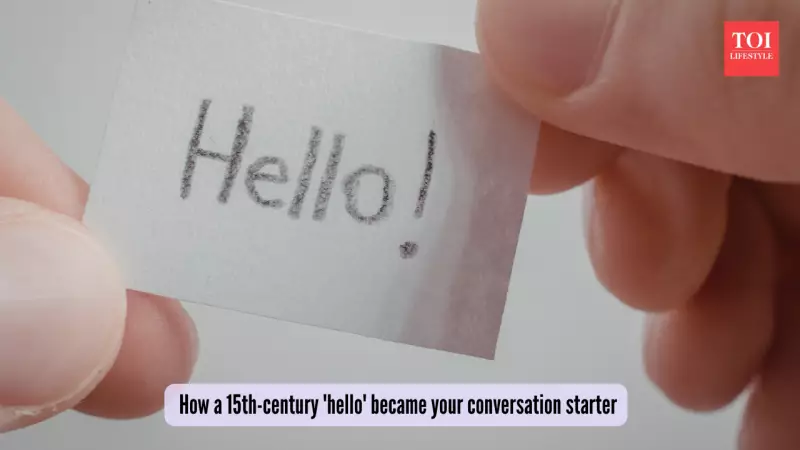
"Hello" connects people across the globe. This simple word weaves strangers, friends, and even foes into a brief, shared moment. It starts phone calls, emails, and chance meetings. Often, we don't notice how it carries curiosity, warmth, or urgency.
Hello in Culture and Daily Life
You hear "hello" everywhere. Adele sings it soulfully. Hollywood films feature iconic lines like "You had me at hello." The word pops up in advertisements, mobile apps, and everyday chit-chat. Its constant presence proves its staying power in our hyper-connected world.
The First Printed Hello
"Hello" made its newspaper debut on January 18, 1826. The Norwich Courier in Connecticut, USA, featured the word. Initially just a greeting, it soon began its conquest of global communication. By the 1850s, "hello" crossed the Atlantic to Britain. Publications like the London Literary Gazette used it, gaining traction amid spelling debates.

Ancient Roots of the Greeting
The word's roots trace back to the 15th century. Old High German had "halâ," used to address ferrymen. French used "holà," meaning "stop." English had "hollo" or "halloo" as hunters' calls. Dialect influences created variants like "hullo," "hillo," and "holla." Regional accents caused changes too, such as h-dropping in "ello."
Thomas Edison Seals the Deal
Thomas Edison strongly advocated for using "hello" on telephones. He favored its clarity over Alexander Graham Bell's suggested "ahoy." Charles Dickens preferred "hullo," but by 1884, the Oxford English Dictionary listed "hello" as the preferred form. Lexicographers chose the prevalent spelling, standardizing it amid fluid early usage.
Hello Adapts Globally
Global dialects shaped "hello" to fit local needs. Romance languages offer melodic versions like Spanish "hola" or Portuguese "olá." Germanic languages use crisp "hallo." Greek "Γειά σου" wishes health, while Hawaiian "aloha" conveys affection. Interestingly, many languages also use it for goodbyes, like Italian "ciao," which originated from servitude pledges.
The Digital Evolution of Hello
In texts and apps, "hello" often shortens to "hi." People elongate it for style, typing "heyyy," or replace it with emojis. Technology accelerates linguistic change, giving rise to new terms like "Google." This mirrors the 19th-century spelling flux. Yet, "hello" persists, remaining a vital part of our communication today.