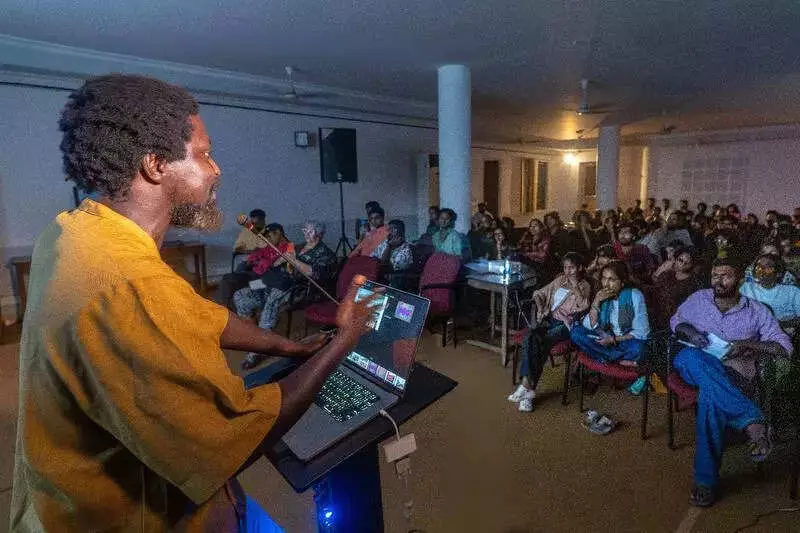
Renowned Ghanaian artist Ibrahim Mahama has highlighted the profound potential of discarded materials—from abandoned railway infrastructure to rotting jute sacks—to serve as powerful inputs for creative works. He shared these insights during a special 'Let's Talk' session at RLV College of Music & Fine Arts in suburban Tripunithura, Kochi, ahead of the upcoming Kochi-Muziris Biennale where his own artwork is nearing completion.
From Colonial Extraction to Community Reclamation
Mahama, 38, explained how imaginative minds can convert industrial and colonial junk into thought-provoking installations. These works tackle impactful global subjects such as unfair trade, colonial exploitation, forced labour, and migration. He cited his own critically acclaimed projects in Tamale, in Ghana's northern region, where he transformed decommissioned rail coaches into educational spaces on his studio campus.
Each installation underlines a powerful narrative: colonial-era infrastructure, originally built for resource extraction, can be reclaimed by local communities for memory, learning, and empowerment. His art seeks to expose histories of injustice, including labour exploitation and the damaging economic legacy of extractive industries that still burden African nations.

Art as a Tool for Social Critique and Healing
In his dialogue with students, Mahama explored how installations can embody politics, memory, and identity. He positions art not merely as aesthetic expression but as a potent instrument for social critique and transformation. His practice focuses on converting narratives of exploitation into stories of resilience, healing, and raised collective consciousness.
The session was followed by a lively question-and-answer round, fostering deep engagement between the artist and the young audience. Mario D'Souza, Director of Programmes at the Kochi Biennale Foundation, noted that Mahama's approach makes art a fundamental process of collective learning. "His commitment to workshops, open conversations, and experimental education reminds us that creativity and socio-political awareness grow when people build knowledge together," D'Souza said.
Setting the Stage for the Biennale
The lecture effectively sets the conceptual stage for Mahama's upcoming contribution to the Kochi-Muziris Biennale, one of India's most significant contemporary art events. His work, often large-scale and crafted from found materials, is known for its direct commentary on global economic systems and historical wounds. By using scrap that carries the weight of its own history, Mahama creates a tangible link between Kochi's past as a historic port and the broader themes of colonial trade and its aftermath.
This engagement in Tripunithura underscores the Biennale's commitment to fostering meaningful discourse around art that challenges viewers to reconsider the objects and histories that surround them.