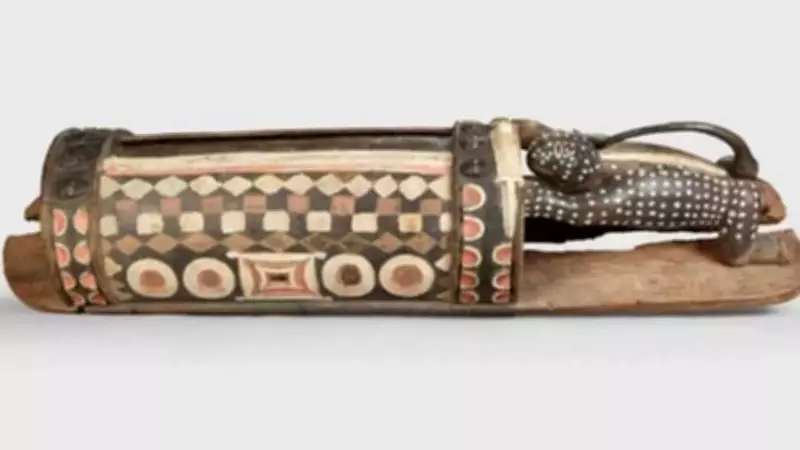
Sacred Ivory Coast Talking Drum Returns Home After a Century in France
A revered talking drum, once a vital communication tool for communities in Ivory Coast, has made a historic return to its homeland more than a century after it was confiscated during French colonial rule. Known as the Djidji Ayokwe, this massive wooden instrument was taken by French authorities in 1916 and later transported to France, where it spent decades in museum collections. Its recent repatriation signifies a profound moment for cultural restitution and historical justice, resonating deeply with the Ebrie people for whom the drum is not merely an artifact but a living symbol of identity, tradition, and authority.
The Journey Back: From Paris to Abidjan
The Djidji Ayokwe was officially returned to Ivory Coast following the French parliament's approval of a special law that permitted its removal from France's national collections. Previously displayed in Paris at institutions like the former Trocadero Museum and the Musee du Quai Branly, the drum arrived in Abidjan aboard a specially chartered plane. At Félix Houphouet-Boigny International Airport, it was greeted with jubilation by traditional dancers, local chiefs, and cultural officials, carefully transported in a large wooden crate marked "fragile" to ensure its protection.
Ivory Coast's Culture Minister, Françoise Remarck, expressed the emotional and historical weight of the occasion. "This is a historic day with a lot of emotions," she stated. "We are living through a moment of justice and remembrance that finally marks the return of the Djidji Ayokwe to its land of origin."

What Is the Djidji Ayokwe Talking Drum?
The Djidji Ayokwe, often translated as "Panther Lion," is an enormous wooden talking drum measuring over three meters in length and weighing approximately 430 kilograms. Carved from durable iroko wood, a staple in West African craftsmanship, this instrument was uniquely designed for long-distance communication. Unlike smaller talking drums used in music, its powerful sound could traverse vast landscapes, enabling messages to reach multiple villages across forests and lagoons.
Belonging to the Ebrie people, an ethnic group historically centered around what is now Abidjan, Ivory Coast's largest city, the drum held sacred status and was intricately linked to leadership and community authority.
Why It Is Called a Talking Drum
The term "talking drum" derives from the instrument's ability to mimic the rhythm and tonal patterns of human speech. Many West African languages are tonal, where pitch and rhythm alter word meanings. Skilled drummers mastered reproducing these patterns through controlled beats, adjusting rhythm, tempo, and pitch to transmit recognizable phrases and signals. This functioned as an early communication system, with specific rhythmic patterns announcing gatherings, relaying important messages, warning of dangers, or summoning people for ceremonies and emergencies.
Symbolism and Authority of the Drum
Beyond its practical utility, the Djidji Ayokwe carried deep symbolic significance, representing authority within the Ebrie community. It was closely associated with traditional leadership, used by designated drummers to communicate on behalf of chiefs and elders. As a sacred object, it was not treated as ordinary musical equipment but as a cultural emblem tied to identity and governance, symbolizing unity and organization.
Colonial Seizure and Broader Restitution Movement
The drum's removal in 1916 occurred during French colonial administration, with authorities reportedly confiscating it due to fears over its capacity to mobilize communities and spread messages rapidly. Transported to France in 1929, it became part of museum collections documenting African cultures during the colonial era, remaining distant from its creators for decades.

This return is part of a wider international movement advocating for the restitution of cultural artifacts taken during colonial rule. In recent years, France has initiated returns of several significant items to African nations, a process accelerated after French President Emmanuel Macron's 2017 announcement supporting the repatriation of African heritage. Ivory Coast has requested the return of over a hundred cultural objects from European museums, with the Djidji Ayokwe being the first to be repatriated. Similar returns have occurred elsewhere, such as France returning royal treasures to Benin and a historic sabre to Senegal.
A New Home and Cultural Revival
Following its return, the Djidji Ayokwe will be exhibited at the Museum of Civilizations in Abidjan. According to museum director Francis Tagro, the instrument will occupy a central position in the galleries, allowing visitors to appreciate its cultural importance. "We are deeply happy and proud to receive this sacred drum," Tagro remarked. "It means so much to us, and it will elevate the sense of culture of the younger generation."
For many Ivorians, this repatriation transcends the recovery of a historical artifact; it restores a symbol of collective memory and reconnects a community with a vital piece of its cultural heritage, absent for more than a century.