Jaipur Art Week 5.0 Unveils Multidisciplinary Art Exploring Boundaries and Rituals
When Sawai Madho Singh II, the former ruler of Jaipur, embarked on an ocean voyage in 1902 to attend King Edward VII's coronation in England, it sparked significant controversy. At that time, crossing the kala pani (black waters) was considered a sin, believed to pollute the soul and result in loss of caste. To circumvent this, the Maharaja carried thousands of litres of Ganga jal (water from the Ganges) on his ship to London, performing elaborate rituals for protection.
Historical Inspiration Meets Contemporary Reflection
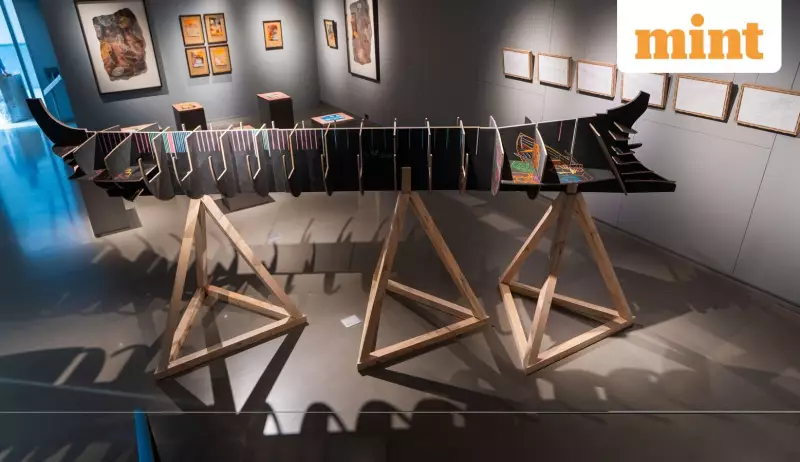
This fascinating historical anecdote serves as the springboard for multidisciplinary artist Boris Colin Alphonse's installation, What We Carry When We Cross, featured at the upcoming Jaipur Art Week: Edition 5.0 (JAW 5.0). Alphonse's speculative artwork, displayed at the Gyan Museum, presents a fragmented ship hull accompanied by diagrammatic instructions.
"The work invites viewers to imagine their own contemporary kala pani: the boundaries they fear crossing, the rituals they invent for protection, and the materials—visible or invisible—that they would choose to carry. The ship becomes less a vehicle of travel than a tool for reflection," explains the artist.

Diverse Artistic Expressions Across Jaipur
Alphonse is among 15 artists presenting solo exhibitions at this edition of JAW. Beyond these individual showcases, the works of more than 100 artists will be featured in group and digital exhibitions across multiple venues in the pink city. Organized by the Public Arts Trust of India (PATI), the event functions as an incubator for early and mid-career artists, encouraging bold experimentation.
The 2026 edition received over 450 submissions through an international open call, with final selections made by a distinguished jury including gallerist Renu Modi, artist duo John Wood and Paul Harrison, curator Aindrea Emelife, and Sana Rezwan, founding chairwoman of PATI.
"What struck me was the sheer variety, use of materials and ideas that were submitted as well as the current issues they addressed such as gender, migration, memory and ecology," says Modi. "They are mixing craft and technology in a very contemporary and innovative way."
Notable Installations and Artistic Innovations
Modi expresses particular excitement about participating artist Poojan Gupta's work, A Sacred Walk, installed at Jaipur's Central Park. Drawing inspiration from temple architectural layouts, Gupta has stitched together nearly 51,000 discarded pharmaceutical blister packs to create a corridor of light, with perforations producing a jaali-like effect.
"For the artist, each empty pocket marks a moment in time, a temporal journey towards someone's personal healing," notes Modi. "I see this work as a reminder that the sacred and the everyday coexist, and can shift our perspective about looking at an empty blister pack beyond just waste."
Mentorship and Artistic Development
To refine their concepts, artists participated in a mentorship programme guided by senior practitioners including Gigi Scaria, Thukral & Tagra, and Vibha Galhotra. Scaria, who has been casting sculptures in Jaipur for years, helped artists select appropriate sites for their works. He also presents his own bronze and white metal sculpture, Ascend towards the unknown, in this edition.
"The mentorship programme is definitely a unique idea for a public art project. The ideas go through an interesting filtration through the process. It is beneficial for everyone involved," he observes.
Nature-Based Art and Environmental Consciousness
Nature-based artist and bio-designer Kaanchi Chopra significantly benefited from mentorship by Thukral & Tagra. "They encouraged me to think more ambitiously about scale. Their guidance pushed me to expand the work spatially, resulting in an eight-feet-tall, 9.5-foot-diameter circular steel structure that houses eight floral panels mapping the region's flora," says Chopra. "This shift allowed the work to move from an intimate archive to an immersive installation."

Chopra's artwork, The Earth Laughs in Flowers, draws from her ethnobotanical knowledge of the Aravali range. The installation incorporates foraged and preserved native flora including:
- Bandar ki Roti
- Kachnar
- Kaner
- Khair
- Khejri
- Neem
- Palash
- Peepal
- Shahtoot
"Functioning as a living botanical archive, the installation reflects the biodiversity of the Aravalis at a moment of increasing erasure, insisting on attention to what remains rooted, what is being lost, and what still longs to be protected," explains Chopra.
Addressing Climate and Memory Through Art
Also exploring landscape and notions of loss is Aditi Aggarwal's sculptural-digital installation, As We Rise: The Last Pillar of the Fort. This work reflects on climate, memory, and the gradual collapse of inherited worlds through photomontage panels and projections that create a suspended landscape oscillating between decay and regeneration.
With their innovative ideas and unconventional materials, the multidisciplinary artists at Jaipur Art Week 5.0 are clearly pushing artistic boundaries. More importantly, they are bringing urgent contemporary issues to public attention through immersive and interactive experiences that engage viewers on multiple levels.
The Jaipur Art Week runs from 27 January to 3 February, offering art enthusiasts a unique opportunity to experience cutting-edge contemporary art in one of India's most culturally rich cities.