Kanpur's Holi Ganga Mela: A Week-Long Cultural Tribute to Freedom Struggle
In the vibrant city of Kanpur, Holi transforms into an extended week-long cultural celebration, reaching its peak with the historic Holi Ganga Mela. This unique event masterfully intertwines festive joy with poignant memories of India's freedom movement and the city's deep-rooted social traditions.
Historical Origins: Defiance Against Colonial Rule
The origins of the Holi Ganga Mela trace back to the pivotal year of 1942, during British colonial rule. Authorities imposed strict restrictions on public gatherings and celebrations, aiming to suppress nationalist sentiments. In a bold act of defiance, patriotic youths of Kanpur hoisted the Indian tricolour flag at Rajjan Babu Park the day after Holi, challenging British embargoes.
According to preserved family accounts, including those of Mool Chandra Seth, whose father actively participated, British officers attempted to remove the flag, sparking intense clashes between citizens and colonial police. This confrontation led to the arrest of approximately 45 individuals, notable names including Gulab Chandra Seth, Raghubar Dayal Bhatt, Bal Kishan Sharma, Kanhaiya Lal Gupta, Amrik Singh, Pt Munshi Ram Som, Shyam Lal Gupta, Budho Lal Mehrotra, and Hamid Khan.

Widespread Protests and National Support
The arrests ignited massive public outrage across Kanpur. Markets shut down in solidarity, mill workers initiated strikes, and transport services ground to a complete halt. Residents from Hatia locality and various other city neighborhoods joined forceful demonstrations against British authority.
This movement rapidly gained national attention, receiving vocal support from eminent leaders like Mahatma Gandhi and Jawaharlal Nehru. The escalating scale of protests compelled British officials to enter negotiations with Indian leaders. A crucial meeting at Rajjan Babu Park resulted in the unconditional release of all detainees. Significantly, their release coincided with the auspicious Anuradha Nakshatra, a celestial alignment that now marks the annual observance.
Birth of a Lasting Tradition
As the protesters were freed, citizens welcomed them with faces smeared in vibrant Holi colors, reigniting the festive spirit. The jubilant crowd then proceeded to Sarsaiya Ghat on the banks of the sacred Ganga River, where they performed ritual baths. This spontaneous celebration established a tradition that has endured for decades, observed about a week after Holi under the Anuradha Nakshatra. This year, the Holi Ganga Mela is scheduled for Tuesday, March 10.
The Vibrant 'Rango Ka Thela' Procession
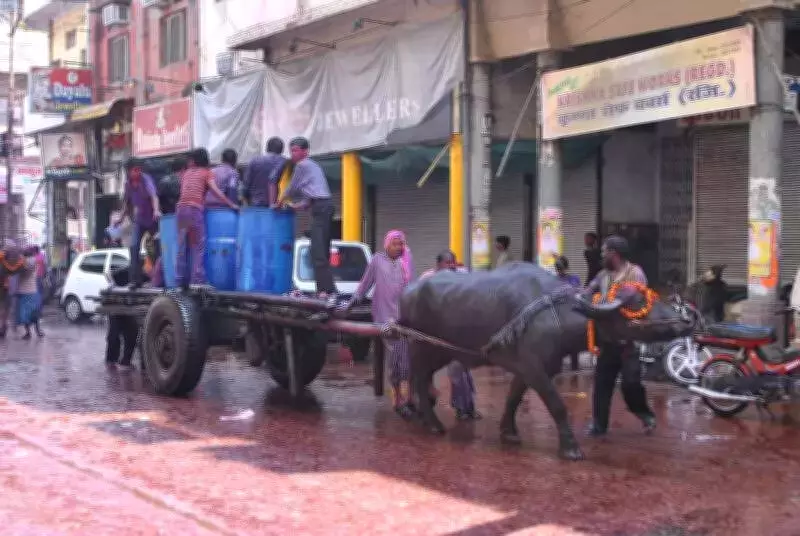
A distinctive highlight of the mela is the 'Rango Ka Thela' procession, a colorful parade featuring drums filled with colored water. Historically, this procession traveled 11 kilometers through the city on a traditional buffalo cart, traversing several old localities before returning to the park. While modern vehicles have since joined the caravan, tradition is meticulously preserved by ensuring at least one buffalo cart remains part of the vibrant procession.
Evening Festivities and Commercial Roots
In the evening, citizens gather at Sarsaiya Ghat for the grand Holi Mela, where traders, political leaders, social figures, and district administration officials unite in celebration. The mela also reflects Kanpur's commercial heritage. During British rule, the city emerged as a major trading hub for North, Central, and Eastern India. Many market workers and laborers returned to their native villages only annually. To accommodate travel and celebration, markets typically remained closed for up to five days during Holi.
Regional Variations and Local Lore
Approximately 18 villages along the Ganga, including Wajidpur, Pyondi, Sheikhpur, and Ahirwan, observe Holi not on the main day but on Rang Panchami, the fifth day following. Local folklore recounts that during the British era, heavy taxes imposed on villagers provoked strong opposition led by local zamindars. After several villagers were arrested, the community boycotted Holi celebrations in protest. Their release on the fifth day prompted joyous festivities, cementing a tradition that persists to this day.

The Holi Ganga Mela stands as a powerful testament to Kanpur's resilience, blending cultural festivity with historical reverence, ensuring the legacy of freedom fighters is celebrated with every splash of color.