Kolkata's 'Boi Tirtha' Book Sanctuary: Detailed Project Plan Submitted to State Government
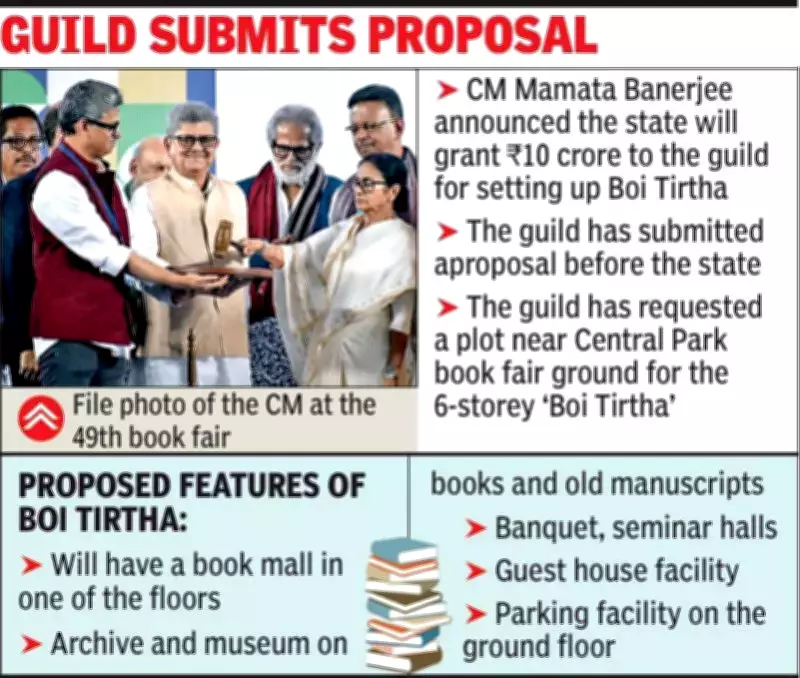
The Publishers and Booksellers Guild, organizers of the International Kolkata Book Fair (IKBF), has formally submitted a comprehensive project plan to the West Bengal government for developing a 'Boi Tirtha' (Book Pilgrimage) complex in the city. This significant development follows Chief Minister Mamata Banerjee's announcement at the recently concluded 49th International Kolkata Book Fair of providing a substantial Rs 10 crore grant for this ambitious cultural initiative.
Architectural Vision and Strategic Location
According to the detailed proposal, the 'Boi Tirtha' would be constructed as a six-storey architectural marvel, preferably situated near the Salt Lake Central Park book fair ground. The Guild has specifically requested the government to allocate the nearest available location to this iconic venue, emphasizing the importance of accessibility and symbolic connection to Kolkata's literary heritage.
The building structure would be developed through a unique public-private partnership model, with the state government providing the initial framework and funding, while private entities would contribute to further development and operational aspects.

Multi-Functional Literary Complex Design
The project plan outlines a meticulously designed facility with multiple dedicated spaces:
- Ground Floor Parking: Ample parking facilities to accommodate visitors and dignitaries
- Book Mall: A comprehensive retail space featuring books from national and international authors, including bestsellers and rare publications
- Archive and Museum: A dedicated space showcasing ancient manuscripts, rare books, and a chronological timeline documenting the evolution of written materials through the ages
- Auditoriums and Seminar Halls: State-of-the-art venues for literary festivals, author interactions, and cultural events
- Banquet Facilities: Spaces for literary gatherings, book launches, and cultural celebrations
- Guest Accommodation: Dedicated floors providing lodging facilities for foreign dignitaries, authors, and cultural delegates attending literary events in Kolkata
Historical Context and Political Backing
The 'Boi Tirtha' concept originated during the inaugural program of the 49th International Kolkata Book Fair when Guild General Secretary Tridib Chatterjee appealed to Chief Minister Mamata Banerjee to develop a book sanctuary modeled after cultural landmarks like Jagannath Dham and Durga Angan. The Chief Minister immediately accepted the proposal and directed guild authorities to submit an official letter detailing their vision.
"We have placed a detailed project plan to the state government," confirmed Tridib Chatterjee. "We have requested the government to provide us with the nearest location to the Central Park book fair ground, and a rough building structure of 'Boi Tirtha' which could be further developed through private partnership."
The Chief Minister specifically stated that the state information and culture department would allocate Rs 10 crore to the guild for this purpose, demonstrating significant political commitment to Kolkata's literary and cultural development.
Cultural Significance and Future Impact
This initiative represents a landmark development in Kolkata's cultural landscape, often referred to as India's literary capital. The 'Boi Tirtha' complex aims to serve as a permanent hub for book lovers, researchers, authors, and cultural enthusiasts, providing year-round access to literary resources and events beyond the annual book fair.
The project aligns with Kolkata's historical identity as a center of intellectual and literary activity, while introducing modern facilities and international standards of cultural infrastructure. By combining archival preservation with contemporary retail and event spaces, the complex seeks to bridge historical literary traditions with modern publishing and cultural exchange.

Guild officials emphasize that the 'Boi Tirtha' will not only preserve Kolkata's rich literary heritage but also position the city as a global destination for literary tourism and cultural exchange, potentially attracting international authors, publishers, and literary scholars to West Bengal.