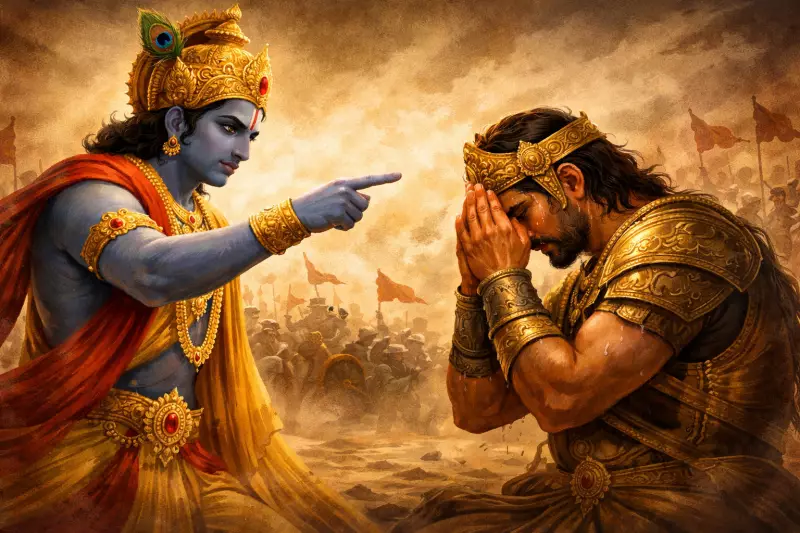
In the second chapter of the Bhagavad Gita, a powerful moment unfolds on the battlefield of Kurukshetra. Arjuna stands paralyzed by fear and moral confusion. He faces teachers, relatives, and friends across the field. His hands tremble. His mouth dries up. He tells Krishna he cannot fight.
The Turning Point in Verse 2.2
Chapter one ends with Arjuna giving up. Chapter two begins with Krishna breaking that mental paralysis. Verse 2.2 contains Krishna's first strong words to his friend. There is no soft reassurance here. Krishna confronts Arjuna's state of mind directly.
He questions where this weakness has come from. He asks why it has appeared at such a critical moment. Krishna challenges why this state is unworthy of the warrior Arjuna knows himself to be. This verse marks the shift from emotional collapse to spiritual awakening.

Understanding Krishna's Message
Krishna essentially asks Arjuna a piercing question. "Where has this weakness come from, at a time when clarity is needed most?" The word kaśmalam holds deep meaning. It describes mental confusion mixed with emotional collapse.
This is not true compassion. It is not wisdom. Rather, it represents a fog created by fear and attachment. Krishna tells Arjuna that what feels like morality is actually panic wearing the mask of virtue. Fear disguises itself cleverly in many forms.
- It pretends to be realistic thinking
- It masquerades as cautious behavior
- It appears as kindness toward others
- It shows up as false humility
But underneath all these disguises, it remains pure fear. Krishna calls this state anārya-juṣṭam. This means it is not the path of a noble mind. He is not insulting Arjuna. Instead, he reminds him of who he really is beneath the fear.
The Cost of Inner Dishonor
Krishna delivers another powerful line. He uses the word akīrti-karam, meaning something that leads to inner dishonor. Krishna points out a crucial truth. When you betray your deeper self because of fear, the real pain comes later as regret.
Doubt makes even strong people forget their own nature. Fear does not usually appear when nothing is at stake. It emerges when something meaningful hangs in the balance. Arjuna is not afraid because he is weak. He is afraid because the moment truly matters.
How This Verse Helps Overcome Modern Fear
This ancient verse reframes fear as misplaced identification. On the battlefield, Arjuna has started identifying with his emotions rather than his true self. He focuses on his attachments instead of his duty. He dwells on imagined futures rather than present strength.
When doubt takes over, the mind shrinks. It concentrates only on what might be lost. Krishna expands Arjuna's awareness again. He pulls him out of emotional short-term thinking. He guides him back to his larger purpose.
In everyday life, fear and doubt work the same way. You hesitate to speak because you might face judgment. You delay important decisions because you might fail. You remain stuck in situations because you might be wrong.
Krishna's teaching here is both simple and fierce. Do not confuse fear with wisdom. Not every pause represents true insight. Not every doubt contains hidden truth. Sometimes doubt is just fear trying to stay comfortable.
Why This Verse Remains Powerful Today
Modern life creates constant low-grade anxiety. People face floods of choices, comparisons, and expectations. The mind becomes overprotective. It starts avoiding risk, discomfort, and uncertainty. That is exactly the mental state Arjuna experiences on Kurukshetra.
Krishna's question still cuts through centuries of time. "Where has this weakness come from?" The Gita teaches that courage is not the absence of fear. True courage means refusing to let fear decide who you become.
Arjuna's transformation begins at this precise moment. He stops identifying with his panic. He starts listening to a deeper voice within. This shloka reminds us that fear itself is not the enemy. Blindly obeying fear creates the real problem.
When doubt clouds your mind, remembering who you are becomes the first step back to strength. The battlefield of Kurukshetra exists within every person facing difficult choices. Krishna's words continue to guide seekers toward clarity and purpose.