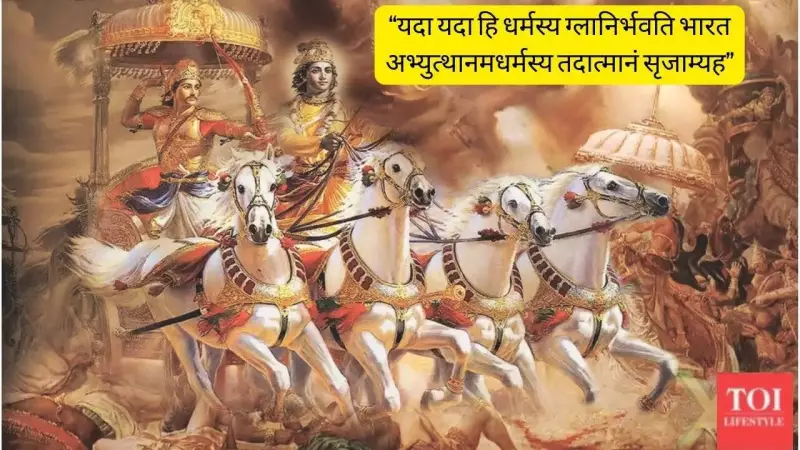
In the epic Mahabharata, a profound moment of crisis on the battlefield of Kurukshetra gave birth to timeless wisdom. The warrior Arjuna, overwhelmed with grief and moral confusion at the prospect of fighting his own kinsmen, laid down his arms. It was then that his charioteer, Lord Krishna, imparted the teachings of the Bhagavad Gita, anchoring them with a powerful, eternal truth.
The Eternal Promise in a Timeless Verse
To guide the despondent Arjuna, Krishna recited the now-immortal Sanskrit shloka: "Yadā yadā hi dharmasya glānir bhavati Bhārata, abhyutthānam adharmasya tadātmānaṁ sṛjāmy aham." This translates to: "Whenever there is a decline of righteousness (Dharma) and a rise of unrighteousness (Adharma), O Arjuna, I manifest Myself." Krishna clarified that this was not a mere prophecy but a fundamental law of the inner universe—a blueprint for how consciousness evolves through chaos.
Five Profound Life Lessons for the Modern Seeker
This single verse is a reservoir of psychological and spiritual insight, offering actionable guidance for anyone facing inner or outer turmoil.

1. You Are Built for Self-Recovery
Dharma here signifies not just righteousness, but also truth, alignment, and inner order. The verse reveals that we are inherently wired for healing. Whenever we fall away from our authentic self due to fear, injustice, or negativity, an innate force automatically activates to restore balance, much like the body healing a wound. This means our soul perpetually nudges us back toward our core truth.
2. Inner Darkness Signals Transformation
A rise in internal chaos or confusion is not a punishment but a divine signal. Krishna did not ask Arjuna to suppress his turbulent emotions; he urged him to face them. The peak of chaos is often the precise moment where awakening begins. Therefore, personal storms should be viewed as invitations for deep soul-level transformation and growth.
3. Help Arrives When You Truly Need It
The heart of the verse—"I manifest Myself"—holds a profound promise. Divine assistance doesn't always arrive in a physical form. It can appear as a timely insight, a supportive guru, sudden clarity, a surge of courage, or an inner voice of truth. When you feel you have reached your limit and cannot continue, that is often the moment the universe orchestrates a rescue, aligning help with perfect timing.
4. Your Inner Warrior is Stronger Than Your Fear
Arjuna's real battle was internal—a conflict of duty, emotion, and morality. When he wanted to flee, Krishna reminded him of a crucial truth: When external circumstances seem impossible, your higher self can take command. A latent warrior exists within everyone, awakening precisely when you must stand and fight for your Dharma.
5. Truth is Indestructible; It Can Only Be Forgotten
Krishna assured Arjuna that while Dharma may decline, it can never be destroyed. It remains eternal and unchanging. Your essential truth is immortal. If you forget who you are, life will send reminders—through challenges, teachings, or intuition—until you reconnect with your divine essence.
The Ultimate Soul Message
The core message of "Yada Yada Hi Dharmasya" is about the divine rising from within. Every failure, breakdown, or period of darkness is an opportunity for your inner Krishna to awaken. This wisdom assures us that we are never alone, abandoned, or without guidance. No matter how profound the darkness, the light within knows exactly when to shine forth. This ancient verse, therefore, remains a powerful manual for navigating the human condition, proving that the Gita's lessons are as relevant today as they were on the fields of Kurukshetra.