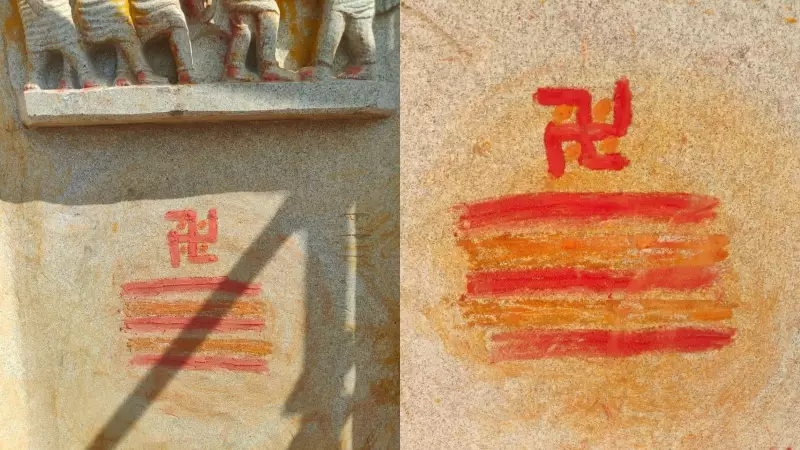
Medaram Jatara Ignites Debate Over Tribal Swastika Symbol
Telangana is buzzing with preparations for the Medaram Jatara, South Asia's largest biennial tribal festival. The event runs from January 28 to 31. As the Congress government readies over 3,000 buses and sets up a 50-bed hospital, a deeper cultural discussion has taken center stage. The focus is on the left-facing swastika engraved on pillars at the Sammakka-Saralamma temple in Medaram village.
Tribal Researcher Explains Symbol's Origins
M Arun Kumar, a tribal researcher from Medaram in Mulugu district, speaks passionately about the symbol. He holds a doctorate in Koya tribal studies. Kumar states the left-facing swastika is a core tribal motif, different from the right-facing version in Hindu tradition.
"The left-facing swastika is a recurring motif in Koya tribal tradition," Kumar told The Indian Express. "We selected several such pictorial traditions for the temple's 32 pillars." The temple now features 7,000 pictorial depictions, with the swastika being the most prominent.

Kumar traces the symbol's history back to the Indus Valley civilisation. He argues it is a tribal symbol later adopted by Hinduism. "Belief in Lord Shiva is tribal in nature," he adds, noting Shivling-like structures at the temple will also display the swastika. "The swastika will greet people, reminding them of unique tribal traditions in our country."
Academic Support and Wider Tribal Connections
Bhangya Bhukya, a professor of Modern Indian History at the University of Hyderabad, supports this view. He confirms the left-facing swastika is common across Adivasi communities in Telangana. "Other than the Koyas, Lambadas also draw the left-facing swastika," Bhukya notes.
Kumar points out the symbol is not exclusive to tribal traditions. It also appears in Buddhist traditions across South Asia. "The temple is sacred for Koyas and Gonds," he asserts. "We will continue our traditions despite any opposition."
Controversy and Opposition Voices
However, the left-facing swastika has sparked criticism. Some organisations call it a distortion of Hindu history. Arvind Arya, a Warangal-based researcher, strongly opposes the symbol. "The researchers who introduced the left-facing swastika have no basis for including it," Arya told The Indian Express.
This debate unfolds as the Telangana government backs a Rs 200-crore facelift for the temple. The renovation aims to enhance the site for the massive festival crowds.
The Significance of Medaram Jatara and Its Deities
Medaram Jatara draws the largest number of devotees in India after the Kumbh Mela. Past events have recorded a staggering footfall of 10 million people. The temple venerates two goddesses, Sammakka and Saralamma, a mother-daughter duo revered as protectors of Medaram.
Kumar shares folklore from Koya oral tradition. Tribal chiefs found a newborn girl, Sammakka, emitting light while playing among tigers. They brought her to their habitation, where the tribe's head adopted her. She grew to become a chieftain and had three children: Sarakka, Nagulamma, and Jampanna.
Historical narratives suggest the mother and daughter resisted Kakatiya rulers attempting to annex Medaram. "But our research indicates Sammakka-Saralamma were chieftains even before the Kakatiyas," Kumar explains. He cites palm-leaf scriptures in the Koya language to support these theories.
Research Efforts and Cultural Preservation
Kumar emphasizes the collaborative effort behind the temple's rebuilding. "Several Koya researchers have given support," he says. His own team includes at least ten researchers dedicated to preserving and documenting tribal heritage.
The Medaram Jatara stands as a powerful testament to Telangana's rich tribal culture. The festival not only draws millions but also highlights ongoing efforts to recognize and celebrate indigenous symbols and histories.