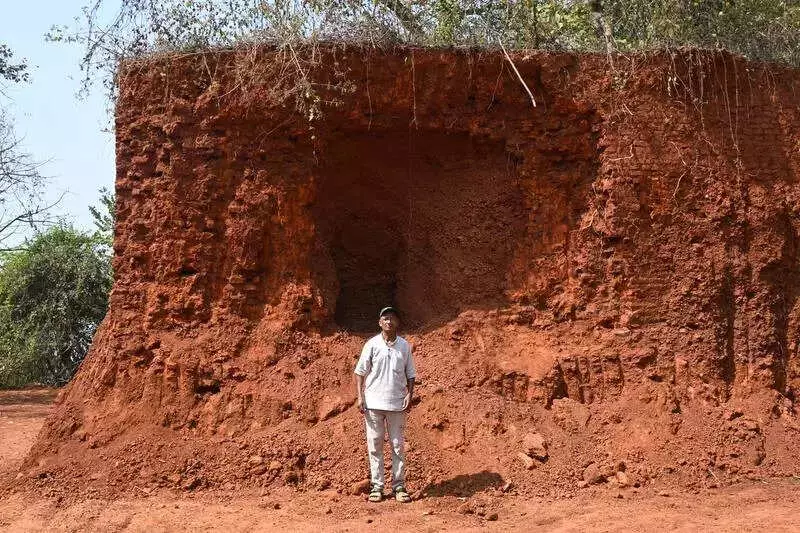
In a significant development for Indian archaeology, marine archaeologist Aniruddh Gaur has conducted a detailed field study at a newly discovered archaeological site on Akhada Island in Goa. The site came to light recently when local villagers, while excavating mud for embankment construction work, unearthed a remarkable structure constructed using laterite and earthen bricks, accompanied by numerous pottery fragments of diverse shapes, sizes, and colours.
Expert Investigation Follows Initial Discovery
Following a comprehensive report published in the Times of India on January 22, 2026, Aniruddh Gaur, the retired principal technical officer of the prestigious National Institute of Oceanography, visited the archaeological location alongside colleagues Madhu Gaonkar and Shubham Bhonsle. The team embarked on a thorough preliminary investigation to assess the historical significance of the findings.
Preliminary Findings Suggest Ancient Origins
Gaur stated that initial examinations strongly indicate the archaeological site dates back to the pre-Kadamba period, a crucial era in Goan history that predates the well-known Kadamba dynasty. "After extensive excavation work in Chandor, discovering such a unique brick structure on Akhada Island represents a remarkable archaeological development," Gaur emphasized during his assessment. He further clarified that while preliminary observations are promising, a detailed and systematic study is absolutely essential to confirm the exact historical timeline and cultural context of the site.

Additional Archaeological Examination Conducted
As part of his comprehensive field visit, Gaur also examined the residence of local resident Sairaj Tari to study additional archaeological remains currently in his possession. This supplementary investigation aims to provide broader context and potentially connect various artifacts to the main site discovery.
Geographical and Historical Context of Akhada Island
Akhada Island, though administratively classified as a hamlet of Santo Estevao in Tiswadi, actually functions as a distinct and separate island within the picturesque Mandovi River basin. Along with neighboring islands including Cumbarjua, Divar, Vanxim, Chorao, Santo Estevao, and Tolto, Akhada forms part of a beautiful constellation of islands that characterize this region of Goa.
Historically, Akhada maintained important connections to Old Goa and other significant locations through Tolto Island. The Dhauji waterway between Tolto and Akhada islands served as a crucial passage for barges and various vessels navigating the Mandovi River, highlighting the area's historical significance in regional trade and transportation networks.
The discovery of this archaeological site on Akhada Island opens new avenues for understanding the pre-Kadamba historical landscape of Goa, potentially shedding light on settlement patterns, construction techniques, and material culture from this ancient period. Archaeologists anticipate that further systematic excavation and analysis will reveal more detailed insights into this fascinating chapter of India's coastal history.