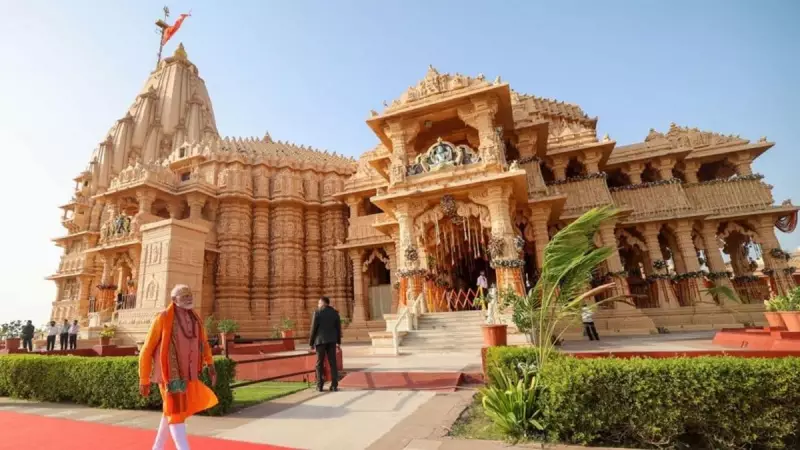
Prime Minister Narendra Modi recently delivered a powerful tribute to the iconic Somnath Temple in Gujarat, highlighting its extraordinary journey of destruction and rebirth. The temple stands today not just as a revered Jyotirlinga site but as a monumental testament to India's unyielding cultural and spiritual resilience.
A Legacy Forged in Stone and Spirit
During his address, PM Modi emphasized the temple's profound significance, stating it represents the soul of India's reconstruction and reawakening. The history of the Somnath Temple is a chronicle of repeated invasions and an even more powerful spirit of revival. Historical records indicate the original temple was first attacked and plundered by Mahmud of Ghazni in 1026 AD. This was not an isolated event; the sacred structure faced subsequent assaults over centuries by various invaders, including Alauddin Khilji's army in 1299 AD and later by Aurangzeb in 1706 AD.
Each time, the temple was reduced to ruins, and each time, the collective will of devotees and patrons led to its reconstruction. This cycle of destruction and rebirth cemented Somnath's status as more than a place of worship; it became a powerful symbol of India's enduring faith and identity.

The Modern Reconstruction: A National Endeavor
The most significant chapter in its modern history began after India gained independence. The present temple is the result of a major reconstruction initiative that started in 1947. This project was championed by Sardar Vallabhbhai Patel, who famously linked the temple's revival to the nation's own resurgence from colonial rule. The foundation stone was laid in 1947, and the work was completed under the guidance of K. M. Munshi, the founder of the Somnath Trust.
The magnificent structure that pilgrims see today was finally inaugurated by the then President of India, Dr. Rajendra Prasad, in 1951. Built in the Chalukya style of architecture, the temple now features a towering shikhara (spire), a massive courtyard, and intricate carvings that echo its ancient glory. The temple trust continues to manage its affairs, preserving its sanctity and heritage.
Why Somnath Resonates Today
PM Modi's focus on the Somnath Temple underscores its dual role in contemporary India. Firstly, it remains one of the twelve sacred Jyotirlingas, making it a pivotal destination for Hindu pilgrims from across the globe. Its spiritual magnetism is undeniable. Secondly, and perhaps more significantly in a national context, its history is invoked as a narrative of civilizational continuity and strength.
The story of Somnath teaches a lesson of indomitable spirit. It shows how faith and collective effort can overcome repeated attempts to erase cultural heritage. For many, the temple's saga mirrors the journey of the Indian nation itself—overcoming adversity to reclaim and celebrate its ancient legacy.
Located in Prabhas Patan near Veraval in Gujarat, the temple is not just a state treasure but a national icon. PM Modi's remarks reinforce its position as a living monument, reminding citizens of a past where resilience triumphed over ruin and inspiring a future built on the foundations of cultural pride and unity.