The Humble Beginnings of Pune's Cinema Culture
Pune's love affair with the movies began in a simple shed during the 1910s. This modest structure housed Napier Cinema, widely recognized as the city's very first theatre. In the silent film era, this makeshift space within Poona Cantonment offered paying audiences an escape to different worlds. It proved the enduring power of cinema from its earliest days.
American Serials and Architectural Transformation
Historical records show American films played at Napier Cinema. Among them was The Broken Coin, a 1915 adventure-mystery series directed by Francis Ford. David Fenster's book Mehera-Meher: A Divine Romance mentions these screenings. Fenster notes audiences grew tired of the serial's endless, unresolved episodes.
Architect and professor Mustansir Dalvi describes the cinema's evolution in his blog A Cinema House in Poona. He writes that Napier's growing popularity led to a significant refurbishment around 1919. The shed transformed into a Neo-Classical building with timber framing and a stone gable. A Baroque-inspired front completed the new look.

Dalvi emphasizes Napier's popularity in contemporary accounts of Poona. He highlights the screening of serials—short, ongoing features that drew crowds weekly. The cinema stood among local landmarks like a fountain and a bandstand. The Napier Cinema Band performed regularly at this bandstand.
From Napier to West End: A New Identity
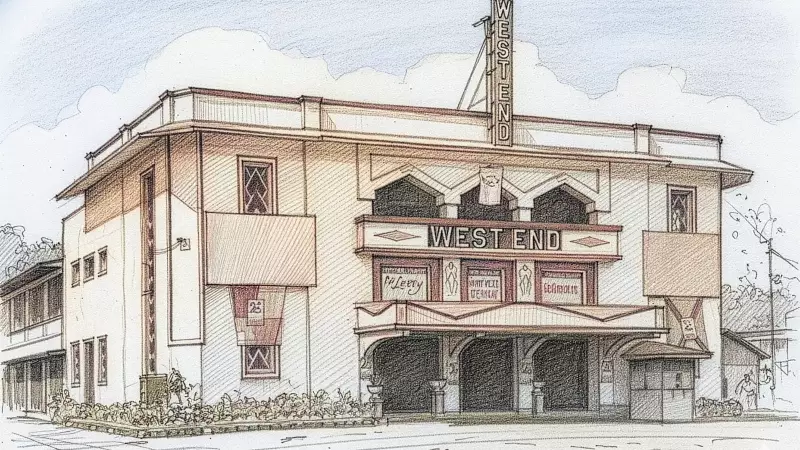
By 1931, Napier Cinema had changed its name to West End cinema. The new building prominently displayed the name twice on its facade. One inscription appeared on the second-floor balcony balustrade. Another graced a vertical mast atop the structure. Despite the rebranding, architectural elements of the old theatre remained visible. The original gable and timber staircase survived within the new design.
The premises featured a low boundary wall adorned with show posters. Dalvi notes West End was not an Art Deco building. However, its design reflected contemporary fashion trends. A cantilevered porch, fake arches, and vertical ornament striping defined the new front. The architecture showed proto-Deco flattened ornament, sloping chajjas, and Palladian symmetry. A protruding porch supported by concrete brackets exemplified this style.
Later Years and Eventual Demolition
By the late 1960s and early 1980s, West End screened films of questionable quality from around the world. These included the American production Sssssssnake with its dramatic tagline. Another feature was Italy's campy 3 Fantastic Supermen, which gained cult status among some critics.
Dalvi shares a personal memory from his childhood in Pune. He recalls being taken to watch Lost in the Desert, a South African film, during a school outing in Class II or III. He describes this as a traumatic choice for young viewers. The film depicted a child surviving a plane crash only to face further horrors, including being spat in the eye by a venomous snake.
The West End cinema met its end in the 1980s. Demolition crews brought down the building, closing the curtain on a significant era of cinema-going in Pune. This marked the final chapter for a venue that had evolved from a simple shed to an architectural landmark.