Kalaimamani Radhika Shurajit: The Dreamer Who Dances
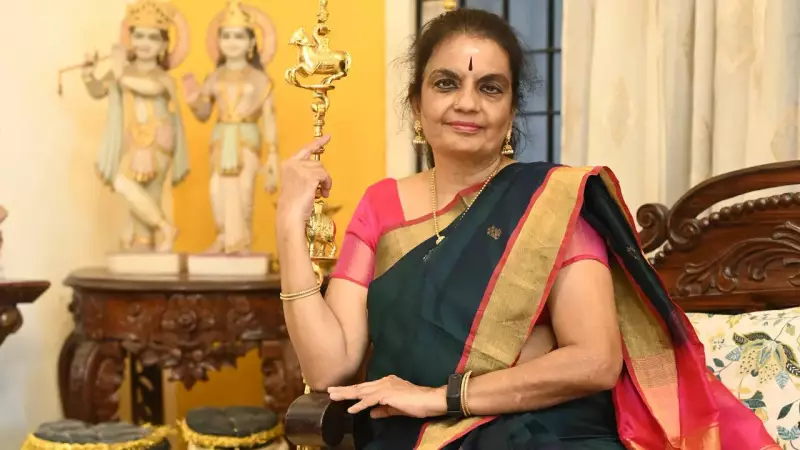
"I am a dreamer," declares Kalaimamani Radhika Shurajit with a warm smile. As the vibrant Margazhi season draws to a close, we sit down with the celebrated Bharatanatyam exponent. Her journey spans decades, gracing countless stages with exceptional performances. She evolved into a revered guru and even choreographed memorable film songs. In an exclusive conversation, she opens up about her artistic philosophy, personal discipline, and unwavering mission.
The Magic of Margazhi
We begin by asking what the Margazhi month means to her. "For me, Margazhi is pure magic," she states emphatically. "Among all the months, it feels the most beautiful and deeply divine. Chennai hosts the world's largest music and dance festival during this time. Performing a show in Margazhi holds a special, unique significance."
The Inner Fire of an Artiste
What drives an artiste like her to excel? "The drive comes from within," Radhika explains. "I cannot dance merely to please an audience. I must feel that inner fire. Only then can I stay relevant. I am an idealist at heart. I believe in hard work and infusing a personal touch into everything I do. I also constantly critique my own work. I try to view it from the perspective of the rasikas, the connoisseurs, and make necessary changes."

The Discipline Instilled by a Mother
Who shaped this rigorous discipline? Was it her mother or her gurus? "It was my mother," she reveals. "My gurus certainly wanted excellence in all I did. But my mother was the one who constantly pushed my boundaries. I faced severe criticism when I decided to step into cinema. I felt very low during that period. My mother stood firmly by my side. She once told me, 'Either be a legend or be different.' That statement completely changed my way of thinking."
Inspiration and the Creative Process
What sparks her creativity? "Music is my primary inspiration," she says. "A creative idea can strike at any moment. My process involves planning the entire choreography on paper before execution. Times have changed. My teachers, the Dhananjayans, could experiment with new forms instantly because we students were available around the clock. Today, we lack that privilege. My students have numerous other commitments."
Challenges for the New Generation
Does the current generation face difficulties learning classical arts? "Absolutely, if they lack financial means," Radhika asserts. "Learning classical dance today is incredibly expensive. Even now, performing at sabhas is largely for those who can afford it. A single performance can cost between sixty thousand to one lakh rupees. How many aspiring artistes can manage that?" She highlights her television shows, Thaka Thimi Tha and Tharikida Thom, as vital platforms for showcasing upcoming talent.
A Lifelong Mission
What drives her even now, as a sexagenarian? "I am constantly working to bring classical arts to the common man," she states with passion. "All my productions follow this vision. Classical arts should not resemble museum exhibits. I aim to be a bridge between traditionalists and contemporary audiences. Any art form, whether abstract or traditional, must reach people. Otherwise, dance, as a visual art, cannot grow. Art is like a flowing river; it must evolve."
Addressing Concerns of Oversimplification
Some argue this approach might oversimplify classical art. "Personally, I do not believe in art that fails to communicate," she counters. "Art must be a two-way process. The audience should enjoy the performance, and the performer should relish presenting it. Art is not solely about awards or performances. It should help one evolve to a higher spiritual plane. I have evolved too. Art must make a person better. That is my central focus."

A Foray into Cinema
She had a brief but notable stint in films. "My desire to take dance to the masses led me to cinema," Radhika recalls. "The camera always fascinated me. I even harbored dreams of film direction. While my parents opposed the idea, the magic of cinema remained etched in my mind. After establishing myself as a Bharatanatyam dancer, I ventured into films." Her journey began with the song Nila Kaaigirathu from the film Indira. "I got the chance when I visited A.R. Rahman's studio with Suhasini Maniratnam. We listened to Harini's unmixed track. Rahman played it and asked if I liked it. When I said yes, he simply said, 'Why don't you choreograph it?' That moment in his studio decided it. I would choreograph film songs, but only those aligning with my ethics." She went on to choreograph several songs, including Mayil Pola Ponnu Onnu (Bharathi), Paattu Solli Paada Solli (Azhagi), and the challenging Indha Nimidam (Pallikoodam). "For Indha Nimidam, I had to consciously 'undo' my Bharatanatyam training," she notes. Her last song was Thuli Thuliyay (Ramanujan). "People were sceptical, but I wanted to introduce authentic Bharatanatyam to cinema. I wanted to explore where it could fit in that world."
The Legacy She Desires
How does she wish to be remembered? "As a good human being," she says softly. "Someone who was kind and nice to people. There is no point in being a superb artiste but a nasty person. You might be admired for your performances, but not for who you truly are."
Quick Bites: Personal Glimpses
In a rapid-fire segment, Radhika Shurajit shares more:
- One artiste you follow a lot: "Padma Subrahmanyam. I've seen all her shows. I admire her immensely."
- Regrets in life: "None. I have done everything I wanted to do."
- Fashion: "I avoid makeup; I don't like it. Flowers are my fashion accessory. I adore saris, but for work, I prefer churidars."
- Best audiences: "Chennai, Delhi, Iraq, and Baku."
- Fitness: "Dancing was my fitness regimen. Now, as a diabetic, I walk daily."
- Favourite sabha caterer: "Arusuvai Arasu."
- Favourite dishes: "I have a sweet tooth. I love cakes and ice creams."
- A secret you haven't revealed: "I strongly believe in luck. I need to wear jasmine flowers (mallipoo) before a programme. I prefer idols at home arranged in a specific way. I sleep with my head pointing in a particular direction. I consider my granddaughter my lucky charm. These rituals may not affect real-life actions, but I hold faith in them."
Radhika Shurajit's story is one of passion, resilience, and a dreamer's relentless pursuit to make classical art breathe and belong to everyone.