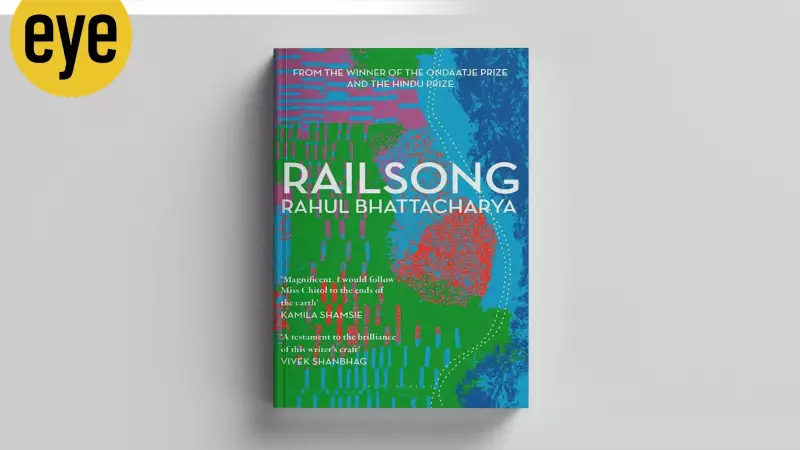
In his latest novel Railsong, author Rahul Bhattacharya presents a sweeping narrative of India, using the country's vast railway network and the bustling metropolis of Bombay as the central stages for a deeply personal and historical exploration. The book, which blends wit with poignant observation, follows the life of its protagonist, Charulata Chitol, against the backdrop of a nation in flux.
A Personal Journey Amidst National Transformation
The story is, at its heart, an intimate coming-of-age tale. Charulata, known variously as Charu, Miss Chitol, and Smt Chitol, navigates her life with a fascination for rules yet a steadfast refusal to be railroaded by societal expectations. Her personal quest for identity and meaning unfolds in lyrical prose, tracing her defiance and self-discovery. This individual journey is cleverly interwoven with the larger, shifting landscape of India from the Nehruvian era through liberalization.
Bhattacharya masterfully uses the Indian Railways as a microcosm of the nation. A telling example is a bureaucratic circular logic cited in the novel: old, unsafe coaches cannot have their speed reduced because the resulting delays would cause public agitation, which would further damage the coaches—a perfect, absurd loop. Charulata recognizes this as "a momentum to recklessness that was its own logic," showcasing the author's sharp eye for systemic irony.

India's Historical Backdrop Through a Personal Lens
The narrative spans pivotal moments in modern Indian history. It moves from the optimism of the early post-independence years to the fading of that dream, touching upon events like the great railway strike of 1974, the Emergency, the assassination of Indira Gandhi, and culminating with the destruction of the Babri Masjid in 1992. Politics, religion, and caste dynamics frequently surface, not as distant headlines, but as forces that touch the lives of the characters.
Characters like Charulata's father, Animesh Kumar Chitol, embody the certainties and contradictions of their time. A man who changed his surname from Chattopadhyay to Chitol to disavow caste, married outside his region, and believed deeply in the modern, progressive ideal of a railway colony, he is a product of the Nehruvian era. His daughter inherits some of these ideals but is forced to confront their complexities and limitations as she matures.
An Anthropological Study of a Diverse Nation
Beyond the plot, Railsong functions as a rich anthropological study. Through Charulata's eyes—and particularly through her professional engagement with the decennial Census of India—readers encounter a tapestry of people and perspectives. The census, described as a clockwork event of a bygone era, becomes a tool for understanding and a point of conflict, highlighting the challenge of categorizing human beings.
Charulata's growing awareness of caste and communal fault lines is a central theme. A pivotal moment occurs when, seeking validation from a Dalit colleague, she is met with a dignified response that leaves her embarrassed. The novel critically examines tokenism, suggesting that merely jettisoning a surname does not address deep-seated blindness. The influence of B.R. Ambedkar and the Ambedkarite movement is acknowledged, adding depth to this exploration.
The rise of Hindutva politics and the Ram Janmabhoomi movement form a potent political backdrop, especially in the Bombay sections of the story. Bhattacharya implicitly poses a question: did the history of a certain idea of India end on December 6, 1992, with the demolition of the Babri Masjid? The novel leaves this for the reader to ponder, juxtaposing epochal national change with Charulata's ongoing personal evolution towards broader understanding and empathy.
Written by Rohan Manoj and published on December 6, 2025, the review positions Railsong as a significant literary work that captures the essence of India's complex 20th-century journey through the intimate saga of one woman's life and the twin melting pots of the railways and Bombay.