For countless Bengluru residents who spent their childhoods in the 1980s and 1990s, Cubbon Park was far more than just a public garden. It was the eagerly anticipated annual school picnic destination, the site of their first thrilling theme-park ride, and the place where a summer horse ride felt like a grand adventure. The taste of ragi balls from park-side pushcarts remains an unmatched memory, and the Putani Express train chugging beneath the canopy felt like pure, unadulterated magic.
A Park That Grew With The City
This iconic green space, officially named Sri Chamarajendra Park, occupies the very centre of Bengaluru. Its journey began humbly in 1870 as a 100-acre garden. Over the decades, it has expanded into the sprawling 300-acre green cathedral that citizens wander through today. The park's name has evolved alongside the city itself—starting as Meade's Park, then becoming Cubbon Park, and finally receiving its current official name in 1927. Yet, for generations, it has remained the same beloved stretch of urban wilderness.
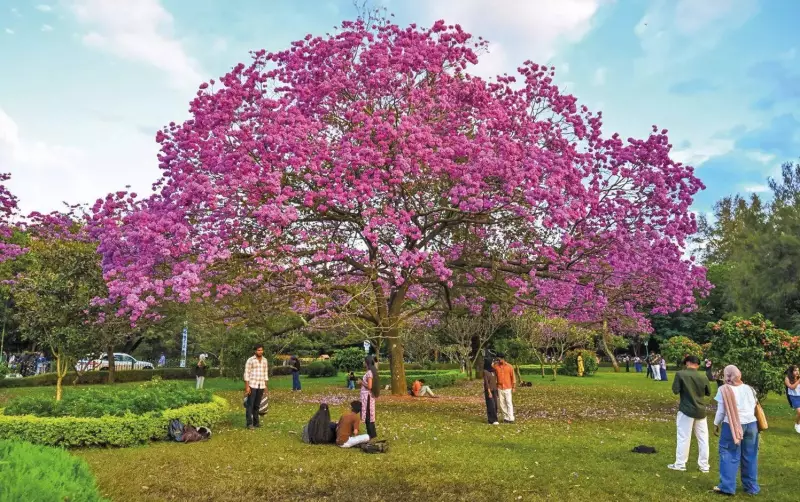
Right now is a particularly beautiful time to visit. The park's avenues are brightened by the arrival of soft pink blossoms, transforming an ordinary morning stroll into a quietly magical experience. While visitors often look up at the imposing red High Court building, the iconic State Central Library, or the historic bandstand, a new initiative encourages looking closer at the park's true giants: its trees.

Cubbon Walks: A Living Classroom Unveiled
Cubbon Walks, a guided trail run collaboratively by the Horticulture Department, The Naturalist School, and Bangalore Walks, treats the park as a vast, open-air classroom. Naturalist and guide Suchi Govindarajan begins sessions with a grounding fact: the latest tree census recorded approximately 8,800 trees within the park's boundaries. The walk reveals that you can tread the same path every weekend and still discover something new—a previously unheard bird call or a tree you've passed a hundred times but never truly observed.
Participants like Sagi Krishna Prasad note that while they have walked these paths for years, hearing stories from a naturalist's perspective completely opens up the park, revealing how every tree and insect plays a crucial role. Another participant, Nanci Mishra, who brought her young son along, shared that after six years in Bengaluru, she wanted to truly learn about the local plants and notice nature—something they had been missing.
The Remarkable Trees of Cubbon Park
The walk introduces participants to an incredible diversity of species, each with its own fascinating history and ecology:
Cook Pine: This tree has a unique characteristic—it literally leans toward the equator. Native to New Caledonia and spotted during Captain Cook's voyages, it forever tilts as if knowing exactly where the sun resides.
African Tulip Tree: Those vibrant orange blooms from childhood water-squirting battles belong to a species with an aggressive, villainous streak. It is considered one of the world's most invasive tropical trees, stunning yet ecologically dominant.
Banyan (Ficus): In the world of figs, the flower hides inside the fruit. Each Ficus species shares an exclusive, co-dependent relationship with a single species of fig-wasp, making every fig a hidden love story on a global scale.
Gulmohar: Before becoming the unofficial emblem of scorching Indian summers, this tree hailed from Madagascar. The first specimens arrived in 1800s Bombay, and the rest is a history painted in blazing orange and red.
Akasha Mallige (Jasmine): This flower smells divine, looks delicate, and performs nature's charming party trick—it transforms into a tiny trumpet when plucked.
Peepal (Ficus religiosa): This is the sacred tree under which the Buddha attained enlightenment. A descendant planted in 236 BCE in Sri Lanka is still alive today, giving this species the longest continuous spiritual lineage on Earth.

Tabebuia Rosea (Pink Trumpet Tree): Every spring, these trees are responsible for Cubbon Park's spectacular pink burst, turning its avenues into a breathtaking floral tableau perfect for a contemplative wander.
This insightful walk, much like the Malleswaram trail, serves as a potent reminder that Bengaluru still knows how to breathe. The invitation is simple: step into the green expanse of Cubbon Park and allow yourself to slow down. The magic, it turns out, was not just in the rides and snacks of childhood, but in the enduring, whispering life of its thousands of trees.