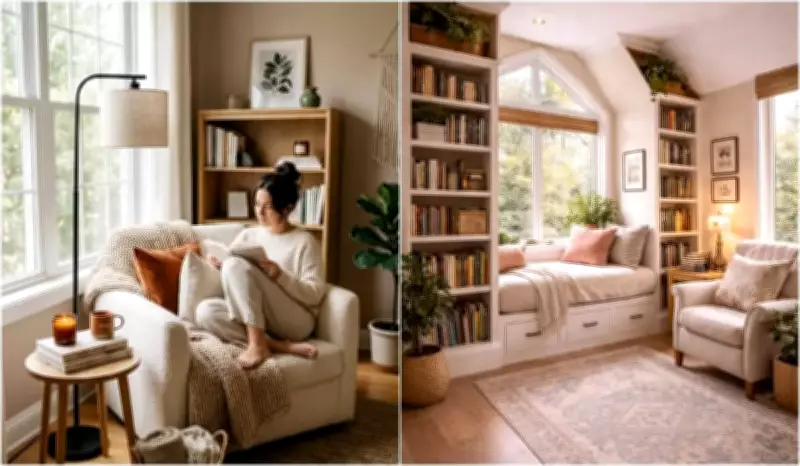
For Mumbai-based actress Snehlata Vasaikar, reading has long been a way to slow down and return to herself. At home, she has carved out a small, quiet corner that serves as her pause from a fast-moving life.
“It is a small space where I can disconnect from everything outside and reconnect with myself. Even if I sit there for 15–20 minutes, it brings a certain calm and clarity,” she says.
Her habit mirrors a wider shift. More homeowners are turning overlooked corners into cosy reading nooks—simple spaces to pause, breathe, and step away from daily noise. According to the Pinterest trends report, searches for ‘comfy reading chair small spaces’ have risen by 455%, while ‘closet reading nook for adults’ is up by 55%, reflecting a growing need for quiet, personal escapes at home.

Experts note that this reflects a wider shift away from rigid design styles toward more lived-in, personal spaces.
- Searches for reading nook ideas have surged by over 245%
- Sunroom reading nook searches are up by 60%
- Closet reading nook for adults has seen a 55% rise (as per Pinterest trend report)
How to create a reading nook
- Reading nooks can be created in corners, under windows, or as window seats, using soft seating like armchairs, chaise lounges or floor cushions, layered with throws and warm lighting
- In children’s spaces, a cosy corner with colourful pillows and accessible books helps foster a love for reading
- Outdoor areas like balconies or garden spots can also be turned into relaxing nooks with a comfortable chair or a simple blanket
- Portable options, such as a book cart, allow you to move your reading nook to wherever there’s the best light or quiet (as suggested by Adwait Pedhamkar, an interior designer)
Designing with light and comfort
Searches for sunroom reading nooks have risen by 60%, reflecting a growing preference for light-filled, calming spaces at home. For Snehlata, natural light was central. “It’s in a quiet corner of my home where I get a good amount of natural light. I didn’t want it to feel like a separate, styled space; I wanted it to feel like a natural extension of my home and routine,” she says.
“A reading nook is less about décor and more about experience. It’s a secluded, comfortable spot shaped by natural light, soft furnishings, and personal touches,” says Adwait Pedhamkar, an interior designer.
For Nazia Ali, 32, the idea was more personal. “While growing up, books were always tucked away in corners. When I moved out, I wanted something more intentional. My roommate and I DIY-ed a bookshelf and the surrounding area, and it became our reading space,” she says.
Echoing this, Priyanka Mishra adds, “There’s a strong emphasis on bespoke detailing,” noting that luxury today is defined more by experience than scale.
Reflect broader lifestyle shifts
Experts say the growing popularity of reading nooks reflects a larger shift in how people are choosing to live. Many homeowners are now consciously seeking ways to slow down, unplug, and build mindful routines within their spaces. Priyanka says, “When I design these spaces, I’m not just thinking visually; I’m considering comfort, natural light, and a sense of calm. We’re moving toward spaces that support well-being, and reading nooks embody that perfectly—they encourage you to step away from the noise and reconnect with a quieter, more intentional pace of living.”
Designers say these corners go beyond aesthetics, becoming calming retreats that prioritise comfort and well-being at home.
There’s a growing focus on creating ‘pause points’ within homes, and I often find myself carving out these corners from underutilised spaces to give homeowners a sense of retreat within their everyday environment — Priyanka Mishra, an interior designer
I have kept it very simple and personal… I like soft textures, so I use comfortable cushions and throws to make the space feel warm. I also pay attention to fragrances—nothing too strong, just something subtle that adds to the calm — Snehlata Vasaikar, an actress who recently created a reading nook at her home