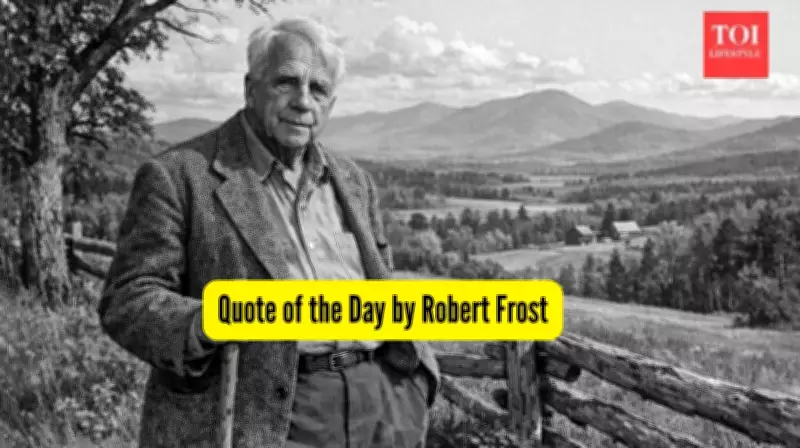
The Enduring Legacy of Robert Frost: Poetry in Plain Clothes
Most readers have encountered the iconic opening lines of Robert Frost's celebrated poem: "Two roads diverged in a yellow wood, and sorry I could not travel both." For generations, these words have resonated deeply, capturing the universal human experience of choice and consequence. Robert Frost remains one of America's most revered poets, celebrated for his ability to distill complex truths from the simplicity of everyday life.
A Life Shaped by Personal Tragedy and New England Roots
Born in 1874 in San Francisco to a journalist father and teacher mother, Frost's early life was marked by upheaval. His father's death when he was just eleven forced the family to relocate eastward, where Frost would eventually settle in New England. There, he balanced farming and teaching with his passion for poetry, developing the distinctive voice that would define his career.
Frost's personal life was shadowed by profound loss, including the deaths of four of his six children and his wife Elinor. These tragedies imbued his work with an authentic, often somber understanding of human struggle, even as he achieved remarkable professional success. He received four Pulitzer Prizes and delivered a memorable reading at President John F. Kennedy's 1961 inauguration, cementing his status as a national literary treasure.

The Frost Style: Deceptive Simplicity and Natural Rhythm
Robert Frost possessed a unique gift for making poetry feel like an intimate conversation. His lines, profound yet unpretentious, draw readers into the quiet, contemplative world of rural New England. Frost employed simple, everyday language reminiscent of the region's farmers, utilizing iambic pentameter and traditional rhyme schemes to create a natural, conversational rhythm.
His poems often begin with tangible, familiar settings—a fork in a wooded path, a stone wall, a snowy evening—before unfolding into deeper meditations on isolation, decision-making, and the human condition. This seamless blend of the concrete and the philosophical, often infused with subtle irony and sharp insight, is a hallmark of Frost's genius.
Iconic Works and Their Hidden Depths
"The Road Not Taken" stands as Frost's most famous poem, its opening lines quoted worldwide. On the surface, it depicts a traveler choosing between two paths in a wood. However, Frost layers the narrative with irony; the roads are described as "worn... really about the same," yet the speaker later claims the "less traveled" one "made all the difference." This sly commentary on how we romanticize our choices in hindsight was originally inspired by Frost's friend Edward Thomas, who frequently agonized over which path to take during walks. The poem's misinterpretation as a straightforward anthem for individualism exemplifies Frost's playful engagement with reader assumptions.
In "Mending Wall," Frost explores themes of boundaries and human connection through the annual ritual of neighbors repairing a stone wall. The repeated line, "Good fences make good neighbors," prompts reflection on whether physical barriers foster community or perpetuate isolation, leaving the interpretation provocatively open-ended.
"Stopping by Woods on a Snowy Evening" presents a weary traveler captivated by the "lovely, dark and deep" woods, yet compelled by duty to move on: "But I have promises to keep." The poem's ambiguous pull—toward rest, escape, or even oblivion—invites endless contemplation without offering easy answers.
Wit and Wisdom Beyond Nature
Frost's sharp wit extended beyond pastoral scenes. His often-quoted line, "A diplomat is a man who always remembers a woman's birthday but never remembers her age," humorously dissects social dynamics and selective memory. Frost suggests that successful relationships may hinge on remembering what matters to others while tactfully overlooking what does not, showcasing his keen observational skills in human interaction.

Complex Legacy and Enduring Relevance
Frost was not without flaws; contemporaries sometimes viewed him as competitive or cantankerous, and he engaged in notable feuds with peers like T.S. Eliot. His later years were tinged with bitterness, yet his public readings remained warm and engaging, filled with folksy anecdotes that charmed audiences. He died in 1963 at age 88, blind but still reciting his poetry from memory.
More than five decades later, Robert Frost's work endures because it mirrors life itself: a tapestry of messy choices, quiet moments, and mended fences. He offers no sermons, only questions dressed in plain language. Reading Frost feels like walking those diverging roads yourself, pondering which path you might choose, and appreciating the beautiful ambiguity of it all. He is the poet who makes us pause, see the extraordinary in the ordinary, and find poetry waiting in the next birch tree or stone wall.