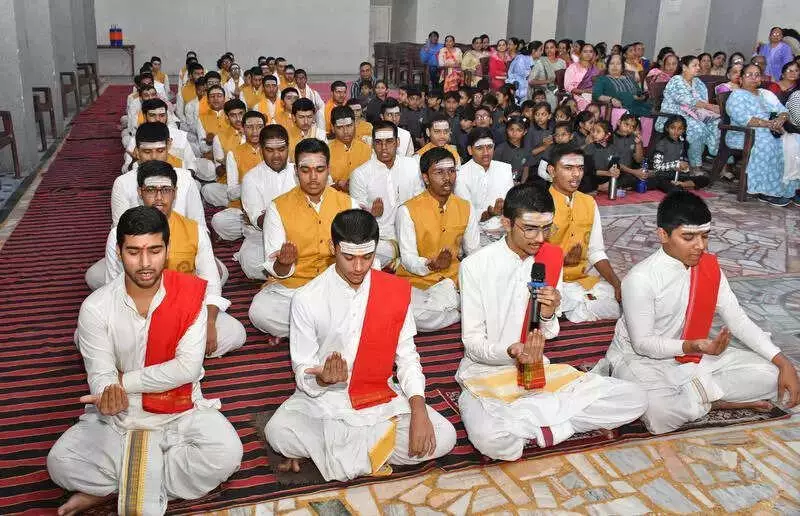
A wave of enthusiasm filled the hall at Surat's Badrinarayan Temple as a unique Antakshari competition, based entirely on Sanskrit shlokas and stanzas, got underway. The event, organized to mark Gita Jayanti, witnessed an overwhelming public response, forcing organizers to expand participation beyond initial plans.
From Four Teams to Twelve: An Overwhelming Turnout
The program was initially conceived for just four teams of four members each. However, the interest was so palpable that the final event featured 12 competing teams. The teams were symbolically divided into groups named after the four Vedas: Rigveda, Yajurveda, Samaveda, and Atharvaveda. Geeta Shroff, Trustee of Akhil Hind Mahila Parishad Bruhad Surat (AKMPBS), expressed delight at the turnout, stating it was a first-of-its-kind attempt to generate interest in Sanskrit through Antakshari.
The Rules of Engagement: Precision in Recitation
The competition required participants to recite verses from a vast repository of Vedas, Upanishads, and other Sanskrit scriptures. Three judges—Punit Shilu, Chetan Shastri, and Ravindra Ojha—orchestrated each round. A judge would recite a shloka to provide the cue, and the teams had to respond with another shloka beginning with the last letter of the judge's verse.

Marks were deducted not only for incorrect verses but also for poor pronunciation. Judge Ravindra Ojha emphasized that "reciting them with proper pronunciation is equally important" as remembering the shlokas. This emphasis on accuracy added a layer of challenge to the game.
Participants' Dedication: From Notebooks to Daily Practice
The event saw participation from 32 students learning Sanskrit from Shree Shandilya Rushi Ved Sanskrut Mahavidhyalay (SSRVSM), which collaborated with AKMPBS, along with 16 women from the city. The students revealed meticulous preparation strategies. Participant Parth Bhatt shared that they wrote the Sanskrit alphabet in a notebook and listed 10 shlokas starting from each letter. They also proactively identified shlokas ending with difficult letters like 'Gh' or 'Ch'.
Another student, Rakesh Mishra, highlighted the importance of understanding the meaning, saying their daily practice involved trying to comprehend the shlokas, which generated interest and aided accurate memorization.
Bridging Generations: Elderly Enthusiasm for Sanskrit Heritage
The competition notably attracted elderly enthusiasts, showcasing the timeless appeal of Sanskrit. 85-year-old Aruxa Majmudar from Nanpura, who regularly reads the Gita, stated she learns Sanskrit because "it is our heritage" and expressed a wish for future generations to learn it too. Former college teacher Hina Desai described it as a wonderful experience that helped improve her understanding of the language's depth.
The successful event in Surat demonstrated a vibrant, cross-generational interest in Sanskrit, proving that traditional scriptures can be promoted through engaging and competitive formats like Antakshari.