Sant Ravidas's Vision of Begampura: A Reminder of Unconditional Dignity and Justice
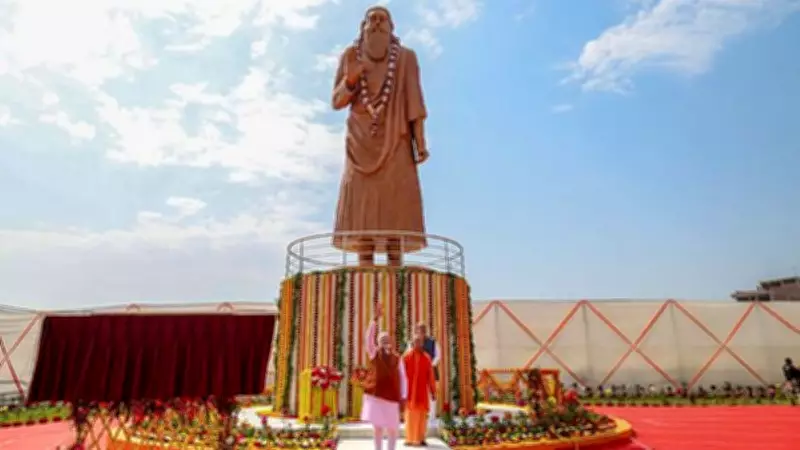
The recent homage to Sant Ravidas before the Union Budget announcement was far more than a symbolic gesture. It represented a profound message of social harmony, moral confidence, and collective forward movement. Revisiting the life and legacy of Guru Sant Ravidas is not merely an act of remembrance; it is a deep inquiry into India's civilisational ethics. This exploration delves into how dignity is constructed, inclusion is practised, and social healing unfolds through sustained moral action.
The Ethical Challenge of Sant Ravidas
Born into a marginalised community and earning his livelihood as a cobbler, Sant Ravidas infused everyday work with spiritual dignity. His challenge to social hierarchy was ethical, personal, and profoundly unsettling to entrenched assumptions. His vision of Begampura was not an abstract ideal but a moral framework shaped by lived experience. Ravidas powerfully reminded society that dignity cannot be conditional, and that harmony is not the absence of conflict but the presence of justice. In a civilisation often tempted by ritual over ethics, his unwavering insistence on equality within faith remains sharply relevant today.
Public Acknowledgement of Long-Revered Figures
In recent years, India has begun to publicly acknowledge figures who were long revered in community memory but absent from national symbolism. The naming of Ayodhya airport after Maharshi Valmiki, and now Adampur's association with Sant Ravidas, tell a larger story of transition. For communities historically denied representation in elite public spaces, such recognition does not undo historical injustice. However, it signals a meaningful attempt to correct the asymmetry of remembrance. In this sense, the Sant Ravidas airport represents an act of social repair.

Disrupting Inherited Hierarchies
A similar reworking of symbolism was visible during the installation of the Sengol in the new Parliament building, consecrated by OBC pandits. For centuries, ritual authority was monopolised by lineage. That moment quietly disrupted inherited hierarchies through broader participation. Sant Ravidas would have instinctively understood this ethical shift. The same moral instinct was evident decades earlier when Kameshwar Chaupal laid the first stone of the Ram Mandir in 1989.
The Moral Dimension of Constitutional Debates
Even constitutional debates, often viewed through legal or security lenses, carry this moral dimension. The removal of Article 370, for instance, extended long-denied rights to Dalits, OBCs, and women in Jammu and Kashmir. While Ravidas did not speak the language of constitutionalism, his position was unmistakable: Justice cannot be selective, and harmony cannot coexist with invisibility.
From Symbolic Inclusion to Structural Participation
What connects these developments is not ideology alone, but intent—the attempt to move from symbolic inclusion to structural participation. Prime Minister Narendra Modi's emphasis on "sabka saath, sabka vikas, sabka vishwas" resonates here as an aspiration aligned with Ravidas's ethical universe. Ravidas reminds us that real social change manifests in who is honoured, who performs rituals, who gains rights, and who feels less afraid to belong.
Transforming the Moral Geography
The renaming of Adampur airport, alongside Ayodhya's tribute to Valmiki, represents a transformation in the imagination of the marginalised—from the periphery to the centre of the nation's moral geography. This quiet work of social healing may be Sant Ravidas's most enduring legacy, and perhaps India's most urgent responsibility.