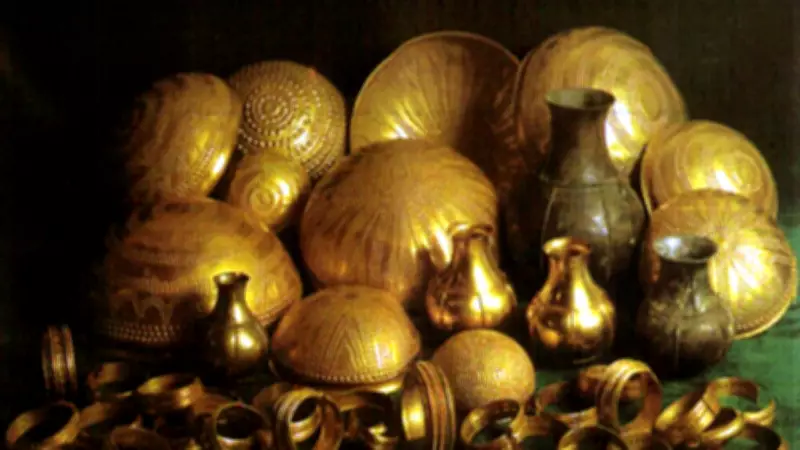
The Cosmic Treasure of Villena: Bronze Age Hoard with Meteoritic Iron
In the sun-drenched plains of Alicante province in southeastern Spain, the small town of Villena holds an archaeological secret that connects ancient Earth with the cosmos. The remarkable Treasure of Villena, discovered in 1963, represents one of Europe's most significant prehistoric finds, containing not just precious metals but rare artifacts forged from meteoritic iron that fell from space approximately one million years ago.
A Fortuitous Discovery in a Gravel Pit
Workers digging a gravel pit in 1963 near Villena stumbled upon what would become known as the Treasure of Villena. This dazzling collection consists of over 60 Bronze Age artifacts weighing nearly 10 kilograms, predominantly featuring gleaming gold bowls, bracelets, and bottles. The hoard has been dated to between 1400-1200 BC, a period when iron smelting technology had not yet been developed on Earth.
What makes this discovery truly extraordinary is the presence of two specific items: an iron bracelet and a sword hilt pommel that scientific analysis has confirmed were crafted from meteoritic iron. These artifacts predate the Iron Age by several centuries, offering compelling evidence that ancient civilizations worked with extraterrestrial materials long before they mastered terrestrial iron production.

Scientific Analysis Reveals Cosmic Origins
Recent scientific investigation published in Archaeology magazine has definitively established the space origins of these iron artifacts. Researchers including Salvador Rovira-Llorens from Spain's National Archaeological Museum, Martina Renzi of Saudi Arabia's Diriyah Gate Development Authority, and Ignacio Montero-Ruiz from the Institute of History at the Spanish National Research Council conducted mass spectrometry analysis.
Their examination revealed high nickel concentrations in the iron artifacts, a distinctive chemical signature characteristic of meteorites rather than terrestrial iron sources. The corroded C-shaped bracelet and gold-decorated pommel represent some of the earliest known examples of meteoritic iron working in the Iberian Peninsula.
"These two pieces of iron had enormous value," noted Ignacio Montero-Ruiz, emphasizing their significance. "Who manufactured them and where this material was obtained are still questions that remain to be answered," he added, highlighting the ongoing mystery surrounding these celestial artifacts.
One of Europe's Richest Prehistoric Collections
The Treasure of Villena stands as one of Europe's most substantial prehistoric gold finds, second only to the royal graves discovered in Mycenae, Greece. The complete collection includes 59 gold items, three silver bottles, an amber-gold button, and the two enigmatic iron pieces.
Archaeologists marvel at the sophisticated craftsmanship displayed throughout the hoard. Intricate repoussé gold work on vessels mimics leather pouches, demonstrating advanced metalworking skills for the Late Bronze Age period. The absence of similar artifacts from nearby archaeological sites has sparked scholarly debates about the treasure's origins, with theories ranging from ritual offerings to elite burial goods.
Researchers believe meteorites likely crashed in the vicinity of ancient Villena, observed by sky-gazing communities who prized the metal's otherworldly sheen for creating status symbols. This discovery pushes back the timeline of meteoritic iron use in Iberia, challenging conventional understandings of early metallurgical development in the region.
Villena: Guardian of Cosmic Legacy
The town of Villena, with its population of approximately 35,000 residents, provides a picturesque backdrop for this cosmic archaeological story. The medieval core features the impressive 12th-century Atalaya Castle, originally constructed by the Almohad Empire as a Muslim refuge. Beyond its architectural heritage, Villena celebrates traditional fiestas and Renaissance structures.
Today, the Archaeological Museum of Villena serves as the permanent home for these extraordinary artifacts, displaying the treasure alongside Bronze Age tools and contextual materials. The collection has previously toured museums throughout Spain before returning to its place of discovery, testament to its significant cultural importance.

For history enthusiasts and curious travelers, Villena offers a unique connection between terrestrial history and celestial phenomena. Visiting this unassuming Spanish town provides an opportunity to contemplate how Bronze Age craftsmen transformed stardust into enduring jewelry and artifacts, creating a tangible link between ancient human civilization and the cosmos.
The Treasure of Villena continues to draw visitors who ponder the intersection of archaeology, astronomy, and ancient craftsmanship. This remarkable discovery illuminates how prehistoric societies valued and utilized materials from beyond our planet, offering profound insights into early human interaction with the celestial realm.