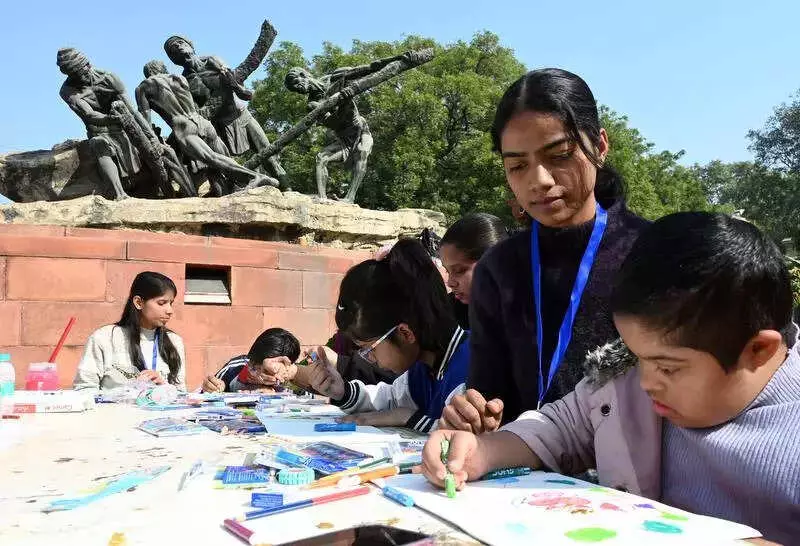
On a warm Monday afternoon, the lawns of New Delhi's National Gallery of Modern Art (NGMA) transformed into a vibrant canvas of creativity and uninhibited expression. The occasion was the fourth edition of 'Srijan,' a unique art and craft workshop specifically organized for Divyang artists, celebrating World Disability Week.
A Canvas Without Rules: Freedom of Expression Takes Center Stage
The open-air event was a deliberate departure from structured art lessons. There were no templates, no strict rules, and certainly no insistence on "correct" colours. Instead, children with diverse developmental and learning needs were encouraged to let their imaginations guide their brushes. The results were a breathtaking array of personal visions—pink skies, orange trees, and even depictions of Lord Hanuman in unconventional, earthy shades.
A total of 450 children from nine different institutions participated in the workshop. Each group was paired with an assigned artist-mentor who provided gentle guidance. The mentors, alongside special educators, created a supportive environment, sometimes even breaking into playful runs with the children before returning to the canvases.

Mentors Step Back, Young Artists Lead
At one workstation, artist mentor Shalini Yadav encouraged participants to add a 'tilak' to their Hanuman paintings. What followed was a beautiful exercise in autonomy. "I only marked a few dots. The children are drawing their own version of Lord Hanuman," Yadav explained. She highlighted how the young artists were independently choosing greens, browns, and other colours of the earth. "They are leading this, not us," she affirmed, watching tiny fingers dip hesitantly at first, then with growing confidence, into pots of blue, green, and brown paint.
The artistic approaches varied wonderfully. While some children mirrored the strokes demonstrated by their mentors on large canvases, others followed the unique paths of their own imaginations. Eighteen-year-old Anurag Rana, a student with Down syndrome from Aathak Prayas Special School in Ghaziabad, held up a bright floral painting with pride. Another participant, Manas Mehra, also living with Down syndrome, created broad, sweeping strokes to depict water and sky. Sixteen-year-old Anandya Panda, who has a hearing impairment, sketched a detailed portrait of the Prime Minister.
Beyond Medals: Building Pathways to Livelihood
The workshop, organized by Citizens for Welfare State and Special Olympics Bharat in collaboration with NGMA, had a profound objective that extended beyond a single day of painting. Mallika Nadda, Chairperson of Special Olympics Bharat, pointed to the critical need for sustainable opportunities. "Many of these children have won medals—but what job opportunities wait for them?" she questioned. The initiative aims to build long-term skill pathways so that artistic talent can translate into tangible livelihood options. In a significant move, Nadda announced that the organization plans to purchase select artworks created during the workshop, providing direct encouragement and support.
The event also featured artist-led sessions, student performances, and saw participation from government representatives. Union and Delhi government ministers attended the opening ceremony, underscoring institutional support for such inclusive efforts.
A Commitment to Inclusive Cultural Platforms
Sanjeev Kishor Goutam, Director General of NGMA, expressed the gallery's hope to continue hosting similar initiatives. He emphasized the transformative power of providing space for expression. "When we give space for expression, we build confidence. Inclusive cultural platforms like this remind society of the immense potential within every individual," Goutam stated. The Srijan workshop stands as a powerful testament to this belief, proving that when barriers are removed, extraordinary creativity and ability shine through, colouring the world with new perspectives.