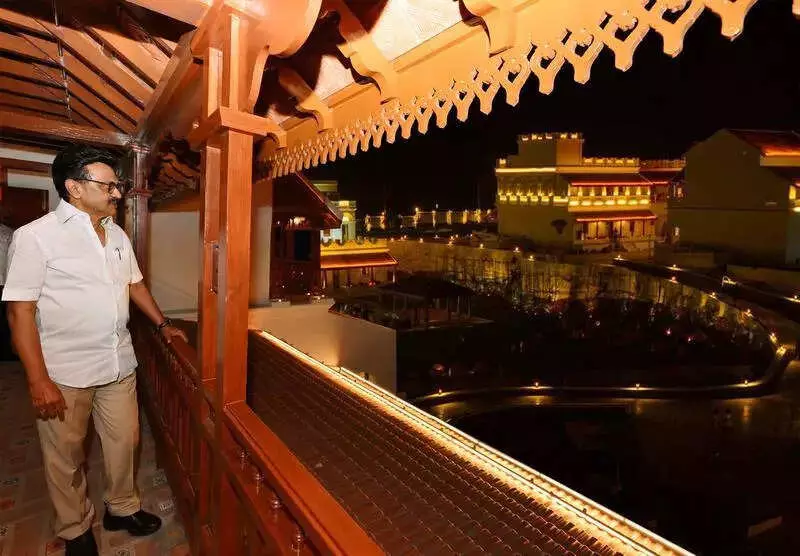
Tamil Nadu Chief Minister M K Stalin inaugurated the state-of-the-art Porunai Museum at Reddiarpatti near Palayamkottai in Tirunelveli on Saturday, marking a significant milestone in the state's archaeological endeavours. The museum, built at a cost of ₹56.36 crore, is dedicated to showcasing the ancient Porunai (Thamirabarani) river civilisation.
A New Pillar for Tamil Archaeology
In a video statement released ahead of the inauguration, Stalin emphasised a profound historical perspective. He stated that the history of the Indian subcontinent must be written from the Tamil landscape, a claim he described not as mere rhetoric but as a scientific truth being affirmed by his Dravidian model government. The Porunai Museum is positioned as the next major pillar in Tamil Nadu's archaeological roadmap, following the resounding success of the Keeladi museum, which has already attracted over 12.5 lakh visitors.
The museum complex, spread across 13 acres with a built-up area of 55,000 square feet, will house precious artefacts excavated from three key archaeological sites: Adichanallur, Sivakalai, and Korkai. Stalin highlighted that the Porunai civilisation provides a continuous timeline of human habitation, stretching from the microlithic age through the Iron Age and into the Early Historic period.

Unveiling Ancient Glory with Modern Tech
The Porunai Museum is designed to be an immersive experience, blending traditional aesthetics with cutting-edge technology. Visitors can embark on a 5D sensory journey across Tamil landscapes, witness a digital simulation of ancient iron-smelting, and enjoy a virtual reality boat experience. Other innovative features include interactive walls demonstrating tool-making, floor projections of traditional games like Pandi, and an audio tour titled ‘Voice of Porunai Journey’.
The CM made a special mention of a groundbreaking discovery: scientific dating has confirmed that iron found at Sivakalai is the oldest iron artefact discovered in any archaeological excavation to date. This finding was formally presented to the international scholarly community in January 2025.
Architectural Layout and Global Significance
The museum features two prominent two-story structures: the Korkai block (17,429 sq ft), the largest facility, and the Adichanallur block (16,486 sq ft). A third dedicated area of 8,991 square feet is specifically designed to display artefacts from Sivakalai. A road network connects all blocks to the administrative building, while the surrounding space has been developed into scenic lawns, parks, fountains, and an open-air theatre. The facility is also equipped with battery-operated vehicles for senior citizens and visitors with disabilities.
Stalin elaborated on the historical significance of the sites, noting that the Sangam-era port city of Korkai is well-documented in ancient Tamil literature and was also written about by foreigners like Ptolemy and Pliny, who highlighted its pearls. He recalled that Robert Caldwell had researched Korkai as early as 1876. The current DMK government, Stalin added, is committed to bringing the antiquity and excellence of Tamil culture to the global stage.
Concluding with an appeal, the Chief Minister urged families and the ‘Gen-Z’ to visit both Keeladi and Porunai museums, coining the slogan: ‘Keeladi is our mother's lap; Porunai is the pride of Tamils.’ The inauguration event was attended by several state ministers, Assembly Speaker M Appavu, MP Kanimozhi, and T Udhayachandran, Commissioner of State Archaeology.