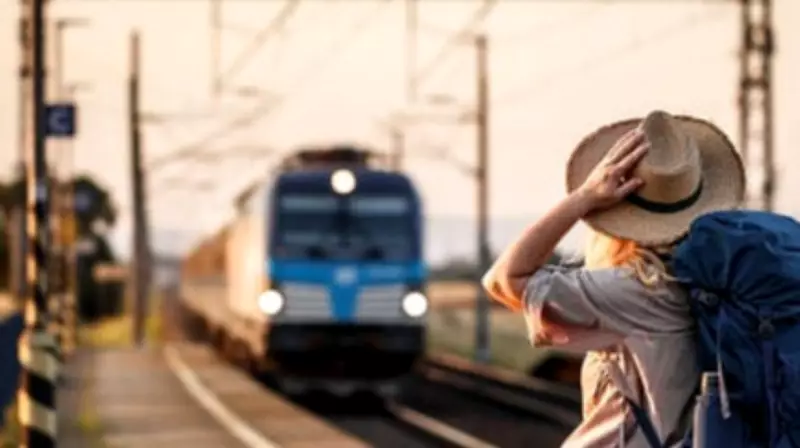
Faster Than the Train: A Journey Through Memory and Imagination
In a world where speed is often measured in miles per hour, there exists a different kind of velocity—one that transcends physical boundaries and races through the corridors of the mind. This is the essence captured in a poignant opinion piece titled "Faster than the train," where the author, Surender Singh Dudi, delves into the profound experience of a train journey that becomes a catalyst for introspection.
The Racing Mind Amidst Slow Travel
The article opens with a striking observation: "My thoughts travelled faster than the train." This simple yet powerful statement sets the stage for an exploration of how, even as the train chugs along at its steady pace, the human mind can outpace it, embarking on a whirlwind tour of the past, present, and future. Dudi describes this mental journey as a dynamic process, where thoughts tumble through memories, form intricate stories, collapse into newer memories, and expand into wild imaginings.
This metaphorical comparison highlights a universal human experience—the ability of our consciousness to leap across time and space, often in moments of quiet reflection. While the train moves forward on its tracks, the mind races backward to childhood recollections, forward to future dreams, and sideways into fantastical realms. It is a reminder that our inner worlds are vast and untamed, capable of journeys far beyond the physical constraints of travel.

Weaving Stories from Memories
Dudi emphasizes how memories are not static entities but living, breathing narratives that evolve with each retelling. As the train passes through landscapes, the author's thoughts weave these memories into stories, only to see them collapse and reform into newer memories. This cyclical process mirrors the way our brains constantly reinterpret past experiences, shaping our identities and perspectives.
The article suggests that such journeys—whether by train or through life—offer fertile ground for creativity and self-discovery. In the rhythmic clatter of the wheels, there is a space for the mind to wander, to imagine scenarios both plausible and impossible, and to find connections between disparate moments. It is in these quiet interludes that we often stumble upon insights about ourselves and the world around us.
The Expansion into Wild Imaginings
Beyond memories, Dudi touches on the expansion of thoughts into "wild imaginings." This speaks to the boundless nature of human imagination, which can transform a mundane train ride into an adventure of epic proportions. Perhaps the passing fields become alien landscapes, or fellow passengers turn into characters in a grand tale. This ability to dream and envision is what fuels innovation, art, and hope.
The opinion piece, published on March 4, 2026, at 23:26 IST, serves as a timely reflection in an era dominated by fast-paced digital distractions. It invites readers to slow down, embrace the journey, and let their minds roam free. In doing so, it celebrates the richness of our inner lives, which often move faster than any train, car, or plane ever could.
In conclusion, "Faster than the train" is more than just a travelogue; it is a meditation on the human condition. It reminds us that while we may be bound by physical limits, our thoughts and imaginations know no bounds. As we navigate the tracks of life, it is this inner velocity that truly defines our journeys.