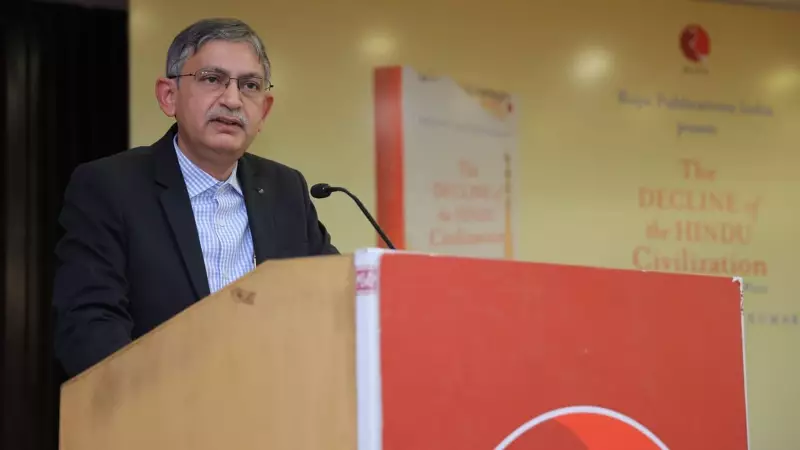
Shashi Ranjan Kumar, Secretary of the Union Public Service Commission, delivered a compelling address at the launch of his new book. The event took place at the India International Centre in New Delhi. Kumar emphasized the critical need for a balanced reading of history.
A Call for Honest Historical Engagement
Kumar spoke passionately about confronting the past with honesty. He stated that the past continues to influence the present through memory and ruins. The only productive path forward, according to him, involves facing both the beauty and the failures of history directly.
His book, titled The Decline of Hindu Civilization: Lessons from the Past, is published by Rupa Publications. Kumar explicitly rejected two common distortions in historical discourse. He criticized the tendency to celebrate the past as an era of limitless achievement. He also dismissed the opposite view that reduces historical traditions to mere superstition.

Navigating Between Extremes
The author explained that his work attempts to move beyond these polarized ideas. He aims to provide a more nuanced examination. The book is structured into four distinct sections: The Zenith, The Decline, The Defeats, and The Reasons.
Kumar's research highlights a civilization that once led the world in several fields. He pointed to extraordinary achievements in mathematics, astronomy, and philosophy. However, he also honestly confronts the complex reasons behind its gradual loss of vitality.
The book examines how Hindu civilization faltered across multiple domains. It looks at cultural, political, social, and intellectual spheres. Kumar stressed that the past should not be approached as a source of either nostalgia or grievance. He made a powerful observation: "The past cannot be avenged, it can only be understood."
Intellectual Achievements and Comparative Analysis
One of the early chapters traces India's significant intellectual contributions, particularly in mathematics. Kumar noted that a decimal system was already in use in Vedic texts. This system later evolved to include the recognition of zero as a number.
"The need to comprehend the vastness of the universe forced abstraction," he said. This intellectual leap, he argued, set Indian mathematics apart from several contemporaneous traditions. Kumar extended this comparative approach to other fields like medicine, aesthetics, and music.
He argued that while elementary surgical practices existed across civilizations, India developed more advanced procedures. These included techniques akin to plastic surgery. These traditions reflected a broader culture of inquiry that, according to his analysis, later weakened.
"A civilization does not decline overnight," Kumar observed. "It declines when curiosity narrows."
Primary Sources and Broader Context
The book draws on a wide range of primary sources. These include historical texts like the Chachnama of Ali Kufi and the Tabaqat-i-Nasiri of Minhaj-i-Siraj. It also references the Kitab-i-Yamini of al-Utbi and the Futuh al-Buldan of al-Baladhuri.
Other sources are the Kitab al-Hind of Al-Biruni and travel accounts by al-Istakhri. Kumar situates Indian civilization alongside Greek and Chinese traditions. He argues against viewing it in isolation, promoting a more connected historical perspective.
Focus on Warfare and Statecraft
A significant portion of the book and the discussion focused on warfare and political strategy. Referring to a chapter titled "War is Deception," Kumar argued that Indian rulers often failed to adapt strategically. He suggested they did not respond effectively to changing political realities.
Panel Reflections and Praise
The launch event featured a panel that reflected on the book's claims from various perspectives. Journalist and former Rajya Sabha member Swapan Dasgupta offered his insights. He noted that the book avoids presenting Hindu civilization as a single, uniform entity.
"Civilization here means plurality – languages, philosophies, practices," Dasgupta said. He cautioned against reducing history to a simple ideological identity.

Gautam Sen, Co-Director of DIPF and a retired professor from the Delhi School of Economics, praised the book. He commended its structure and tone, calling it "balanced and accessible." Sen highlighted that the book's refusal to assign blame was one of its core strengths.
"It does not mourn the past," Sen stated. "It asks why certain capacities were lost." He also stressed the urgency of the questions the book raises, describing it as particularly timely.
Author and former diplomat Amish Tripathi joined the discussion virtually. He offered a complementary reading of history. While acknowledging repeated historical defeats, Tripathi argued that survival itself was a significant achievement.
"The last thousand years was not only a story of loss," he said. "It was a story of resistance." At the same time, he echoed the book's emphasis on internal fragmentation and strategic failures that contributed to decline.
The discussion was moderated by Chaitanya K Prasad, an author and commentator on communication and cinema. The event provided a platform for a serious and multifaceted conversation about India's historical trajectory and its lessons for the present.