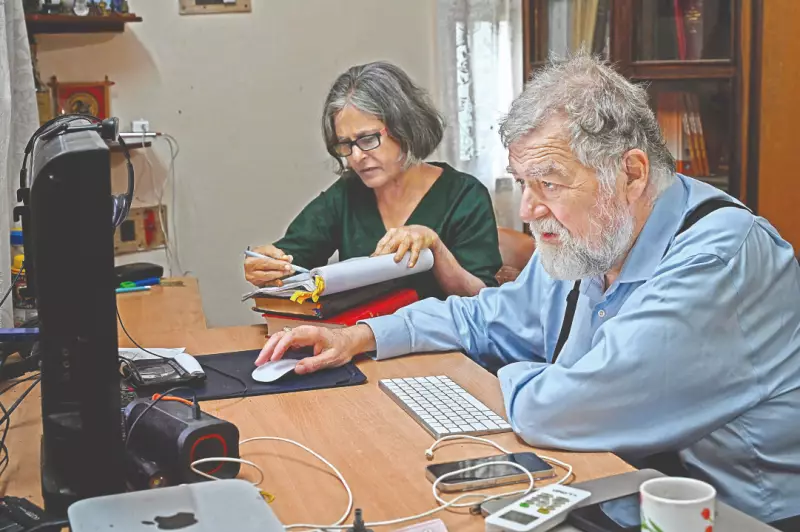
In a quiet home in Madurai, a unique cross-cultural collaboration is unfolding, dedicated to bringing ancient Tamil devotional poetry to the English-speaking world. American author John A Loud, 71, and retired professor V A Vidya have joined forces to translate the Thevarams, the revered 7th-century Shaiva hymns, into English.
A Journey Rooted in Decades of Tamil Love
John A Loud's connection with Tamil spans decades, beginning in the 1970s when he first arrived in India. His formal study of the language started under his first teacher, K Paramasivam from Tirunelveli, an influence that explains his enduring fondness for the Tirunelveli dialect. "I have lived in Madurai on and off for seven years," Loud shares, "But my relationship with Tamil goes back decades." He humorously notes the difference in dialects, saying, "Senthamizh veru, Chennai Thamizh veru (pure Tamil is different from Chennai Tamil)."
His partner in this scholarly endeavor, V A Vidya, is the founder of the Chella Meenakshi Centre for Educational Research and Services. For Vidya, the Thevarams are not merely historical religious texts. "I am not very religious," she admits, "But I have immense interest in the language." She sees them as living texts, still sung by devotees, and layered with deep linguistic and philosophical meaning. Each verse, she believes, holds clues to how people lived, worshipped, and perceived the world centuries ago.

The Precision of Translation: No Beautification, Just Accuracy
The translation process is meticulous. Vidya explains pages of verses, unpacking their cultural references and historical contexts to help Loud find the most apt English equivalent. For Loud, the goal is singular: accuracy. "There is no necessity to beautify it. If I am accurate, the beauty of the original will come through," he states. He marvels at Tamil's complex grammar (ilakkanam), pointing out words like "Aaru" which can carry multiple meanings. "Tamil is a language like that," he says with appreciation.
This is not Loud's first foray into Tamil devotional literature. In 2023, he published an English translation of 'Abirami Andadi', the celebrated 18th-century poetic tribute to Goddess Abirami. His academic background includes a dissertation on the Chidambaram temples and extensive Tamil research during his college years.
A Project Born from Historical Academic Exchange
Vidya situates Loud's presence and work within a broader historical framework: the US Food for Peace programme (PL-480) launched in 1954. This program, which sold surplus American grain in India for rupees, used the local currency to fund academic exchanges, research, and libraries. "This was when the US opened eyes on South Asia and India," Vidya explains, highlighting how this initiative led to a boom in American scholars studying India.
The task ahead is monumental. "There are many Thevarams, some of which are from not so famous temples, yet such beautiful hymns are associated with them," says Loud. Their current priority is to complete hymns from popular temples in Thiruvarur, Chidambaram, Madurai, and Kanchipuram, with the aim of publishing them as small, readable books. With characteristic humility, Loud wonders, "There are so many of them. I don't know if I will finish them by the time I die."
Yet, for both scholars, the collaboration transcends deadlines. It is about the work itself—the joy of unlocking ancient wisdom. Their shared hope is modest: that their labor of love will eventually claim "four inches of library space at the very least," ensuring these timeless hymns find a new audience and a permanent scholarly footprint.