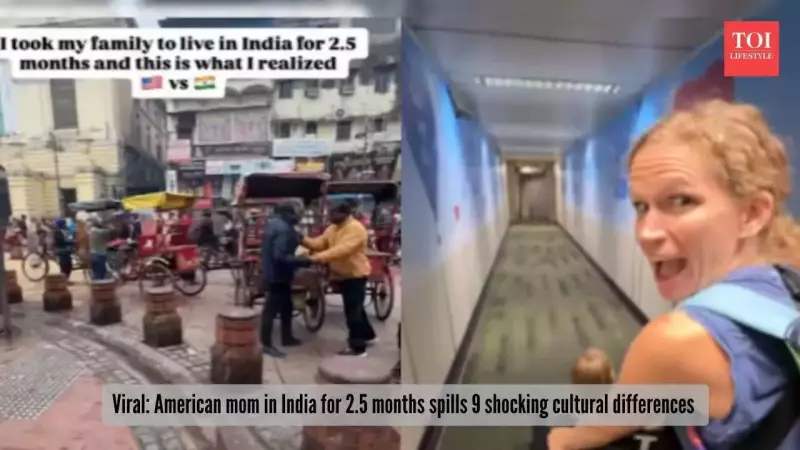
An extended family trip to India has provided an American mother with a profound lesson in cultural contrasts, and her honest reflections have resonated with millions online. Anna Haakenson, a mother of two from the United States, spent two and a half months exploring India with her family. She recently shared her key takeaways in a viral Instagram reel that amassed nearly four million views, sparking a global conversation about the beautiful diversity of daily life across nations.
From Road Rage to Friendly Beeps: Everyday Life in Contrast
Haakenson's observations delve into the fabric of everyday interactions, starting on the roads. She highlighted a fundamental difference in car horn usage. In the US, honking is often a sign of impatience or anger, she noted. However, in India, she described it as a form of communication—a friendly "hello, I'm here" amidst the bustling traffic. This system, which she termed "controlled chaos," allows a mix of cars, bikes, rickshaws, and pedestrians to navigate shared spaces with a unique, intuitive flow that initially baffles outsiders.
The American mom was equally struck by the warmth of social interactions. She pointed out that while people in the US might generally avoid engaging with strangers in public, Indians often show a welcoming curiosity. They are likely to ask where you are from, where you are going, and why. Haakenson found this openness not intrusive but genuinely friendly, with strangers readily offering tips and sharing smiles.

Spice, Family, and Faith: Deep-Rooted Cultural Nuances
Food culture presented another significant contrast. Haakenson loved the bold flavors but warned that the Indian definition of "spicy" is on another level compared to the mild warmth often labeled as such in America. She connected this to India's diverse regional cuisines, where spices are integral not just for taste but also for digestion and food preservation in the climate.
Family structures and religious life also stood out. She observed that multi-generational households are common in India, with grandparents, parents, and children often living under one roof. In terms of faith, she contrasted the mostly quiet gatherings in American churches with the vibrant, all-encompassing nature of Indian festivals that can "take over entire cities," with temples being ubiquitous landmarks.
Infrastructure, Environment, and a Viral Response
Haakenson also touched on differences in public cleanliness and waste management, noting littering as a systemic issue related to infrastructure challenges amid rapid urbanization, rather than mere individual carelessness. She even commented on the weather, humorously summarizing India's seasons as "hot, monsoon, and 'surprise extra heat,'" compared to America's four distinct seasons.
The overwhelming response to her video saw users from around the world agreeing, sharing their own stories, and adding nuance. Some commenters clarified that India's Himalayan regions do experience distinct seasons, while others wholeheartedly agreed with her take on the communal care extended even to strangers. The discussion served as a powerful reminder, as Haakenson implied, that no country is inherently "better"—they are simply, and beautifully, varied, each shaped by its own unique history, climate, and community values.