Unraveling the Van Allen Belt Myth: Kasar Devi, Machu Picchu, Stonehenge
At first glance, Kasar Devi Temple in India, Machu Picchu in Peru, and Stonehenge in England seem worlds apart. One is a serene Himalayan hill temple, another a majestic Inca fortress perched in the Andes, and the third a prehistoric stone circle in the English countryside. They differ vastly in age, culture, architecture, and geography. Yet, a persistent claim has emerged over the years, suggesting these three iconic sites are connected through what is often termed the “Van Allen Belt phenomenon.” This idea posits that all three locations lie along a specific band of geomagnetic or cosmic energy associated with Earth’s magnetic field. But what does this really mean, and how much of it holds up to scientific scrutiny?
Understanding the Van Allen Radiation Belts
The “Van Allen Belt” refers to the Van Allen radiation belts, discovered in 1958 by American physicist James Van Allen using data from the Explorer 1 satellite. These are doughnut-shaped regions encircling our planet, filled with high-energy charged particles trapped by Earth’s magnetic field. Located thousands of kilometers above the surface, they are a crucial part of the Earth’s magnetosphere, primarily significant in space science. Importantly, the Van Allen belts are not fixed points on Earth’s surface. Therefore, no specific location, including Kasar Devi, Machu Picchu, or Stonehenge, literally “sits on” these belts.
The Claim and Its Origins
The connection between these sites typically stems from a related but distinct notion: that they are situated along a band of unusual geomagnetic activity or magnetic anomalies on Earth’s surface. This theory has gained traction due to the sites' shared characteristics, such as elevated landscapes, historical or spiritual importance, and documented astronomical alignments. However, the scientific basis for a direct link to the Van Allen belts remains unproven.

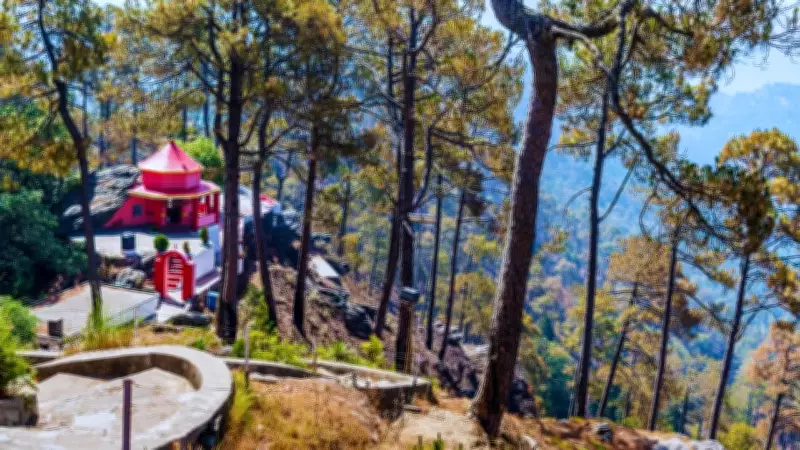
Kasar Devi in Almora, India
Located near Almora in Uttarakhand, Kasar Devi Temple sits atop a ridge in the Kumaon Himalayas. The area has garnered attention for reports of unusual geomagnetic activity, with some studies indicating that parts of the Almora region experience relatively strong geomagnetic variations. Over the decades, this site has attracted numerous spiritual seekers and notable figures, including Swami Vivekananda, Bob Dylan, Allen Ginsberg, D.H. Lawrence, George Harrison, and Uma Thurman. Despite this allure, there is no peer-reviewed scientific consensus proving that Kasar Devi lies on a uniquely powerful global magnetic energy line directly connected to the Van Allen belts.
Machu Picchu in Peru
Built in the 15th century by the Inca civilization, Machu Picchu is perched at about 2,430 meters above sea level in the Andes. Its dramatic location and advanced stone architecture have fueled speculations about astronomical alignments and energetic properties. History strongly suggests that the Inca were advanced astronomers who aligned some structures with solar phenomena like solstices. However, claims that Machu Picchu lies on a specific Van Allen-related energy strip are not supported by established geophysical research.
Stonehenge in England
Stonehenge, dating back to around 3000–2000 BCE, is extensively studied for its astronomical alignments, particularly with the summer and winter solstices. Archaeologists and astronomers agree that its builders carefully positioned stones in relation to solar cycles. Similar to Machu Picchu, some alternative theories propose that Stonehenge stands on a geomagnetic or “energy” line linked to global magnetic fields. While minor local magnetic variations can occur anywhere due to geology, mainstream science does not recognize Stonehenge as uniquely positioned because of the Van Allen radiation belts.
Why Does This Idea Persist?
The theory likely endures because all three sites share compelling features:

- Elevated or dramatic landscapes that inspire awe.
- Historical or spiritual significance that draws pilgrims and tourists.
- Documented astronomical alignments, especially at Machu Picchu and Stonehenge.
- A reputation for being “energetic” or spiritually powerful, often fueled by anecdotal experiences.
Their commonality lies less in space physics and more in humanity’s shared impulse to connect sacred architecture with the cosmos, seeking meaning in the interplay between Earth and sky.
Conclusion
Kasar Devi, Machu Picchu, and Stonehenge are remarkable sites in their own right, each with unique cultural and historical value. The common suggestion that these locations are connected through the “Van Allen Belt phenomenon” is not supported by scientific fact, as the Van Allen radiation belts are high above Earth, encircling the planet rather than pinpointing specific surface points. Ultimately, it is the common thread of human fascination with the sky, the power of the Earth, and the eternal search for meaning that truly connects these sites, not a radiation belt. This enduring myth highlights our deep-seated desire to find patterns and significance in the world around us, blending science with spirituality in captivating ways.