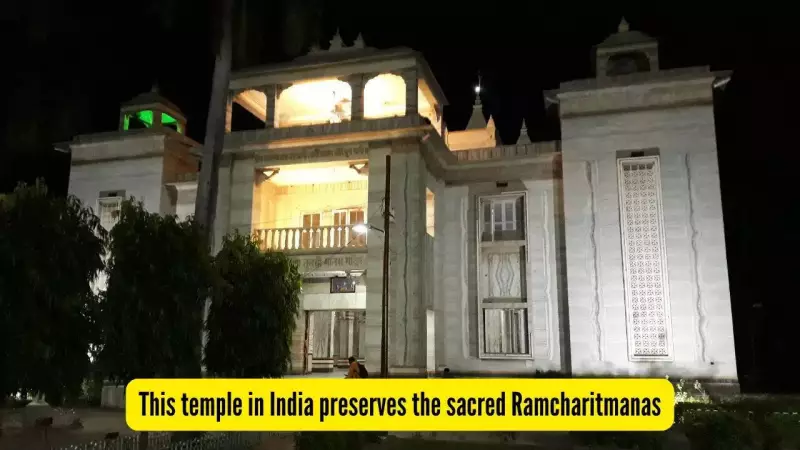
In the ancient, spiritually charged city of Varanasi, one of the world's oldest continuously inhabited cities, lies a temple that is more than a place of worship. It is a living archive of devotion and literature. While Varanasi is famed for its countless ghats and temples, the Tulsi Manas Mandir holds a unique distinction, deeply connected to one of India's most influential religious texts, the Ramcharitmanas.
The Sacred Birthplace of the Ramcharitmanas
The Tulsi Manas Mandir is believed to stand on the very spot where the 16th-century poet-saint Goswami Tulsidas composed the epic Ramcharitmanas. Tulsidas, a devoted follower of Lord Rama also famous for penning the Hanuman Chalisa, wrote this seminal work in Awadhi, making the story of the Ramayana accessible to the common people. His text continues to profoundly shape Indian social and cultural values to this day.
Constructed in the 20th century from gleaming white marble, the temple itself is an open book. Its walls are engraved with verses from the Ramcharitmanas, allowing devotees to literally walk through and read the epic as they circulate within the sacred space. This design transforms devotion from mere prayer into an immersive act of reading and reflection.

The Viral Revelation of the Original Manuscript
What elevates this temple's sanctity is the enduring belief that the original manuscript of the Ramcharitmanas is preserved within its precincts. This manuscript is not publicly displayed and is kept under strict, traditional custodianship, making it a subject of great reverence and mystery.
This belief captured national attention recently when a video went viral on social media. The clip showed an elderly priest carefully retrieving a heavily wrapped bundle from a secure locker. He meticulously unfolded layers of yellow and red cloth to finally reveal what was presented as the ancient, sacred manuscript. The video sparked widespread discussion and awe among netizens, highlighting the deep public fascination with this tangible link to literary and religious history.
A Living Scripture at the Soul of Varanasi
The temple's location adds another layer to its significance. It is situated near the historic Assi Ghat, an area closely associated with Tulsidas himself. It is believed the saint spent considerable time here in meditation. The area remains a hub for spiritual activities like Ramkatha narrations and devotional singing.
In an era where ancient texts are often locked away in libraries, the Tulsi Manas Mandir stands as a powerful exception. It is a rare space where scripture is not a relic of the past but a living, breathing guide for daily life. The temple reinforces the idea that the Ramcharitmanas was always intended as a practical compass for righteous living, not a distant holy book. For this reason, many rightly consider the Tulsi Manas Mandir to be the very soul of Varanasi, a city that itself is the living spiritual archive of India's civilization.