Beyond the Hindu Bulwark: Vijayanagara's Cosmopolitan Fashion Revolution
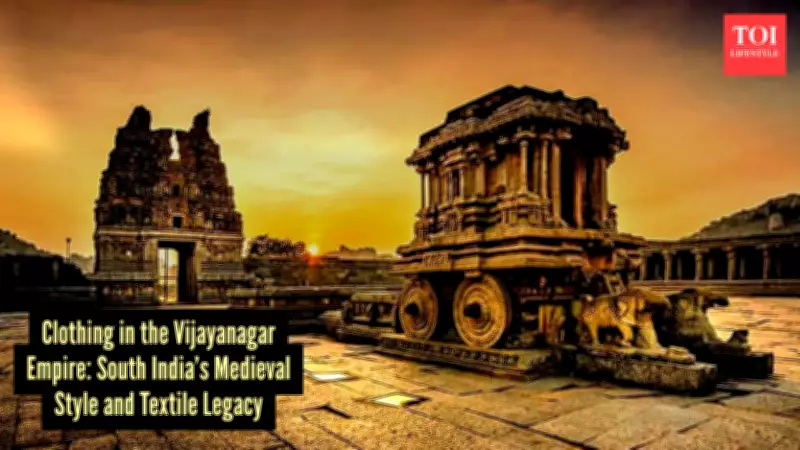
When envisioning the Vijayanagara Empire, most minds immediately conjure images of the breathtaking ruins at Hampi, representing what has long been perceived as a bastion of traditional Hindu culture standing defiantly against the Islamic sultanates of northern India. For generations, history textbooks have reinforced this simplistic narrative, portraying Vijayanagara as a "Hindu bulwark" dedicated exclusively to preserving ancient religious traditions against external influences.
However, groundbreaking historical research is now completely transforming our understanding of this powerful South Indian empire. If you could step back in time and enter the royal court of Krishnadevaraya, one of Vijayanagara's most celebrated rulers, you would witness a scene that contradicts everything you've been taught. The kings and their courtiers weren't merely adorned in traditional silk dhotis and jeweled crowns. They were engaged in sophisticated power dressing, and their sartorial inspiration came directly from the Islamic world they were supposedly resisting.
The Cosmopolitan Reality Behind the Empire
For decades, scholars mistakenly believed Vijayanagara existed as an isolated island of Hindu tradition, deliberately cut off from surrounding cultural influences. Recent comprehensive studies reveal a dramatically different reality: the empire functioned as a vibrant, cosmopolitan hub where cultural exchange flourished. The elite classes weren't hiding from the world around them but were actively and strategically borrowing from it.

This cultural borrowing wasn't driven by religious considerations but by calculated political strategy. To command respect and be taken seriously on the international stage of the 14th and 15th centuries, Vijayanagara's rulers understood they needed to adopt the visual language of power that dominated their era. During this period, the "universal" look of authority and sophistication was unmistakably the style worn by the Sultans of various Islamic kingdoms.
The Power Suit of the Sixteenth Century
So what exactly did this revolutionary fashion look like? Historical evidence points to two specific garments that became the essential uniform of Vijayanagara's elite: the Kabayi and the Kullayi. The Kabayi was a distinctive long-sleeved tunic that derived directly from the Arab qaba garment. Before its adoption, South Indian royalty typically left their upper bodies bare or loosely draped in simple cloth. The introduction of the Kabayi represented a dramatic shift, making full upper-body coverage the new standard for high social status and political authority.
These tunics appeared in plain white versions for court officials and advisors, but for the king himself, they were crafted from the most luxurious materials available. Royal Kabayis were made from sumptuous velvet or satin fabrics and often featured intricate embroidery patterns, including what contemporary accounts describe as "gold roses." Completing this transformative look was the Kullayi, a strikingly tall, conical cap made from brocaded fabric and inspired by the Persian kulah headwear. This represented a complete departure from the traditional turbans or crowns that had previously signified royal status in the region.
Strategic Dressing for Political Legitimacy
Why would devout Hindu kings deliberately dress like Islamic Sultans? The answer lies in a fascinating official title the Vijayanagara rulers adopted: "Hindu-raya-suratrana," which translates directly to "Sultan among Hindu Kings." This title was neither accidental nor merely symbolic. By wearing the Kabayi and Kullayi, Vijayanagara's monarchs were sending a powerful political message to both domestic and international audiences.
They were visually declaring their equality with the powerful Sultans they regularly traded with, negotiated with, and sometimes warred against. This fashion choice represented a sophisticated statement that they belonged to the same modern, civilized world as their Islamic counterparts. Crucially, this transformation remained purely sartorial rather than religious. The Vijayanagara kings maintained their devout Hindu faith and religious practices, but their wardrobe became decidedly international and politically strategic.

Concrete Evidence in Art and Historical Accounts
We don't need to speculate about these revolutionary fashion choices, as concrete evidence survives in multiple forms. Perhaps the most compelling visual documentation appears on the ceiling murals of the Virabhadra temple at Lepakshi, dating back to the 1530s. These remarkably preserved paintings clearly depict court officials and elites sporting the distinctive tall conical caps and long tunics that defined Vijayanagara's new court fashion.
Foreign travelers and diplomats also left detailed written accounts confirming this sartorial transformation. Portuguese chroniclers and Persian ambassadors who visited the Vijayanagara court wrote extensively about the sophistication of the royal dress, noting particularly how the king's attire deliberately distinguished him from common people, who continued wearing traditional draped garments called ambaram. These international observers recognized that fashion served as a deliberate marker of status and political positioning.
Ultimately, the fashion revolution of the Vijayanagara Empire teaches us that history rarely conforms to simplistic black-and-white narratives. This was a complex world where a Hindu king could worship at a temple in the morning and receive foreign dignitaries in a Persian-inspired tunic that same afternoon. Their clothing choices represented a profound statement of cultural confidence and political sophistication, demonstrating that they could maintain their core identity while strategically dressing for the future they intended to shape.